
Conversation basics
Spanish restaurant phrases: answer the waiter.
The waiter often asks four things, roughly in this order. Learn one reply for each, then rehearse the loop before you land.
The server says ¿Qué desea? at normal speed and your mind goes blank. You have tapped the right answer on a screen many times; you can recognise the phrase on a page. But now someone is standing in front of you with a notepad, waiting, and the only reply you can find is a panicked look.
The fear underneath is not grammar. It is that you will open your mouth and nothing will come out, that the server will switch to English, and that the switch will feel like proof you cannot do it. The aim here is narrower than learning Spanish: hear four prompts, and have one short reply ready for each, so you answer before you translate every word.
Nothing on this page needs an account, a microphone or an install. Read the replies once, then run the spoken loop near the end.
Your task: choose one reply, Un café, por favor., and say it aloud three times. Then answer the four prompts in the table below without reading the English.
Practise with a seven-day plan.
The free 7 Day Spanish Starter Plan gives you a pronunciation day, seven days of phrases with a dialogue, a listening task and recall prompts, three goal tracks, an answer key and a tracker, 10 to 15 minutes a day. Use it on the web or download the 18-page PDF.
The complete plan is free and open on the web. Enter your email for the printable copy.
The order the waiter usually follows.
Restaurant Spanish is often a script. The waiter may not ask all four questions, and the order can change, but these prompts cover a café counter, a lunch spot and a sit-down meal. If you recognise the opening sound, you can attach your reply.
| Waiter says | English | Your first reply | English |
|---|---|---|---|
| ¿Qué desea? | What would you like? | Un café, por favor. | A coffee, please. |
| ¿Algo más? | Anything else? | No, gracias. | No, thank you. |
| ¿Para tomar o para llevar? | To have here or to take away? | Para tomar, por favor. | To have here, please. |
| ¿Efectivo o tarjeta? | Cash or card? | Con tarjeta, por favor. | By card, please. |
An illustrative script for rehearsal, not a recording of a live service.
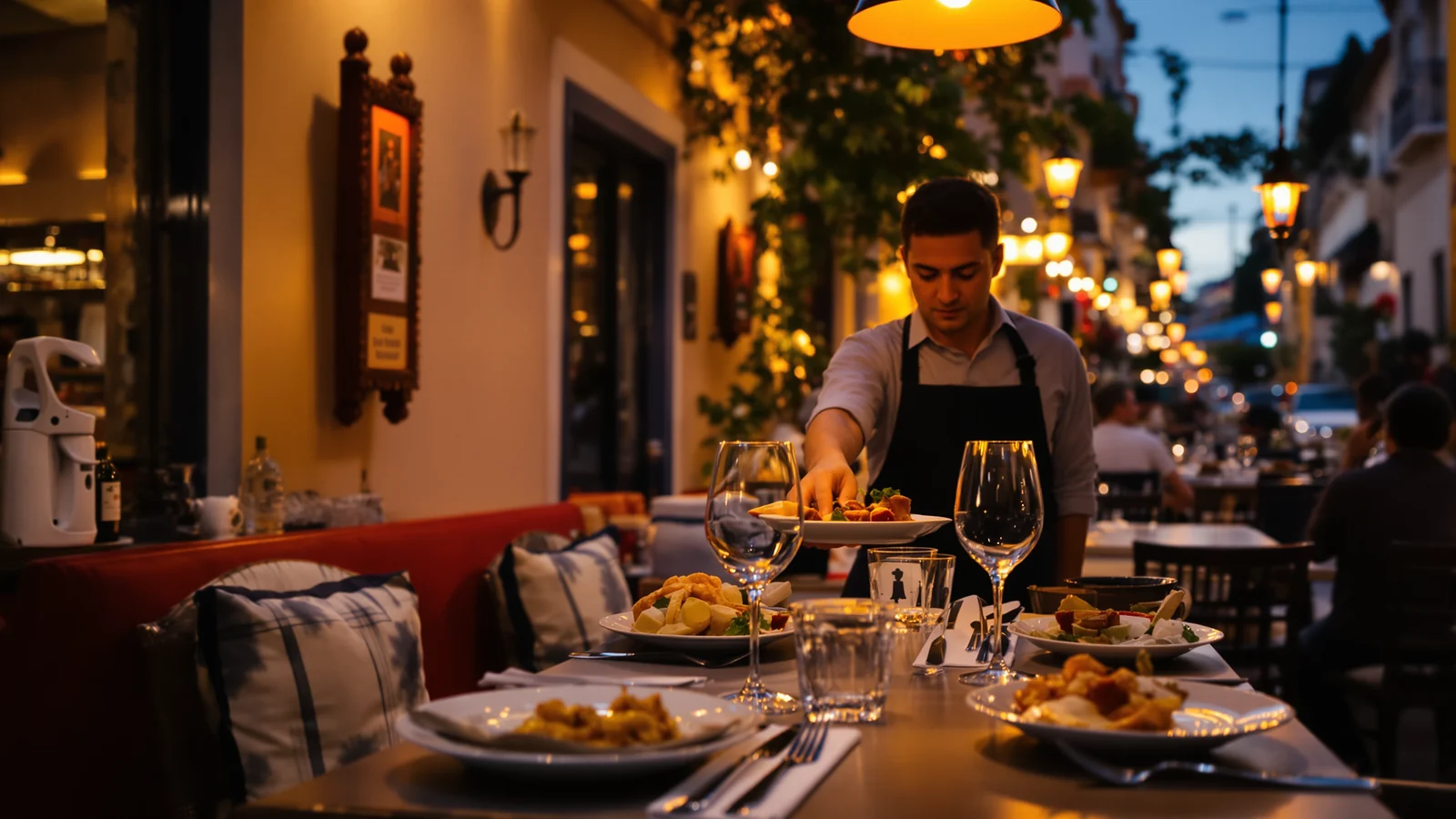
Four basic Spanish restaurant phrases to answer with.
Each reply is a chunk, not a sentence you build in your head. Three of the four end with por favor; the exception is No, gracias., where gracias already carries the politeness. That small phrase gives you a moment to breathe before the next question, and each reply is short enough to say before you feel ready.
These are the Spanish phrases in a restaurant you will use first. You can add food, a drink or a second item later; the shape stays the same.
¿Qué desea? Start with your order.
¿Qué desea? means what would you like? It is polite, and it is common at a counter or a table. The safest reply is the thing you want plus por favor: Un café, por favor. For food, change the item: Una sopa, por favor.
If you want to sound softer, use Quisiera un café, por favor. (I would like a coffee, please.) It is longer, so keep it as a backup. The short version is easier to say when someone is waiting.
A note on register, because it affects three phrases on this page: desea here, puede in ¿Puede escribirlo, por favor? and recomienda in ¿Qué recomienda? are the polite singular forms you use with staff — the usted form. With friends you would say ¿Puedes escribirlo?
You may also hear ¿Qué desea tomar? (What would you like to drink?). Answer with the drink: Agua, por favor. If you need a second to decide, say Un momento, por favor. That is a complete, polite reply.
¿Algo más? Then eat in or take away.
¿Algo más? means anything else? The safe close is No, gracias. If you want something, add one item: Sí, un vaso de agua, por favor. Eso es todo, gracias. (That is all, thank you.) closes the list without sounding abrupt. You do not have to order more just because you were asked.
Next comes ¿Para tomar o para llevar? — are you having it here or taking it away? Reply Para tomar, por favor. or Para llevar, por favor. You may also hear ¿Para aquí o para llevar? and the reply has the same shape: Para aquí, por favor. At a table the question may not come at all; at a counter it often comes early.
If you only remember one pair, remember para llevar (take away) and para tomar (have here). The rest of the question can pass by.
¿Efectivo o tarjeta? Answer the payment question.
¿Efectivo o tarjeta? means cash or card? Reply Con tarjeta, por favor. or En efectivo, por favor. If you want to check before you order, ask ¿Puedo pagar con tarjeta? (Can I pay by card?).
When you are ready for the bill, La cuenta, por favor. is the standard request. See asking for the bill in Spanish for the lines that follow. If the total is said too fast, ask ¿Puede escribirlo, por favor? rather than guessing.
Run it as a spoken loop.
Reading a table is not the same as answering a voice. The loop is short: say the prompt aloud, answer it, swap roles, then cover the English.
Say the waiter line out loud.
Read ¿Qué desea? in a flat, ordinary voice, then answer Un café, por favor. Saying the question yourself makes it easier to catch when someone else says it. The free scenarios page has short everyday dialogues you can read aloud and reuse in the same way.
Answer without the English.
Cover the English column. Say No, gracias. or Con tarjeta, por favor. Then check.
Swap roles.
You ask ¿Qué desea? and answer as the customer. Swapping makes the question easier to recognise next time.
Repeat it tomorrow.
Once today and once tomorrow beats one long session. Stop while it still feels easy enough to come back to.
For a full café exchange, Day 4 of the free 7 Day Spanish Starter Plan is built around ordering and paying, and the plan's dialogues come with audio. The coffee-order dialogue gives you a longer version of the same conversation.
Is this just another app streak?
A fair objection. You have spent evenings feeling productive and still cannot speak. This page is a script, not a score. There are no points, no streak and no microphone. The whole 7 Day Plan is on its web page, so you can read and use it without waiting for anything to arrive; the PDF copy is optional and comes by email after you reply VERIFY to the short message we send.
We do sell optional support: three phrase packs at $9 each or $19 for all three, and a $49 self-paced course. They are one-time payments with a 30-day refund. Every price is on the pricing page, and you can read the refund policy before you decide. You do not need to buy anything to use the phrases here, and the free pages are not a locked trial that opens later.
What this page does not promise: that one loop will end the blank look for good. It gives you a small script, a way to answer it aloud and a recall check. Short repeats are easier to keep up than one long session, and the practice is yours.
Recall check: cover the English.
Cover the right-hand column and say the Spanish aloud before you look. This is practice, not a test of your level.
| Say this in Spanish | Your answer |
|---|---|
| What would you like? | your reply |
| Anything else? | your reply |
| To have here or to take away? | your reply |
| Cash or card? | your reply |
Check your answers: Un café, por favor. · No, gracias. · Para tomar, por favor. · Con tarjeta, por favor.
If you want the phrases on paper, the free Conversation Rescue Card has clarification lines and a worked café example. It asks for a first name and email; reply VERIFY to the short email we send, and we email you the two-page card.
Common questions.
What are basic Spanish restaurant phrases?
Start with four: Un café, por favor. (A coffee, please.), No, gracias. (No, thank you.), Para tomar, por favor. (To have here, please.) and Con tarjeta, por favor. (By card, please.). They answer the four prompts on this page.
What does ¿Qué desea? mean?
It means what would you like? It is a polite prompt for your order. Reply with the thing you want and por favor: Un café, por favor.
How do I order in a restaurant in Spanish?
Wait for the question, then say the item plus por favor. For example: Una sopa, por favor. A softer backup is Quisiera una sopa, por favor. Then answer ¿Algo más? with No, gracias. or one more item.
What if I need more time before ordering?
Say Un momento, por favor. (One moment, please.) or Estoy pensando. (I am thinking.) Then give your order when you are ready. You can also ask ¿Qué recomienda? (What do you recommend?).
How do I say take away in Spanish?
Say Para llevar, por favor. To have it here, say Para tomar, por favor. or Para aquí, por favor., depending on what you hear.
Practice, not a promise. These tasks help you rehearse everyday Spanish at your own pace. Individual progress varies; nothing here promises a level, a qualification or a fixed learning speed. How we write and check our Spanish
Sources and editorial notes
- Smart Learning Path, 7 Day Spanish Starter Plan, Day 4, Ten Everyday Scenarios and Conversation Rescue Card (our own free materials).
The dialogues and phrase tables are original practice examples, not recorded conversations. Spanish checked with AI review; no independent teacher review. See our Editorial Policy. Spotted a mistake? Suggest a correction.
Related reading.
Back to the blogOrder Coffee in Spanish with a Simple Dialogue
A short café exchange you can adapt.
Ask for the Bill in Spanish
Ask for the bill, pay by card, and split a bill.
How to Have a Basic Spanish Conversation
Link greeting, request and payment into one exchange.
Try one useful task.
Open the free seven-day plan and practise about ten minutes a day, at your own pace.
No account or payment needed.