
Conversation basics
How to have a basic Spanish conversation.
Eight lines, one café, and a card in your pocket: a chain drill that joins the phrases you half know into an exchange you can finish.
You know hola. You know gracias. You know por favor. Each one is correct, and each one is useless the moment a real person answers, because the next line is not there.
The conversation stops. The other person hears your accent, switches to English, and the evening spent with a phrase list ends in the language you were trying to leave. You did not forget the words. They never learned to follow one another.
A conversation is a chain. Your greeting invites a greeting, your order invites a question, that question invites an answer. Learn phrases as separate items and you own links with nothing joining them. So this page builds one chain, eight lines long, at a café counter: greet, order, answer, receive, pay, leave.
Your task: write the five-line prompt card below, then run the partner-free role play once, aloud, before the end of the week.
Items are not a conversation.
Most beginner material is organised as items. Here is a greeting; here is how to order; here is how to ask for the bill. You can recognise all of it and still freeze, because recognising a phrase on a page and producing it while someone waits are different skills. Basic conversation in Spanish is not long sentences; it is joined ones.
There is a practical reason to learn the chain rather than the list. The lines you cannot control are few. Two replies do most of the work — ¿Algo más? and Aquí tiene. Prepare those two and the exchange becomes a short script with a predictable shape.

The chain has eight lines.
Read the table downwards once, then read it as a story: I greet, I order, they ask something back, I answer, they hand it over, I thank them, I ask for the bill, I leave.
| Spanish | English | The job it does |
|---|---|---|
| Hola, buenos días. | Hello, good morning. | Opens the exchange. |
| Un café, por favor. | A coffee, please. | Makes the request. |
| ¿Algo más? | Anything else? | The reply you did not plan. |
| No, gracias. | No, thank you. | Closes the order. |
| Aquí tiene. | Here you are. | Hands the coffee over. |
| Gracias. | Thank you. | Acknowledges it. |
| La cuenta, por favor. | The bill, please. | Starts the ending. |
| ¡Hasta luego! | See you later! | Leaves warmly. |
Buenos días is the morning greeting, buenas tardes the afternoon one and buenas noches the evening one. The hour people switch varies by country and by person, so a mismatched greeting is a small mistake, not an insult; if you are unsure, Hola on its own is always safe.
The same exchange, start to finish.
Here is the chain with both parts written out. The learner lines are yours; read them aloud, not silently.
| Speaker | Spanish | English |
|---|---|---|
| You | Hola, buenos días. | Hello, good morning. |
| Server | Buenos días. ¿Qué desea? | Good morning. What would you like? |
| You | Un café, por favor. | A coffee, please. |
| Server | ¿Algo más? | Anything else? |
| You | No, gracias. | No, thank you. |
| Server | Aquí tiene. | Here you are. |
| You | Gracias. La cuenta, por favor. | Thank you. The bill, please. |
| Server | Ahora mismo. | Right away. |
| You | Gracias. ¡Hasta luego! | Thank you. See you later! |
An original practice dialogue for rehearsal, not a recorded conversation.
¿Qué desea? is the line beginners least expect, because English has no fixed equivalent at the counter. It means “What would you like?”, and the answer always has the same shape: the thing you want, then por favor. If you hear something unrehearsed, the rescue phrases further down buy you a second attempt.
Write the chain on one card.
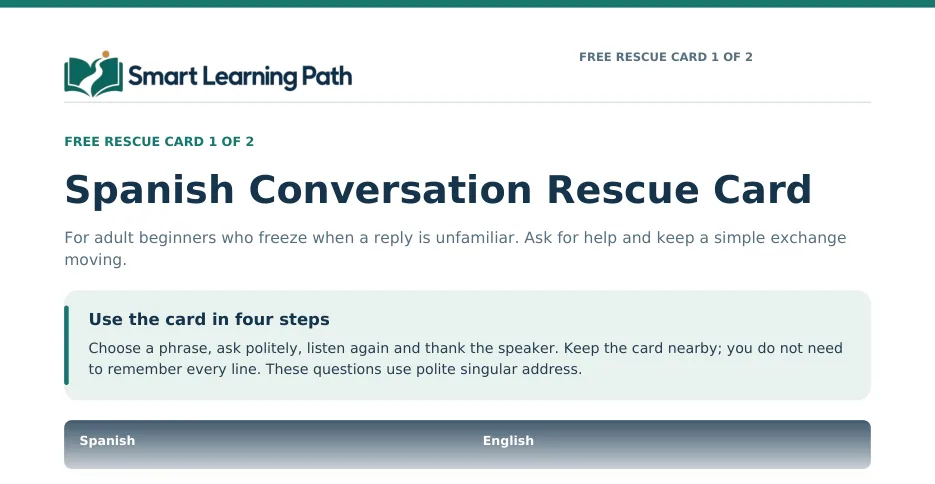
The temptation is to copy forty phrases. Do not. Five lines fit in your hand and in your head, and a card you can read at a glance beats a page you have to search. Take one card, one side — an index card, the back of an envelope, or the cut-out pocket card that comes with the free Conversation Rescue Card. Write your five lines in large letters, with one English cue under each in pencil: greet, order, refuse, bill, leave. A cue should trigger the Spanish, not replace it. Then add the two replies in another colour, because marking them separately reminds you which lines belong to the other person.
- Hola, buenos días.
- Un café, por favor.
- No, gracias.
- La cuenta, por favor.
- Gracias. ¡Hasta luego!
Copy the spelling exactly: ¿Algo más? needs its opening question mark, and más and café need their accents. They are part of the word, not decoration. Then put the card where the conversation will happen: wallet, phone case, inside the notebook you carry.
Role play it with no partner.
You do not need a partner to rehearse a chain. You need to say both parts aloud until your own lines arrive without a search. Four rounds, about ten minutes.
Read the whole dialogue aloud.
Both parts, slowly, without stopping to look anything up. This is the shape of the exchange, not a test.
Cover your lines.
Read only the server’s lines and answer from memory. Look only when you are properly stuck, then cover them again.
Move the replies.
Have the server ask ¿Algo más? before you order, or twice in a row, and answer anyway. Real counters do not follow your script.
Break it on purpose.
Halfway through, say ¿Puede repetir, por favor? Then carry on from where you were. This is the round that matters most.
Saying the other person’s lines is not cheating; it is how the chain gets into your mouth. For more ways to speak without a partner, see our guide to practising speaking Spanish alone.

When the chain breaks, buy a second attempt.
Sooner or later a reply will arrive too fast. Three phrases keep the exchange in Spanish instead of sending it back to English.
| Spanish | English | When to use it |
|---|---|---|
| Perdón, no entiendo. | Sorry, I do not understand. | The reply made no sense at speed. |
| ¿Puede repetir, por favor? | Can you repeat, please? | Ask for a second attempt. |
| Más despacio, por favor. | More slowly, please. | Only the speed is the problem. |
Puede is the polite singular, the form you use with staff, strangers and anyone older than you (usted). With a friend, or a colleague who uses it with you, you will hear puedes. Start with puede: nobody is offended by the polite form, while the familiar one to a stranger can sound too casual. There are four more rescue lines, plus a landlord exchange and a table to check them from memory, in how to ask someone to repeat or slow down in Spanish.
Check the chain from memory.
Cover the answers and say each line aloud before you look. If a line will not come, that is the one to write on the card again.
| Say this in Spanish | Your answer |
|---|---|
| Greet someone in the morning. | your line |
| Order a coffee politely. | your line |
| Refuse a second item. | your line |
| Ask for the bill. | your line |
| Thank them and leave. | your line |
Check your answers: Hola, buenos días. · Un café, por favor. · No, gracias. · La cuenta, por favor. · Gracias. ¡Hasta luego!
Do this today, again in two days, and once more next week. The IES What Works Clearinghouse practice guide Organizing Instruction and Study to Improve Student Learning recommends spacing reviews over time and using quizzing that involves active retrieval rather than re-reading alone, which is why this page asks you to return to the same five lines at intervals instead of reading the table again.
This is practice, not a test of your level.
Is this just another app with points?
You have a right to ask. A streak counter measures taps. This page asked nothing of you to read: no account, no microphone, no install, no score at the end. You get eight lines, a card and a drill you can run in ten minutes.
Everything above is free to use as it stands. The free 7 Day Spanish Starter Plan and the Conversation Rescue Card are complete files you can print, not trials that unlock later; the card download asks for a first name and email, and the whole café chain is already on this page. We also sell our own phrase packs and a course as optional one-time purchases; every price and status is on the pricing page, which also sets out the toolkit, live course and membership we plan but have not opened for booking. Nothing starts automatically.
What this page will not do is promise you a result; progress varies from person to person. What it gives you is one small exchange to rehearse until the joints hold — and a card to take to the counter when they do.
Your first ten minutes.
Read the dialogue aloud twice.
Both parts, standing, at speaking speed.
Write the card.
Five lines in large letters, two replies in another colour.
Run the covered-lines round once.
Answer the server from memory, check, repeat.
Choose the real counter.
A café near the office, hotel breakfast, the place downstairs from the flat. Name it now.
Day 1 of the free 7 Day Spanish Starter Plan covers the greeting half of this chain, and Day 4 is the café dialogue itself. The fuller walk-through, with the bill and a change of drink, is in ordering coffee in Spanish; the opening lines alone, with the tú and usted forms, are in Spanish greetings for your first conversation.
Can you complete this exchange with your lines covered? Continue with Spanish conversation practice: three different scenes, changed details and a rescue pass when a reply surprises you.
Common questions.
How do I start a basic conversation in Spanish?
Greet, then ask for one thing. Hola, buenos días followed by un café, por favor is a complete opening. The chain above is what happens after the person replies.
What counts as basic conversation in Spanish?
A short exchange with a beginning, a middle and an end: you greet, ask for something, answer one unplanned question, thank the person and leave. Long sentences are not the measure.
Do I need a partner to practise a conversation in Spanish?
No. Say both parts aloud, cover your own lines and answer from memory, then change the order of the replies.
Practice, not a promise. These tasks help you rehearse everyday Spanish at your own pace. Individual progress varies; nothing here promises a level, a qualification or a fixed learning speed. How we write and check our Spanish
Sources and editorial notes
- Smart Learning Path, 7 Day Spanish Starter Plan, Day 4 and Spanish Conversation Rescue Card (our own free materials).
- Institute of Education Sciences, What Works Clearinghouse, Organizing Instruction and Study to Improve Student Learning (2007 practice guide): recommendations to space learning over time and to use quizzing that involves active retrieval, retrieved October 18, 2026.
- Real Academia Española and ASALE, Diccionario panhispánico de dudas, «signos de interrogación y exclamación»: Spanish questions open with ¿ and close with ?, and the opening mark should not be dropped, retrieved October 18, 2026.
- Real Academia Española and ASALE, Diccionario panhispánico de dudas, «tilde»: written accents follow the standard rules, so más and café carry one, retrieved October 18, 2026.
The dialogue is an original practice example, not a recorded conversation. Spanish checked with AI review; no independent teacher review yet. See our Editorial Policy. Spotted a mistake? Suggest a correction.
Related reading.
Back to the blogOrder Coffee in Spanish with a Simple Dialogue
A short café exchange you can adapt.
Spanish Greetings for Your First Conversation
Key phrases and when to use them.
How to Practise Speaking Spanish Alone
Role plays and recall prompts without a partner.
New on this topic: When to Use Usted vs Tú in Spanish
Try one useful task.
Open the free seven-day plan and practise about ten minutes a day, at your own pace.
No account or payment needed.