
Conversation basics
Spanish greetings for your first short conversation.
Say hello, introduce yourself and ask someone’s name with a few useful phrases, then practise them in a short dialogue.
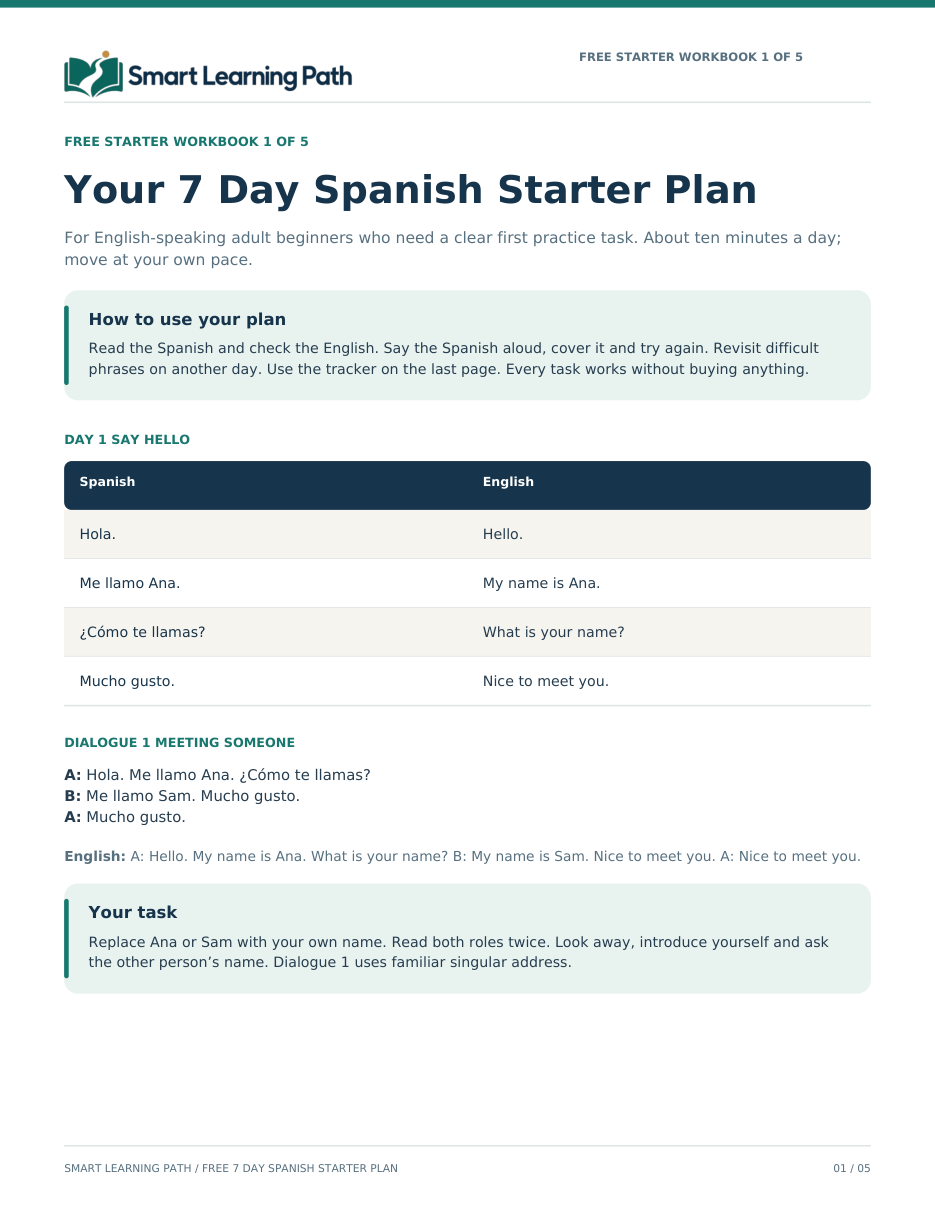
Your task: greet someone, say your name and ask theirs. Free practice; no account needed.
Four phrases to start with.
Read the Spanish, check the English and say each phrase aloud. Replace Ana with your own name.
| Spanish | English |
|---|---|
| Hola. | Hello. |
| Me llamo Ana. | My name is Ana. |
| ¿Cómo te llamas? | What is your name? |
| Mucho gusto. | Nice to meet you. |
Hola works at any time of day, with almost anyone. If you want a greeting tied to the time of day, these are widely used:
Exactly when people switch from tardes to noches varies by place and habit; after dark is a safe guide.
Practise with a seven-day plan.
The free 7 Day Spanish Starter Plan gives you seven short tasks, two dialogues and a tracker, about ten minutes a day. Open it on the web or download the 5-page PDF.
The complete plan is free and open. No account or email needed; an emailed copy is optional.
Put them together in a short dialogue.
A: Hola. Me llamo Ana. ¿Cómo te llamas? · B: Me llamo Sam. Mucho gusto. · A: Mucho gusto.
A: Hello. My name is Ana. What is your name? B: My name is Sam. Nice to meet you. A: Nice to meet you.
Read both roles twice. Then swap Ana or Sam for your name and try again. Practising alone? Read A, pause, then answer as B. This is Dialogue 1 from Day 1 of the free plan; on Day 3 you make it your own.
A first conversation also needs an ending. Two short phrases are enough to close it politely:
Many speakers use hasta luego as an everyday goodbye even when they will not see the person again soon. Add one of them to the end of the dialogue and read it through once more.
A note about familiar and polite address.
¿Cómo te llamas? uses familiar singular address (tú). The Real Academia Española describes tú as the informal form used in Spain and in large parts of Latin America, for familiar or friendly contexts.
With an older stranger, at a reception desk or in a formal setting, many speakers choose polite singular address (usted) instead. Although usted speaks to “you”, its verb takes the same form as for “he” or “she”, so the question changes slightly:
| Spanish | English | Address |
|---|---|---|
| ¿Cómo te llamas? | What is your name? | Familiar (tú) |
| ¿Cómo se llama usted? | What is your name? | Polite (usted) |
| Encantado. / Encantada. | Pleased to meet you. | Either; the ending matches the speaker |
Choose a form suited to the person and situation. If you are unsure, the polite form is a courteous default, and people will usually tell you if they prefer tú. This short example does not cover every level of formality or every regional habit.
Try the greeting from memory.
Read both roles. Cover the example. Use your name, then check.
| English prompt | Your Spanish |
|---|---|
| Hello. My name is (your name). | your phrase |
| What is your name? | your phrase |
| Nice to meet you. | your phrase |
Check your answers: Hola. Me llamo… (your name) · ¿Cómo te llamas? · Mucho gusto.
- I can say hello.
- I can say my name.
- I can ask a name.
Use the example whenever you need it. This is a practice check, not a proficiency score.
If you miss the reply, ask for help.
People often say their name quickly. You do not need to understand every word; ask politely and listen again.
This request uses polite singular address. The free Conversation Rescue Card keeps it and other clarification phrases on one page, and our guide to asking someone to repeat or slow down explains when to use each.
Your next small step: before you leave, greet someone aloud using your name. Then ask “¿Cómo te llamas?” and check the example.
Common questions.
Can I use my own name?
Yes. Replace Ana or Sam with your name after Me llamo.
Do I need a partner?
No. Read both roles, pause between them and try a reply from memory.
What if I forget a phrase?
Look back, say it again and choose one phrase to revisit later.
Practice, not a promise. These tasks help you rehearse everyday Spanish at your own pace. Individual progress varies; nothing here promises a level, a qualification or a fixed learning speed. How we write and check our Spanish
Sources and editorial notes
- Smart Learning Path, 7 Day Spanish Starter Plan, Day 1 and Dialogue 1 (our own free workbook).
- Real Academia Española and ASALE, Diccionario panhispánico de dudas, “tú”, retrieved October 18, 2026.
- Real Academia Española and ASALE, Diccionario panhispánico de dudas, “usted” (formal address and third-person verb agreement), retrieved October 18, 2026.
The dialogue is an original practice example. Spanish checked by our editors. See our Editorial Policy. Spotted a mistake? Suggest a correction.
Related reading.
Back to the blogHow to Ask Someone to Repeat or Slow Down in Spanish
Polite phrases for a fast or unclear reply.
Sample Lesson: Say Hello
A complete quick lesson you can try in five minutes.
Spanish for Family Conversations
Greetings and manageable exchanges with family.
Try one useful task.
Open the free seven-day plan and practise about ten minutes a day, at your own pace.
No account or payment needed.