
Conversation basics
Ask someone to repeat or slow down in Spanish.
Use a polite request when a reply is unfamiliar, then practise a short exchange. You do not need to understand every word before asking for help.
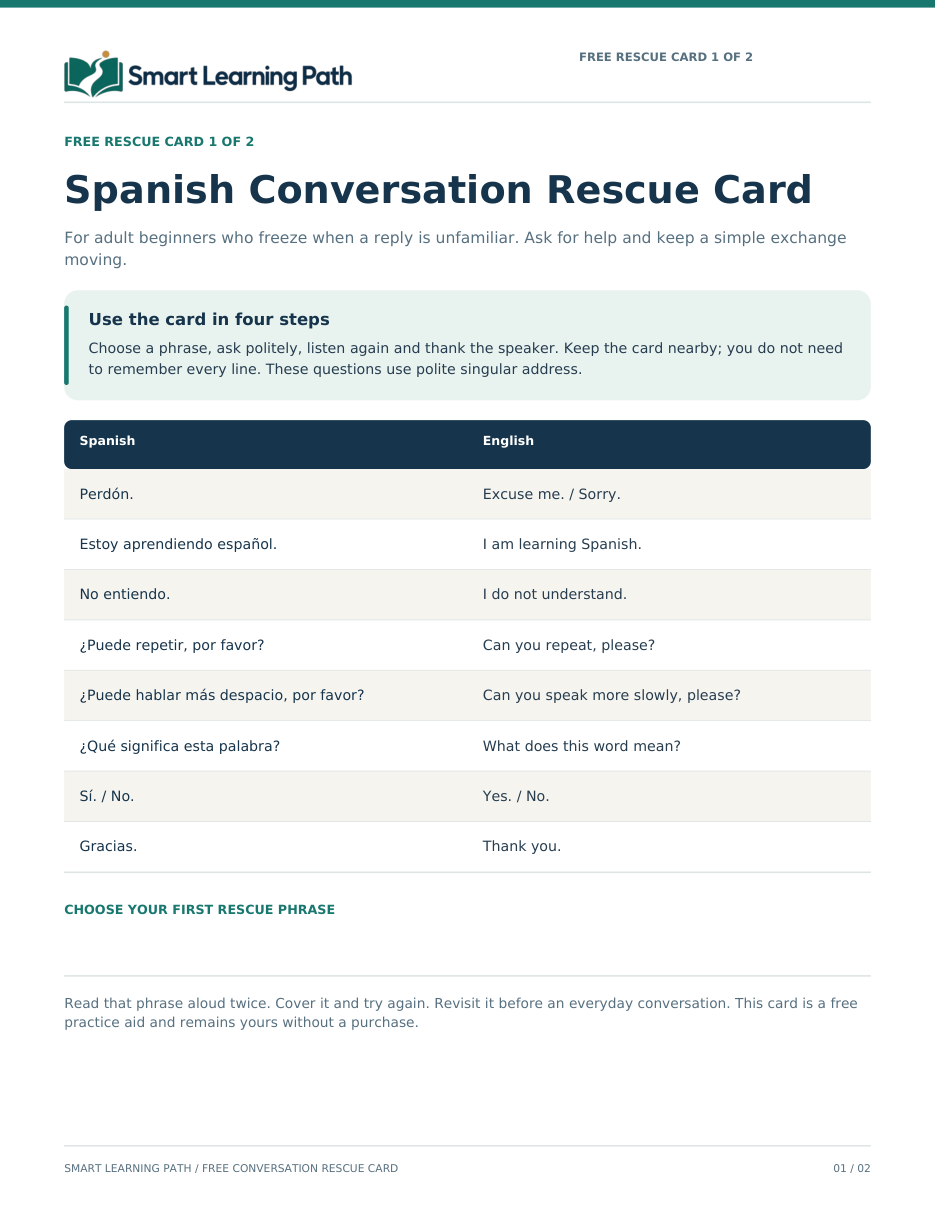
Your task: ask for repetition or slower speech, then say thank you. Free practice; no account needed.
Choose a phrase for the moment.
A fast reply is one of the most common reasons beginners freeze. The fix is not to understand everything; it is to have one polite request ready. Read the Spanish and check its English meaning.
| Spanish | English | When to use |
|---|---|---|
| Perdón. | Excuse me. / Sorry. | Begin politely. |
| No entiendo. | I do not understand. | Say the reply is unclear. |
| ¿Puede repetir, por favor? | Can you repeat, please? | Ask to hear it again. |
| ¿Puede hablar más despacio, por favor? | Can you speak more slowly, please? | Ask for a slower pace. |
| ¿Qué significa esta palabra? | What does this word mean? | Ask about one word. |
| Estoy aprendiendo español. | I am learning Spanish. | Explain that you are learning. |
| Gracias. | Thank you. | Thank the speaker. |
Combine them freely: “Perdón, no entiendo. ¿Puede repetir, por favor?” is a complete, polite request. Note the accent on más (more) and on perdón; they are part of the correct spelling.
Practise with a seven-day plan.
The free 7 Day Spanish Starter Plan gives you seven short tasks, two dialogues and a tracker, about ten minutes a day. Open it on the web or download the 5-page PDF.
The complete plan is free and open. No account or email needed; an emailed copy is optional.
Practise polite singular requests.
The questions with puede use polite singular address (usted). The Real Academia Española notes that usted refers to the person you are speaking to, but takes a third-person verb: that is why the request is puede, not puedes.
| Spanish | English | Address |
|---|---|---|
| ¿Puede repetir, por favor? | Can you repeat, please? | Polite (usted) |
| ¿Puedes repetir, por favor? | Can you repeat, please? | Familiar (tú) |
With strangers, staff or older people, the polite form is a safe default. With friends or a partner’s family who use tú with you, the familiar form fits. Practise each request as a complete phrase. Keep the card nearby rather than trying to memorise every line.
See the request in a café exchange.
| Original practice example | English |
|---|---|
| Server: ¿Algo más? | Anything else? |
| Learner: No entiendo. ¿Puede repetir, por favor? | I do not understand. Can you repeat, please? |
| Server: ¿Algo más? | Anything else? |
| Learner: No, gracias. | No, thank you. |
The example practises a request for help, not understanding every possible reply. It is the worked example from page 2 of the Rescue Card.
Read. Cover. Ask. Check.
Read both parts. Cover the learner’s first reply. Recall it, then check.
| English prompt | Your Spanish |
|---|---|
| Can you repeat, please? | your phrase |
| Can you speak more slowly, please? | your phrase |
| Thank you. | your phrase |
Check your answers: ¿Puede repetir, por favor? · ¿Puede hablar más despacio, por favor? · Gracias.
- I can ask for repetition.
- I can ask for slower speech.
- I can say thank you.
Use the example whenever you need it. This is practice, not a proficiency test.
Try it in your next practice task.
These four steps come from the Rescue Card checklist. They work before any everyday exchange, real or imagined.
Choose one question or request.
For example, ¿Dónde está la estación? (Where is the station?)
Keep a rescue phrase where you can see it.
On the card, your phone or a note.
Ask for help and thank the speaker.
Repeat the request once if needed, then say gracias.
Note one phrase to revisit.
Choose the one that felt hardest and practise it on another day.
Day 2 of the free plan is built around these phrases, and Day 5 combines them with asking where something is.
Your next small step: read “¿Puede repetir, por favor?” aloud twice. Cover it, recall it and choose when to try it again.
Keep a Rescue Card nearby.
A free two-page PDF brings the clarification phrases, the café example and a reusable checklist together. It works on its own, without an email address or a purchase.
Common questions.
Do I need to remember every phrase?
No. Choose one useful request and keep the card nearby.
Can I practise alone?
Yes. Read both roles, cover the learner reply and try it again.
Is it rude to ask someone to repeat?
No. A short polite request with por favor and a thank-you afterwards is a normal part of conversation.
Practice, not a promise. These tasks help you rehearse everyday Spanish at your own pace. Individual progress varies; nothing here promises a level, a qualification or a fixed learning speed. How we write and check our Spanish
Sources and editorial notes
- Smart Learning Path, Spanish Conversation Rescue Card and 7 Day Spanish Starter Plan (our own free workbook materials).
- Real Academia Española and ASALE, Diccionario panhispánico de dudas, “usted” (third-person verb agreement; formal address), retrieved October 18, 2026.
- Real Academia Española and ASALE, Diccionario panhispánico de dudas, “tú”, retrieved October 18, 2026.
The dialogue is an original practice example. Spanish checked by our editors. See our Editorial Policy. Spotted a mistake? Suggest a correction.
Related reading.
Back to the blogOrder Coffee in Spanish with a Simple Dialogue
A short café exchange you can adapt.
How to Practise Speaking Spanish Alone
Role plays and recall prompts without a partner.
Free Practice Tools
The Conversation Rescue Card and the 10 Minute Practice Planner.
Try one useful task.
Open the free seven-day plan and practise about ten minutes a day, at your own pace.
No account or payment needed.