
Everyday situations
Order coffee in Spanish with a simple dialogue.
Ask for a drink, handle a short follow-up question and practise a polite café exchange from both sides.
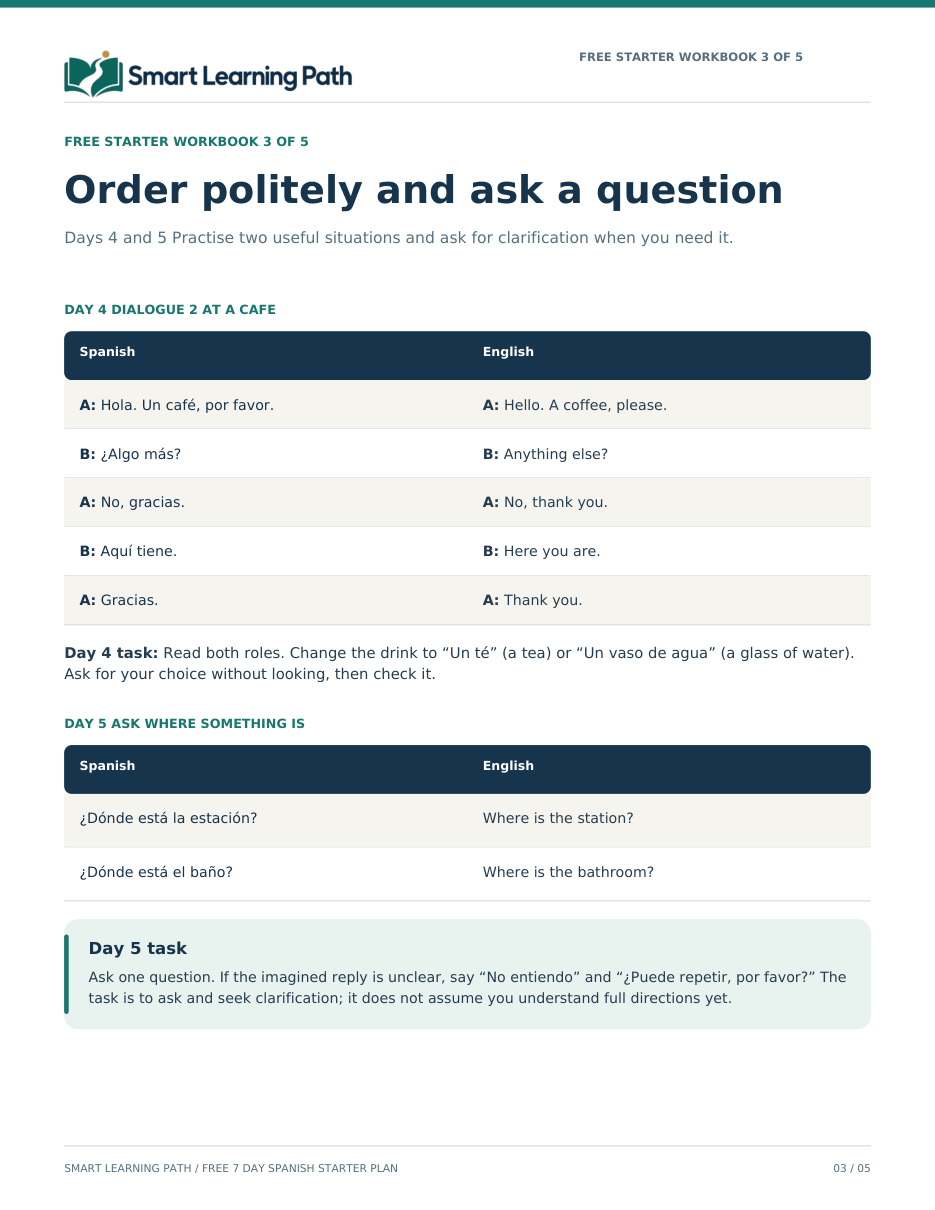
Your task: order a drink, answer “¿Algo más?” and say thank you. Free practice; no account needed.
Start with a simple request.
Ordering a drink is a short, predictable exchange, which makes it a good early practice target. Read the Spanish, check its meaning and say each phrase aloud. Choose one drink for this practice task.
| Spanish | English |
|---|---|
| Un café, por favor. | A coffee, please. |
| Un té, por favor. | A tea, please. |
| Un vaso de agua, por favor. | A glass of water, please. |
| No, gracias. | No, thank you. |
| Gracias. | Thank you. |
These phrases introduce a basic exchange; a real café may involve more questions. Names for coffee drinks also vary by country and by café. Café con leche (coffee with milk) is widely used, but the menu on the wall is your best guide.
Spelling note: café carries an accent on the final syllable, and té (tea) carries one to tell it apart from te, the pronoun you met in ¿Cómo te llamas? The Real Academia Española uses ¿Te apetece un té? to show both.
Practise with a seven-day plan.
The free 7 Day Spanish Starter Plan gives you seven short tasks, two dialogues and a tracker, about ten minutes a day. Open it on the web or download the 5-page PDF.
The complete plan is free and open. No account or email needed; an emailed copy is optional.
Practise both sides of the conversation.
| Original practice example | English |
|---|---|
| Learner: Hola. Un café, por favor. | Hello. A coffee, please. |
| Server: ¿Algo más? | Anything else? |
| Learner: No, gracias. | No, thank you. |
| Server: Aquí tiene. | Here you are. |
| Learner: Gracias. | Thank you. |
Read both roles twice. If you are practising alone, pause after the server’s question and answer as the learner. This is Dialogue 2 from Day 4 of the free plan.
Aquí tiene is what a server says as they hand something over. It uses polite singular address (usted), the usual choice between staff and customers in many places.
Change the drink. Keep the pattern.
The structure stays the same; only the drink changes. Choose coffee, tea or water. Replace the drink in the first line. Cover the example and order again.
| English prompt | Your Spanish |
|---|---|
| A tea, please. | your phrase |
| A glass of water, please. | your phrase |
| No, thank you. | your phrase |
Check your answers: Un té, por favor. · Un vaso de agua, por favor. · No, gracias.
Want one extension? Many cafés will understand “Un café para llevar, por favor” (a coffee to take away, please). Prices, payment and other questions are outside this short task.
If the reply is unclear, ask for help.
Use a polite request rather than guessing. Questions with puede use polite singular address.
Server: ¿Algo más? · Learner: No entiendo. ¿Puede repetir, por favor? · Server: ¿Algo más? · Learner: No, gracias.
Server: Anything else? Learner: I do not understand. Can you repeat, please? Server: Anything else? Learner: No, thank you.
This exchange is on page 2 of the free Conversation Rescue Card, which keeps every clarification phrase on one page. For a week of café practice, the 10 Minute Practice Planner has a worked café routine.
Try a short self-check.
- I can ask for one drink.
- I can answer ¿Algo más? with No, gracias.
- I can ask for repetition and say thank you.
Use the example whenever you need it. This is practice, not a proficiency test.
Your next small step: look away, order your chosen drink, then imagine the server asks “¿Algo más?” Say your reply and check the example.
Common questions.
Can I choose a different drink?
For this task, try the coffee, tea or water examples on this page.
Do I need a practice partner?
No. Read both parts and pause before the learner’s reply.
What if I cannot understand the next question?
Practise asking for repetition or slower speech. This short dialogue does not cover every possible reply.
Practice, not a promise. These tasks help you rehearse everyday Spanish at your own pace. Individual progress varies; nothing here promises a level, a qualification or a fixed learning speed. How we write and check our Spanish
Sources and editorial notes
- Smart Learning Path, 7 Day Spanish Starter Plan (Dialogue 2) and Spanish Conversation Rescue Card (worked café example), our own free workbook materials.
- Real Academia Española and ASALE, Diccionario panhispánico de dudas, “tilde” (accent on café; diacritical accent on té), retrieved October 18, 2026.
- Real Academia Española and ASALE, Diccionario panhispánico de dudas, “usted”, retrieved October 18, 2026.
The dialogue is an original practice example. Spanish checked by our editors. See our Editorial Policy. Spotted a mistake? Suggest a correction.
Related reading.
Back to the blogSpanish Phrases for Your First Trip
Greet, order, ask where something is and clarify.
Spanish for Travel
Practise ordering, asking and clarifying before a trip.
How to Ask Someone to Repeat or Slow Down in Spanish
Polite phrases for a fast or unclear reply.
Try one useful task.
Open the free seven-day plan and practise about ten minutes a day, at your own pace.
No account or payment needed.