
Beginner Spanish · Travel situations
Practise Spanish for everyday travel moments.
Start with a greeting, a drink order, a simple question and a request for repetition. Free practice comes first; extra support is planned, not yet open.
The free tasks need no account, email or payment. Travel is one context for the same planned beginner course, not a separate travel course.
Planned · not yet open
Start with a few useful situations.
At a café
Ask for a drink, answer a short follow-up and say thank you.
Finding something
Ask where the station or the bathroom is.
An unfamiliar reply
Ask for repetition or slower speech, politely.
Beginner practice tasks only; not every question, accent or travel situation.
Useful phrases
Five travel tasks, one phrase at a time.
Read the English, say the Spanish aloud, cover it and try again.
| Spanish | English |
|---|---|
| Perdón. | Excuse me. / Sorry. |
| Un té, por favor. | A tea, please. |
| Un vaso de agua, por favor. | A glass of water, please. |
| ¿Puede hablar más despacio, por favor? | Can you speak more slowly, please? |
| No entiendo. | I do not understand. |
| La cuenta, por favor. | The bill, please. |
Questions with puede use polite singular address (usted), a safe choice with people you do not know. Buenos días is used in the morning; later in the day you will hear buenas tardes. In Spain, signs for toilets often say aseos or servicios, but el baño is widely understood.
Try a free travel task now.
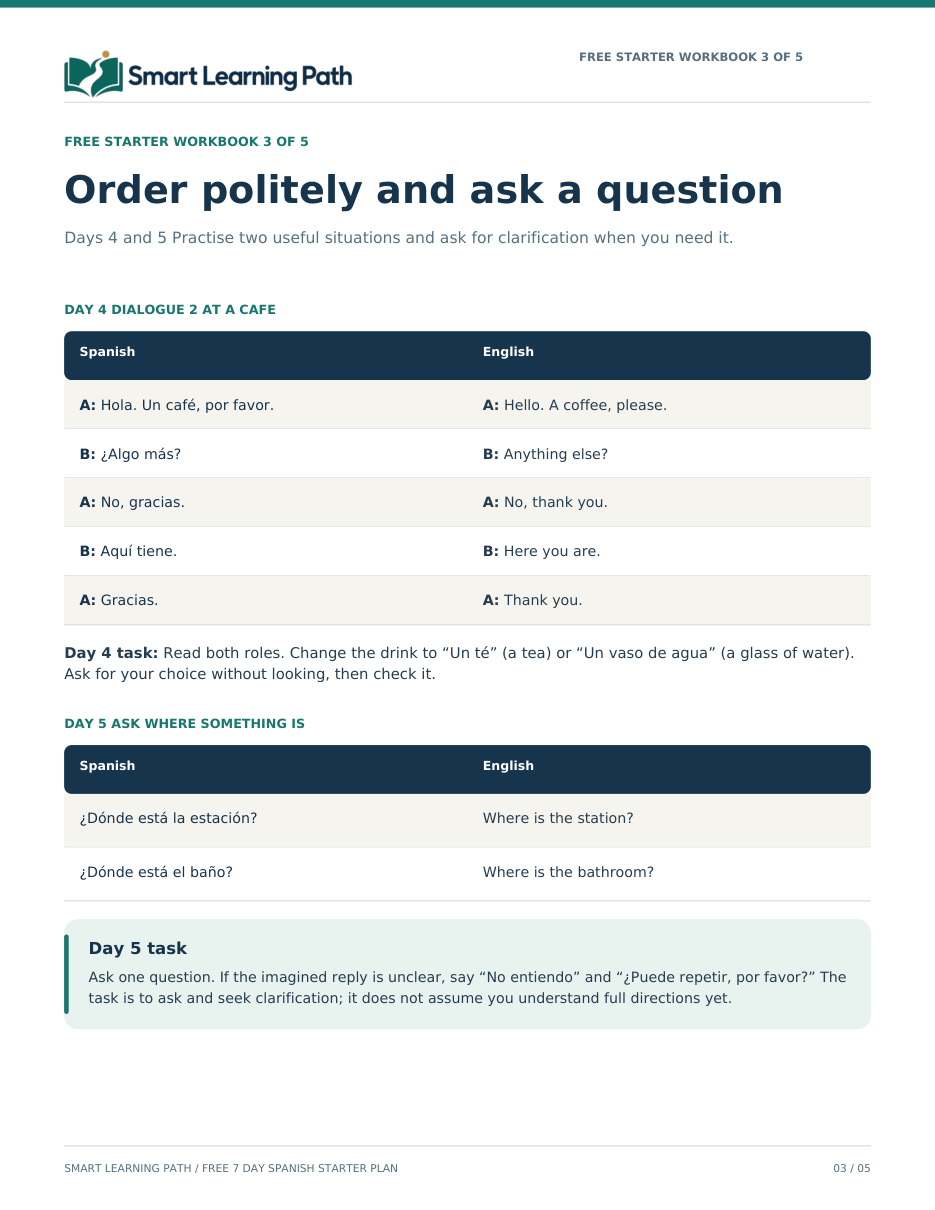
Practice dialogue 1 · at a café
| Spanish | English |
|---|---|
| A: Hola. Un café, por favor. | A: Hello. A coffee, please. |
| B: ¿Algo más? | B: Anything else? |
| A: No, gracias. | A: No, thank you. |
| B: Aquí tiene. | B: Here you are. |
| A: Gracias. | A: Thank you. |
A: Perdón. ¿Dónde está la estación? · B: Está a la derecha, cerca de la plaza. · A: No entiendo. ¿Puede hablar más despacio, por favor? · B: A la derecha. Cerca de la plaza. · A: Muchas gracias. · B: De nada.
A: Excuse me. Where is the station? B: It is on the right, near the square. A: I do not understand. Can you speak more slowly, please? B: On the right. Near the square. A: Thank you very much. B: You are welcome.
An original practice dialogue, not a recorded conversation.
Your task: read both roles of the café dialogue. Change the drink to un té or un vaso de agua, cover the Spanish and say your order without looking. Then play learner A in the second dialogue. The task is to ask and clarify, not to follow full directions.
A mini plan for the week before you go.
About ten minutes a day with the free resources. Repeat a step whenever it helps.
Days 1 and 2: greet and clarify.
Follow Day 1 and Day 2 of the free plan: say hello, then ask for repetition and slower speech.
Days 3 and 4: order politely.
Practise the café dialogue from Day 4. Swap the drink each time you say it.
Day 5: ask where something is.
Use Day 5 and the second dialogue above. Keep the Conversation Rescue Card on your phone or in your bag.
Days 6 and 7: recall and role play.
Say five phrases from memory, then use the 10 Minute Practice Planner to choose two phrases to revisit during the trip.
Optional support · planned
Want guided practice after trying the task?
We plan a Four-Week Conversation Course for adult beginners. Travel examples would be one context for its practice, alongside family and everyday settings. It is not open for booking yet.
- Eight one-hour live group sessions, two a week.
- Four feedback cycles, about 30 minutes per learner in total.
- About 15 minutes of daily practice plus two live hours a week.
- A minimum of 8 confirmed learners and a maximum of 12 per group.
- The planned Spanish Starter Toolkit included.
Four-Week Conversation Course
| Planned price | $249 one-time |
|---|---|
| Status | Not yet open for booking |
| Dates and coach | Not confirmed |
Dates and a coach have not been confirmed. Booking is not open, and nothing can be bought on this site. The planned membership would be a separate optional purchase that never starts automatically.
On the contact page, choose the topic “A planned course, toolkit or membership”.
Common questions.
Is this a separate travel course?
No. Travel examples are one context for the same planned four-week beginner course. There is no separate travel course.
Can I use the free resources without paying?
Yes. The full 7 Day Spanish Starter Plan, the Conversation Rescue Card and the 10 Minute Practice Planner are free and stay free.
Will this cover every travel conversation?
No. It focuses on a few everyday tasks and on asking for clarification. It does not cover every question, accent or travel situation.
What if my trip is soon?
Use the free tasks now. The planned course has no dates yet and booking is not open.
Read before your trip.
Visit the blogSpanish Phrases for Your First Trip
Greet, order, ask where something is and clarify.
Order Coffee in Spanish with a Simple Dialogue
A short café exchange you can adapt.
How to Ask Someone to Repeat or Slow Down in Spanish
Polite phrases for a fast or unclear reply.
Practice, not a promise. These tasks help you rehearse everyday Spanish at your own pace. Individual progress varies; nothing here promises a level, a qualification or a fixed learning speed. How we write and check our Spanish
Sources and editorial notes
- Phrases and the café dialogue are adapted from our free 7 Day Spanish Starter Plan and Conversation Rescue Card.
- Planned course details come from the Smart Learning Path business plan and proposals (October 2026). They are proposals, not a confirmed offer.
Examples are illustrative. Spanish checked by our editors. See our Editorial Policy and Pricing and Learning Options.
Keep practising free.
Repeat the café exchange, ask where the station is and plan your next ten minutes.
No account or payment needed.