
Practice habits
Spanish conversation practice without English.
Rehearse three survival scenes aloud — a café, a landlord, a street corner — and keep a few rescue phrases ready as your escape hatch instead of switching to English.
The fear is the switch to English.
You can picture it: you open your mouth, nothing comes out, the reply arrives at full speed, and out comes English. They answer in English, the exchange is over, and you feel like the person who cannot even order coffee.
A longer phrase list does not settle that fear. Rehearsing the exact moment aloud does more, with one escape hatch that is still Spanish.
So this is basic Spanish conversation practice on purpose: three short scenes you will meet early, each with a rescue route and no English exit.

Practise with a seven-day plan.
The free 7 Day Spanish Starter Plan gives you a pronunciation day, seven days of phrases with a dialogue, a listening task and recall prompts, three goal tracks, an answer key and a tracker, 10 to 15 minutes a day. Use it on the web or download the 18-page PDF.
The complete plan is free and open on the web. Enter your email for the printable copy.
Keep the escape hatch in Spanish.
Switching to English is a habit, so give it a replacement. Six phrases buy time and keep the conversation where you want it.
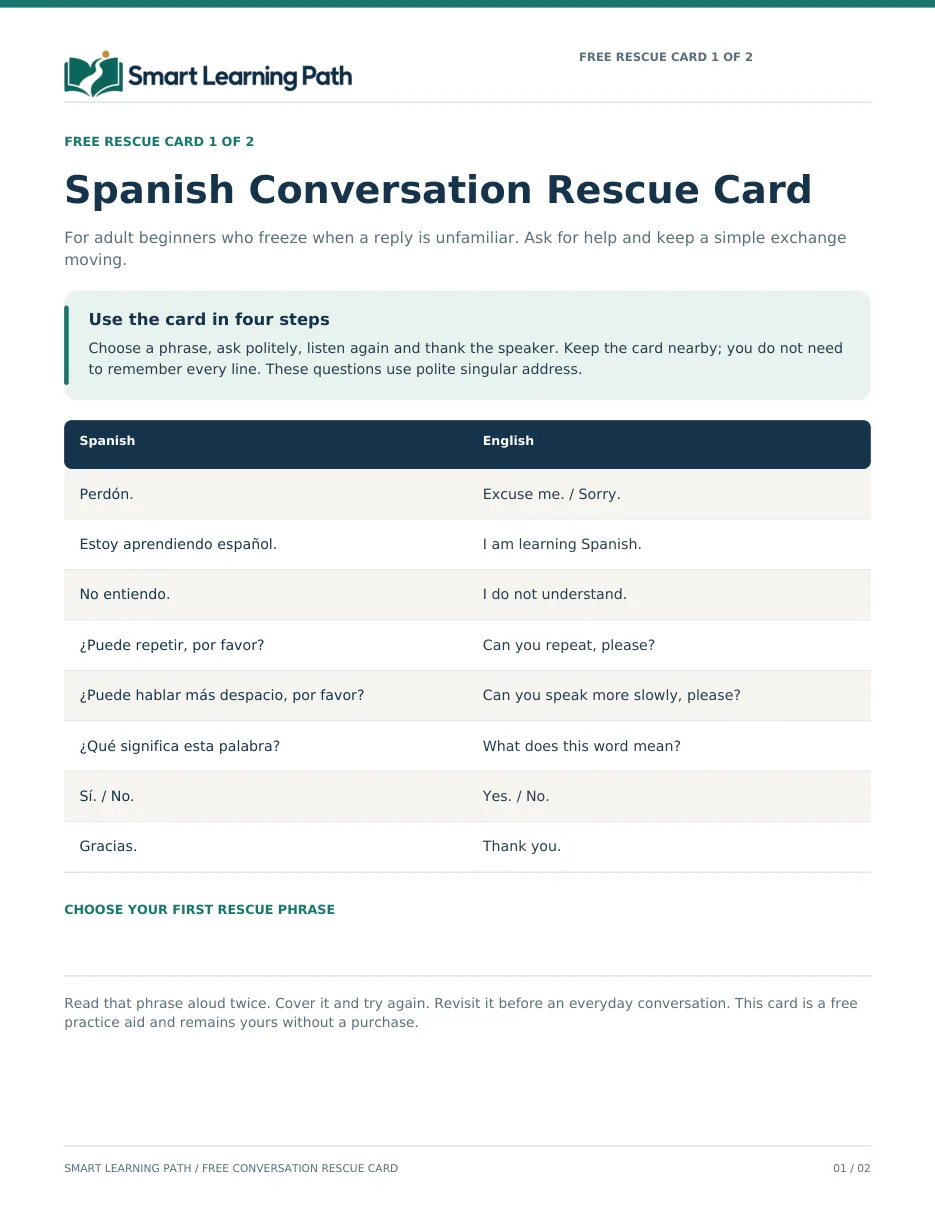
| Spanish | English | When to use it |
|---|---|---|
| Perdón. | Excuse me. | To open, or to interrupt politely. |
| ¿Puede repetir, por favor? | Can you repeat, please? | The reply came too fast. |
| ¿Puede hablar más despacio, por favor? | Can you speak more slowly, please? | You caught the words, not the speed. |
| No entiendo. | I don’t understand. | Nothing landed. |
| ¿Qué significa esta palabra? | What does this word mean? | One word is blocking the sentence. |
| ¿Me lo puede escribir, por favor? | Can you write it down, please? | A time, a price, an address. |
Every question uses the polite singular (usted), the safe choice with someone you have just met. With a friend you would say ¿Puedes repetir, por favor? Using usted is not cold; it is ordinary with a landlord, a shop assistant or a stranger in the street.
The rule for this week: no English inside a scene. If you get stuck, use a rescue phrase and let the other person help, in Spanish.
The same phrases are on the free Conversation Rescue Card, two printable pages with a worked café example and a checklist.
Say it aloud before it is real.
Reading a dialogue silently is not practice for speaking. Run five passes on one scene, all out loud, in about ten minutes.
Read both parts aloud.
Keep the English in view; you are teaching your mouth the shape of the phrases.
Cover the English.
Say the Spanish from the meaning, not from the letters. Peek when you need to, then cover it again.
Role play both parts.
Ask the question, then answer it, leaving a pause as if someone else were about to speak.
Change one detail.
A tea instead of a coffee, another day, a different street.
Run the rescue pass.
Pretend the other person speeds up, and answer twice with ¿Puede repetir, por favor? Calmly, not apologetically.
Finish by saying the whole scene once, standing up, with your phone in your pocket. That pass looks most like the street.
For more to say aloud, the free ten everyday scenarios pair each situation with a short role play, and the 120-phrase practice deck adds audio.
Scene 1: the café counter.
Most people meet this scene within an hour of arriving. Four lines carry it.
| Spanish | English |
|---|---|
| Un café, por favor. | A coffee, please. |
| ¿Algo más? | Anything else? |
| No, gracias. | No, thank you. |
| Aquí tiene. | Here you are. |
A: Buenos días. Un café, por favor. · B: ¿Algo más? · A: ¿Puede repetir, por favor? · B: ¿Algo más? · A: No, gracias. · B: Aquí tiene. · A: Gracias.
A: Good morning. A coffee, please. · B: Anything else? · A: Can you repeat, please? · B: Anything else? · A: No, thank you. · B: Here you are. · A: Thank you. An original practice dialogue; a real exchange may be shorter.
To change the order, swap in Un té, por favor. (A tea, please.) or Un vaso de agua, por favor. (A glass of water, please.) Day 4 of the free plan uses the same exchange.
Scene 2: meeting the landlord.
Keys, a time and one problem to report. The stakes feel higher, which is why people reach for English fastest.
| Spanish | English |
|---|---|
| Buenos días, soy el nuevo inquilino. | Good morning, I’m the new tenant. |
| ¿Cuándo puedo recoger las llaves? | When can I collect the keys? |
| No hay agua caliente. | There’s no hot water. |
| Hasta luego. | See you later. |
If you are a woman, say la nueva inquilina. The rest of the sentence stays the same.
A: Buenos días, soy el nuevo inquilino. · B: Hola, buenos días. · A: ¿Cuándo puedo recoger las llaves? · B: Mañana, por la mañana. · A: ¿Me lo puede escribir, por favor? · B: Sí, claro. · A: Gracias. Hasta luego.
B: Tomorrow morning. · B: Yes, of course. Mañana means both ‘tomorrow’ and ‘morning’; por la mañana makes it clear. An original practice dialogue.

Scene 3: the street corner.
Directions are the hardest listening test: the reply is long and you cannot see the words. Aim to leave with the direction, or with a written note.
| Spanish | English |
|---|---|
| Perdón, ¿dónde está la estación? | Excuse me, where is the station? |
| ¿Está lejos? | Is it far? |
| Gracias. | Thank you. |
A: Perdón, ¿dónde está la estación? · B: Siga derecho y luego gire a la derecha. · A: ¿Está lejos? · B: No, está cerca. · A: Gracias.
B: Go straight on and then turn right. · B: No, it’s near. An original practice dialogue; a real answer may include street names.
In Mexico you will often hear siga derecho for straight on; todo recto is common in Spain. Derecho (straight) and derecha (right) are easy to mix up.
If one word blocks the reply and you can point at something written, ask ¿Qué significa esta palabra? For a word you only heard, ¿Qué significa? is enough.
Check whether you stayed in Spanish.
The test is not whether you understood everything. It is what you did when it got hard. After each real attempt, tick one line in your notes.
- I used a rescue phrase and the conversation carried on in Spanish.
- I used a rescue phrase, then switched to English anyway.
- I switched to English straight away.
The first line is the one to build on. The third is information, not a verdict: it tells you which phrase to rehearse next.
The free seven-day plan spreads the same material across a week: clarification phrases on Day 2, the café on Day 4 and directions on Day 5.
Another app, another tease? A straight answer.
It is a fair worry. Points and streaks can feel like progress while the speaking stays exactly where it was. This page is not an app and it does not score you: it is a short set of scenes you say out loud.
There is no account and no microphone. The feedback comes from you noticing which rescue phrase you reached for.
About the free plan: the whole seven-day plan is published on the free plan page, so you can read all of it before deciding anything. A download click opens a short sign-up box for a first name and email, and the file opens after that. The plan email arrives straight away, then four emails on days 2, 4, 7 and 10, each with an unsubscribe link. No other marketing.
About the paid side: a toolkit, a four-week conversation course and a monthly practice membership are proposed. None is open for booking, there is no checkout, and the pricing page says so. The part that exists today is free, and it is enough to run the three scenes.
Questions about practising conversation.
How do I practise Spanish conversation at home?
Pick one scene, say both parts aloud, cover the English, then add a rescue pass where the other person replies too fast. Repeating the same scene on another day is more useful than adding a new one.
What counts as basic Spanish conversation practice for a beginner?
Ordering a drink, collecting keys, asking for directions, and asking someone to repeat or slow down. Those four cover the first week of most trips and relocations, and all of them appear on this page.
Do I need an account to use these scenes?
No. The scenes and phrases on this page are free to read, with no account and no microphone. A first name and email are only asked when you download a printable file.
What can this page not do?
It cannot hear you, correct your accent or promise how a real conversation will go. It gives you phrases, a rehearsal order and a way to check what happened. Progress varies from person to person.
Practice, not a promise. These tasks help you rehearse everyday Spanish at your own pace. Individual progress varies; nothing here promises a level, a qualification or a fixed learning speed. How we write and check our Spanish
Sources and editorial notes
- Content basis: the Smart Learning Path 7 Day Spanish Starter Plan and the Conversation Rescue Card.
- Institute of Education Sciences, What Works Clearinghouse, Organizing Instruction and Study to Improve Student Learning (practice guide, 2007), retrieved October 18, 2026. General background on spacing practice over time and using quizzing to prompt recall; it was written for teachers and is not a study of this method.
- Real Academia Española, Diccionario panhispánico de dudas: usted, retrieved October 18, 2026, for the note on polite address.
All dialogues are original practice material, not recordings of real conversations. Nothing here has been tested with learners and no results are claimed. Spanish checked by our editors; no independent teacher review yet. See our Editorial Policy and Privacy Policy. Spotted a mistake? Suggest a correction.
Related reading.
Visit the blogHow to Practise Speaking Spanish Alone
Role plays and recall prompts without a partner.
How to Ask Someone to Repeat or Slow Down in Spanish
Polite phrases for a fast or unclear reply.
Spanish Phrases for Your First Trip
Greet, order, ask where something is and clarify.
One scene at a time. Out loud.
Rehearse the café, the flat and the street corner, then follow the free seven-day plan at your own pace.
No account or payment needed.