
Everyday situations
Ask for the bill in Spanish with a short dialogue.
Ask for the bill, choose card or cash and handle a simple split request, then practise both sides of a short café exchange.
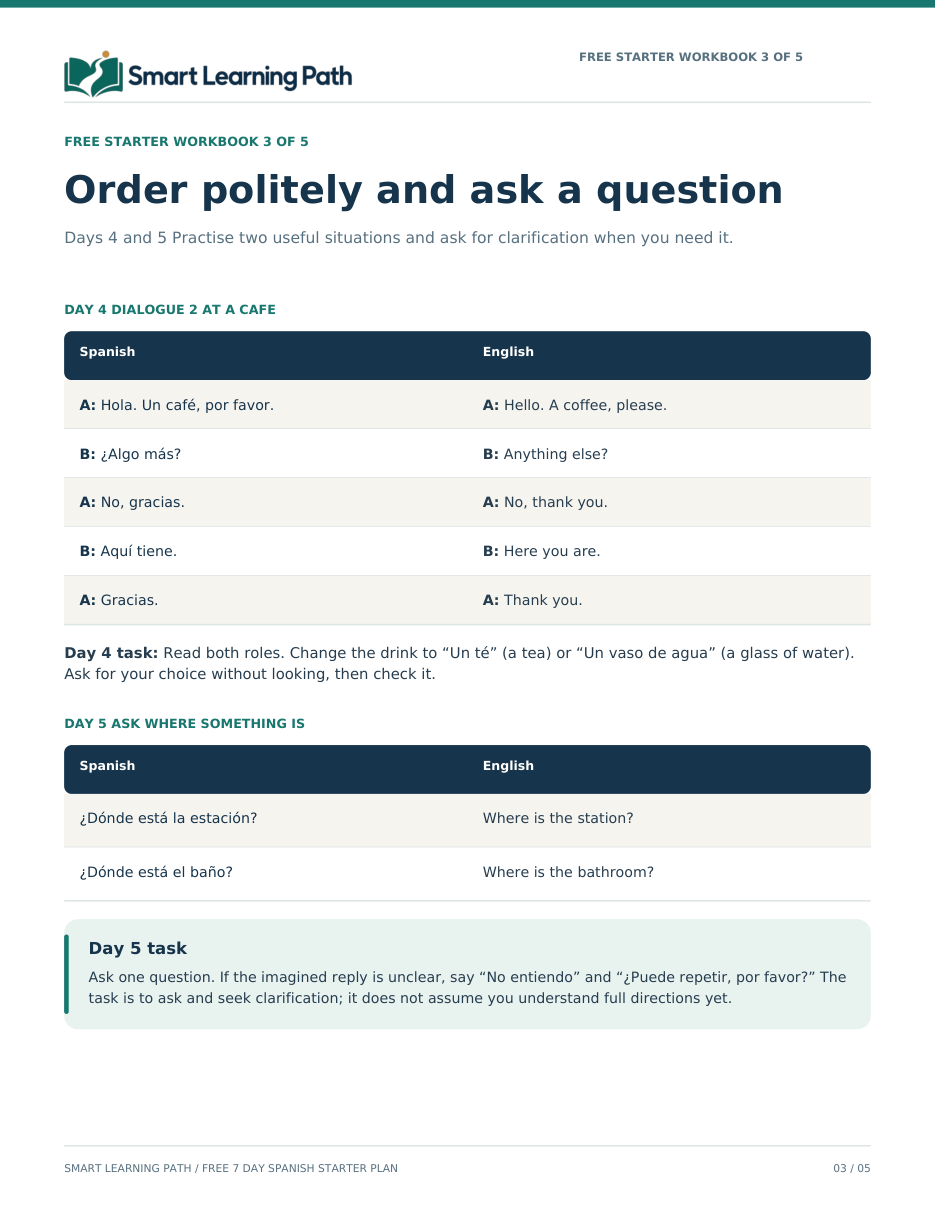
Your task: ask for the bill in a café, answer one short follow-up question and choose how to pay. Free practice; no account needed.
Start with the short request.
Asking for the bill is the last exchange in a café, and one of the shortest. Read each line, check the English and say the Spanish aloud. Use the short phrase first; the longer one is there for when you want a full sentence.
| Spanish | English |
|---|---|
| La cuenta, por favor. | The bill, please. |
| ¿Me trae la cuenta, por favor? | Could you bring me the bill, please? |
| Aquí tiene. | Here you are. |
| Gracias. | Thank you. |
| De nada. | You’re welcome. |
La cuenta is the bill itself, the slip of paper with what you had. The verb contar means to count, which is a memory hook: someone counts up what you ordered. You do not need a verb to ask for the bill, though. The noun plus por favor is enough.
¿Me trae la cuenta, por favor? is the fuller, polite version, close to “could you bring me the bill, please?”. Me trae uses polite singular address (usted), the usual choice between customers and staff. The short La cuenta, por favor is not rude, but keep the por favor in.
Punctuation point. Spanish questions open with ¿ as well as closing with ?. The Real Academia Española explains that the opening marks are characteristic of Spanish and should not be dropped, even when you copy a phrase from a menu or a translation app.
Practise with a seven-day plan.
The free 7 Day Spanish Starter Plan gives you seven short tasks, two dialogues and a tracker, about ten minutes a day. Open it on the web or download the 5-page PDF.
The complete plan is free and open. No account or email needed; an emailed copy is optional.
Practise both sides of the dialogue.
Here is the whole exchange in one place. Read it twice: once as the learner and once as the server. If you are practising alone, pause after each server line and answer out loud before you look at the next row.
| Original practice dialogue | English |
|---|---|
| Learner: La cuenta, por favor. | The bill, please. |
| Server: Ahora mismo. Aquí tiene. | Right away. Here you are. |
| Learner: ¿Puedo pagar con tarjeta? | Can I pay by card? |
| Server: Sí, claro. | Yes, of course. |
| Learner: Gracias. Hasta luego. | Thank you. See you later. |
An original practice dialogue, not a recorded conversation. A real café may add its own questions about tables, tips or loyalty cards.
If you order at the counter first, the café ordering dialogue covers the drinks, and this page covers the end of the visit. Both sets of lines sit inside Day 4 of the free 7 Day Spanish Starter Plan.
Pay by card or in cash.
Two short questions cover payment. Choose the one that matches what you are holding, and say it before you take out your wallet.
You may hear the short statement Solo efectivo (cash only) before you ask. The card machine has different names in different countries, so keep to the question ¿Puedo pagar con tarjeta? and listen for sí or no. In Spain you will also hear ¿Me cobra, por favor?, which means “could you take the payment, please?”.
Spelling point. Solo efectivo writes solo without an accent. Current Real Academia Española guidance is to write the adverb solo without a tilde where the sentence is not ambiguous. An older sólo still turns up in some printed materials.
If the reply comes too fast, say No entiendo and then ¿Puede repetir, por favor? or ¿Puede hablar más despacio, por favor? Both clarification phrases are on the free Conversation Rescue Card.
Split the bill in a few words.
Two friends often pay separately, and there are a few short phrases for it. Read them, then try the worked example below.
| Spanish | English |
|---|---|
| ¿Podemos pagar por separado? | Can we pay separately? |
| Dos cuentas, por favor. | Two bills, please. |
| Cada uno paga lo suyo. | Each person pays for their own. |
| Yo invito. | It’s on me. |
The first two are requests. The third explains the arrangement if the server looks unsure. The fourth is what you say when you want to treat someone.
Server: ¿Todo junto o por separado? · Learner: Por separado, por favor. · Server: Muy bien. Dos cuentas.
Server: All together or separately? Learner: Separately, please. Server: Very good. Two bills.
A small café may work with one till and ask you to pay together, then settle up between yourselves. Treat the phrase as a polite request and follow their lead. If you are heading abroad soon, the Spanish for travel page puts this kind of exchange next to the other travel basics.
Cover the Spanish and recall it.
Recall is the part that makes a phrase stick. Cover the tables above, then write or say the Spanish for each English prompt. Check your answers only after you have tried all four.
| English prompt | Your Spanish |
|---|---|
| The bill, please. | your phrase |
| Can I pay by card? | your phrase |
| Can we pay separately? | your phrase |
| Two bills, please. | your phrase |
Check your answers: La cuenta, por favor. · ¿Puedo pagar con tarjeta? · ¿Podemos pagar por separado? · Dos cuentas, por favor.
- I can ask for the bill with one short phrase.
- I can ask to pay by card or in cash.
- I can ask for two bills when I am with a friend.
Use the examples whenever you need them. This is practice, not a proficiency test.
Your next small step: run this dialogue three times today, then note it in the 10 Minute Practice Planner so it comes back later in the week.
Common questions.
Is La cuenta, por favor polite enough?
Yes. It is the standard short request, and por favor keeps it friendly. A fuller version is ¿Me trae la cuenta, por favor?
How do I ask to pay by card?
Use ¿Puedo pagar con tarjeta? The card machine has different names in different countries, but the question is widely understood.
Can I split the bill?
Ask ¿Podemos pagar por separado? Some small cafés handle payment differently, so treat the phrase as a polite request and follow their lead.
Practice, not a promise. These tasks help you rehearse everyday Spanish at your own pace. Individual progress varies; nothing here promises a level, a qualification or a fixed learning speed. How we write and check our Spanish
Sources and editorial notes
- Smart Learning Path, 7 Day Spanish Starter Plan (Day 4, Dialogue 2 at a café) and Spanish Conversation Rescue Card, our own free workbook materials.
- Real Academia Española and ASALE, Diccionario panhispánico de dudas, “signos de interrogación y exclamación” (opening question marks), retrieved October 18, 2026.
- Real Academia Española and ASALE, Diccionario panhispánico de dudas, “tilde” (the adverb solo written without an accent), retrieved October 18, 2026.
The dialogues are original practice examples written for this page, not recorded conversations. Prices, tipping and card rules differ between cafés and countries, so check locally. Spanish checked by our editors. See our Editorial Policy. Spotted a mistake? Suggest a correction.
Related reading.
Back to the blogOrder Coffee in Spanish with a Simple Dialogue
A short café exchange you can adapt.
How to Ask Someone to Repeat or Slow Down in Spanish
Polite phrases for a fast or unclear reply.
Spanish for Travel
Practise ordering, asking and clarifying before a trip.
Try one useful task.
Open the free seven-day plan and practise about ten minutes a day, at your own pace.
No account or payment needed.