
Conversation basics
Polite Spanish phrases for asking someone to slow down.
When a fast reply leaves you silent, one short polite phrase keeps the conversation in Spanish. Here are the versions that sound gentle, and when to use each.
Someone asks you a question at the counter, the words run together, and your mind goes quiet. You know what you would like to say — please, a little more slowly — but you are not sure whether más lento is polite, whether despacio is the better word, or whether the short version sounds like an instruction rather than a request. So you say nothing, nod, and hope the next sentence is easier.
There is a short answer. Más despacio, por favor. (More slowly, please.) is the safe, gentle default. ¿Podría hablar un poco más despacio? (Could you speak a little more slowly?) is the softer, fuller version for someone you have just met. Más lento, por favor. works too, and you will hear it in Mexico, but it is a shade more direct. Below: all three, when to use usted, a café exchange and a short recall drill.
Your task: choose one phrase from this page and say it aloud before the week ends. One phrase said out loud beats ten read in silence.
Three polite ways to say slow down.
None of these polite phrases in Spanish is rude. The difference between them is length and softness, not whether they are acceptable.
| Spanish | English | When to use it |
|---|---|---|
| Más despacio, por favor. | More slowly, please. | Short and gentle. The safest default. |
| ¿Puede hablar más despacio, por favor? | Can you speak more slowly, please? | A full polite request with usted. |
| ¿Podría hablar un poco más despacio? | Could you speak a little more slowly? | The softest of the three: conditional plus un poco. |
| Más lento, por favor. | More slowly, please. | Shorter and more direct. Common in Mexico. |
| ¿Puede repetir, por favor? | Can you repeat, please? | The problem is a whole sentence, not the speed. |
| ¿Podría repetirlo, por favor? | Could you repeat it, please? | Softer repeat request, same politeness shift. |
Original practice phrases, not a transcript of a recorded conversation.
Despacio or lento?
Despacio is an adverb, so it attaches straight to a verb: hablar despacio, caminar despacio. Lento is usually an adjective — un tren lento, a slow train — but in much of Latin America, Mexico included, people also use it with a verb: habla más lento, por favor. Both are understood everywhere; the habit differs by country, and neither is a mistake. For your first week in Mexico City: use despacio when you want the gentlest request, and expect to hear más lento from other people. You may also hear ¿Mande? — a short, polite way of asking you to repeat, common in Mexico. Recognising it is more useful than producing it.
Why podría sounds softer than puede.
Both phrases below ask for the same thing. The second is the conditional — closer to «could you» than «can you» — so it sounds a little more indirect, which many people read as more considerate. Adding un poco (a little) makes the request smaller still: you are not asking someone to slow down for the rest of the conversation, just for a moment. This is not a choice between polite and impolite; ¿Puede…? is perfectly fine at a café counter. Use one softener, not five: ¿Podría hablar un poco más despacio, por favor? sounds considerate, while stacked politeness starts to sound like a formal letter.

Use usted until someone says tú.
Staff, a landlord, a neighbour you have just met, anyone who looks older than you: start with usted. The polite request takes puede or podría. With friends, a partner’s family and colleagues who use tú with you, it becomes puedes or podrías.
| Spanish | English | Address |
|---|---|---|
| ¿Puede hablar más despacio? | Can you speak more slowly? | Polite singular (usted) |
| ¿Puedes hablar más despacio? | Can you speak more slowly? | Familiar singular (tú) |
| ¿Podría repetir, por favor? | Could you repeat, please? | Polite singular (usted) |
| ¿Podrías repetir, por favor? | Could you repeat, please? | Familiar singular (tú) |
If you are unsure, stay with usted and the matching verb. Nobody takes offence at being addressed politely; it is the familiar form to a stranger that can land oddly. One mechanical note: usted refers to the person in front of you but takes a third-person verb, which is why it is ¿Puede…? and not ¿Puedes…? There is more in our guide to when to use usted vs tú in Spanish.
A café exchange, start to finish.
Here is the whole move in context. Read both parts aloud; the learner’s lines are yours.
| Speaker | Spanish | English |
|---|---|---|
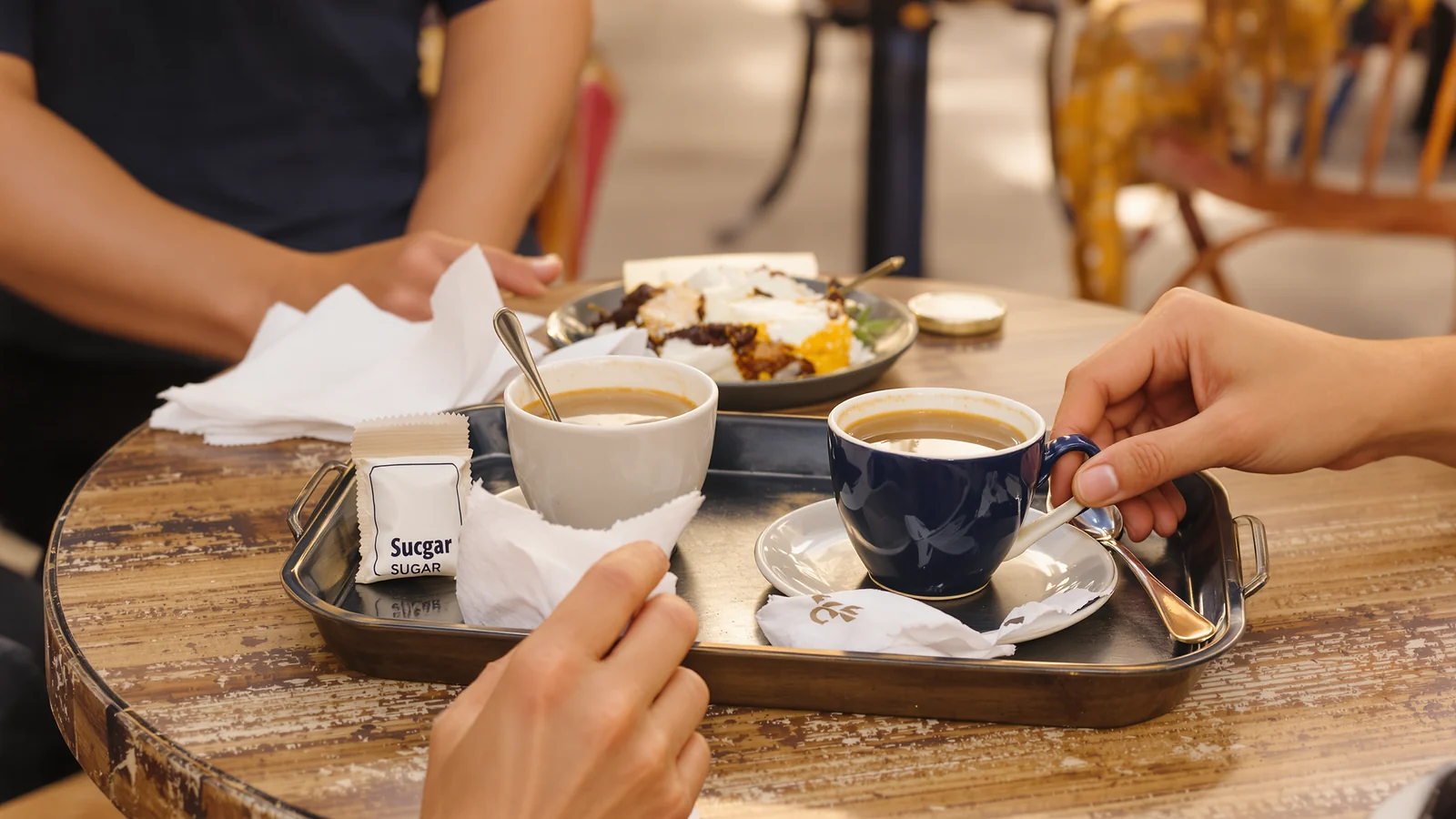
| You | Un café americano, por favor. | A black coffee, please. |
| Server | ¿Para llevar o para tomar aquí? | To take away or to drink here? |
| You | Perdón, ¿podría hablar un poco más despacio? | Sorry, could you speak a little more slowly? |
| Server | Claro. ¿Para llevar o para tomar aquí? | Of course. To take away or to drink here? |
| You | Para tomar aquí, gracias. | To drink here, thank you. |
An original practice dialogue, not a recorded conversation.
Notice what did not happen: you did not switch to English, and the question simply came a second time, a little clearer. That is the whole skill — asking for another attempt instead of leaving the conversation. When the fast answer is a number — rent, a deposit, a price, a date — guessing is expensive. Ask again, or ask to see it written.
| Spanish | English | When to use it |
|---|---|---|
| ¿Podría repetir el número, por favor? | Could you repeat the number, please? | Rent, a deposit, a phone number. |
| ¿Puede escribirlo, por favor? | Can you write it down, please? | When hearing it again is not enough. |
| Un momento, por favor. | One moment, please. | Buy two seconds before you answer. |
Practice phrasing. Do not sign or pay on the strength of a number you only half heard.
Read it, cover it, say it, check it.
Recognising a phrase on a page is not the same as producing it while someone waits for an answer. Cover the right-hand column and say the Spanish aloud before you look.
| Say this in Spanish | Your answer |
|---|---|
| More slowly, please. (short) | your phrase |
| Could you speak a little more slowly? (softest) | your phrase |
| Can you repeat, please? (polite) | your phrase |
| Can you write it down, please? | your phrase |
Check your answers: Más despacio, por favor. · ¿Podría hablar un poco más despacio? · ¿Puede repetir, por favor? · ¿Puede escribirlo, por favor?
- I can ask for slower speech.
- I can ask someone to repeat.
- I can ask for something in writing.
- I can say thank you and end well.
Repeat the table tomorrow, then again in a few days. The second and third attempts are the ones that turn a phrase you can read into one you can reach for. This is practice, not a test of your level.
Is this just another app and another upsell?
You have spent evenings on apps that handed out points and streaks and left you unable to say a sentence to a person. That is a fair reason to be sceptical, so here is the plain version.
This page is a set of phrases, one dialogue and a recall drill. Nothing on it needs an account, a microphone or an install: read it, say the phrases aloud, close the tab. The free material that goes with it — Day 2 of the 7 Day Spanish Starter Plan, the two-page Conversation Rescue Card, the 10 Minute Practice Planner, the 120 phrase cards and the free everyday scenarios with audio — is complete on the web, not a trial that unlocks later. The downloadable files arrive by email: a first name and email, a short message, a VERIFY reply, and then the file.
We also sell two optional things: three phrase packs at $9 each or $19 for all three, and a self-paced course, Spanish Conversation Foundations, at $49. Both are one-time payments with a 30-day refund. The prices sit in the open on the pricing page, and the terms are in the refund policy, so you can judge them long before a checkout. Nothing on this page needs them. What this page will not do either is promise that you will be speaking by a certain date: progress depends on how often you practise and on the situations you meet.
Your first ten minutes.
Say one phrase aloud, five times.
«Más despacio, por favor.» then the fuller «¿Podría hablar un poco más despacio?» at normal speed, standing up.
Read the café dialogue as both people.
Then cover your lines and answer the server’s question without looking.
Choose the real moment.
The coffee counter near the office, the building reception, a phone call about the flat. Decide now which one it is, and use it this week.
Common questions.
How do you say please slow down in Spanish?
Más despacio, por favor. is the short, neutral version. For a softer, fuller request, use ¿Podría hablar un poco más despacio? The conditional reads as «could you» rather than «can you».
Is más lento rude?
No. Más lento, por favor. is understood everywhere and is common in Mexico, though it can sound a little more direct than más despacio. With por favor and a thank-you, both are polite.
Should I use usted or tú with a stranger?
Use usted first, with puede or podría. Switch to tú when the other person does, or when they invite you to.
Do I need an app, an account or a microphone to practise this?
No. Read the phrases aloud, cover the answers in the recall table and say them from memory. Nothing on this page needs an install or a login.
Practice, not a promise. These tasks help you rehearse everyday Spanish at your own pace. Individual progress varies; nothing here promises a level, a qualification or a fixed learning speed. How we write and check our Spanish
Sources and editorial notes
- Smart Learning Path, 7 Day Spanish Starter Plan, Day 2: when you do not understand (our own free material).
- Smart Learning Path, Spanish Conversation Rescue Card (our own free material).
- Smart Learning Path, When to use usted vs tú in Spanish (our own article).
The dialogues and phrase tables are original illustrative practice examples, not recorded conversations, and no third-party product is reviewed, scored or ranked on this page. Statements about how the phrases sound and where lento and despacio are used are general usage notes, not citations. Spanish checked with AI and rule-based checks; no teacher review. See our Editorial Policy. Spotted a mistake? Suggest a correction.
Related reading.
Back to the blogHow to Ask Someone to Repeat or Slow Down in Spanish
Polite phrases for a fast or unclear reply.
When to Use Usted vs Tú in Spanish
Pick the polite form once, then practise the switch.
Spanish Survival Phrases: Café, Landlord, Pharmacy
Three everyday scenes you can handle without switching to English.
New on this topic: Thank You in Spanish: Say Gracias and Reply to De Nada · Spanish Phone Call Phrases: Confirm a Flat Viewing · No Entiendo Meaning: Drill the Phrase Until It's Out
Try one useful task.
Open the free seven-day plan and practise about ten minutes a day, at your own pace.
No account or payment needed.