
Practice habits
No entiendo meaning: drill the phrase until it comes out.
The reply comes back at real speed and four words you know turn into a jumble. Here is what no entiendo means, what its variants mean, and a three-step ladder that gets the phrase out when you are flustered.
You know the phrase. The moment eats it.
You have read No entiendo a dozen times and could write it down right now. Then someone answers at normal speed, the words go past, and what comes out of your mouth is half a syllable and a shrug.
The phrase was never the problem. It had only been read, never said while flustered. Recognising a line on a screen and producing it in two seconds are different tasks.
So this page does one thing: it pins down what no entiendo means, adds the line that should follow it, and runs the pair up a three-step pressure ladder — whisper it, say it to a timer, then answer a recorded prompt within two seconds. No account, no microphone.
What no entiendo means in English.
Two words: no (not) and entiendo (I understand), from the verb entender. Together they mean I don’t understand. The stress sits on the middle syllable, en-TIEN-do, and the pair runs as one block.
Nothing changes with the person you are speaking to, which is what makes it worth drilling: one shape, any counter, any desk, any phone call.
| Spanish | English | When you would use it |
|---|---|---|
| No entiendo. | I don’t understand. | The default: short, safe, understood everywhere. |
| No lo entiendo. | I don’t understand it. | Something specific is in front of you. |
| No entiendo nada. | I don’t understand anything. | The whole exchange has gone past you. |
| No entendí. | I didn’t understand. | About the sentence you have just heard. |
| No te entiendo. | I don’t understand you. | Familiar, with family and friends. |
| No comprendo. | I don’t understand. | More formal, less common in everyday speech. |
All six are correct. The rest of this page drills the first row only.
No lo entiendo and no entiendo nada.
No lo entiendo adds lo, the word for “it”: I don’t understand it. Use it when a specific thing is in front of you, such as a form at the bank or a note from the landlord. No entiendo alone is never wrong, so drill that first.
No entiendo nada means I don’t understand anything. The double negative is standard Spanish, used for emphasis, not a mistake. Save it for the moment a whole exchange passes you by, such as a fast phone call about the internet.
Country note: in Mexico you will also hear No le entiendo in the same situations. No entiendo works everywhere, so rehearse that one.
The line that should follow it.
No entiendo is a statement about you. On its own it hands the problem over, and the other person may repeat the same sentence at the same speed. Add one request and the conversation moves.
| Spanish | English | Note |
|---|---|---|
| Perdón. | Sorry. / Excuse me. | A soft way to break in. |
| ¿Puede repetir, por favor? | Can you repeat, please? | The main request. |
| ¿Puede hablar más despacio, por favor? | Can you speak more slowly, please? | For speech that runs together. |
| ¿Puede escribirlo, por favor? | Can you write it down, please? | For prices, names and addresses. |
| Más despacio, por favor. | More slowly, please. | Two words for when you are close. |
Every puede above is the polite singular, used with usted: the safe default with a stranger or a receptionist. With family and friends you would say ¿Puedes repetir? instead.
Say the two on one breath: No entiendo, ¿puede repetir, por favor? Stress TIEN and TIR and let the rest run.
Reception: ¿Me confirma su nombre y la hora de su cita? · You: Perdón, no entiendo. ¿Puede repetir, por favor? · Reception: Su nombre, por favor. · You: Ah, sí. Ana Ruiz.
Reception: Could you confirm your name and the time of your appointment? You: Sorry, I don’t understand. Can you repeat, please? Reception: Your name, please. You: Ah, yes. Ana Ruiz. An original practice dialogue, not a recorded conversation; a real desk may go differently.
At a counter, reach for these in order:
- The full repair: Perdón, no entiendo. ¿Puede repetir, por favor?
- If you caught the shape but not the speed: Más despacio, por favor.
- For a price, name or time: ¿Puede escribirlo, por favor? Asking is normal, not a failure.
The three-step pressure ladder.
Pressure is what is missing when a phrase you know disappears. You can add it in small amounts, with no app, no score and no audience.
Whisper the pair.
Ten times, under your breath, page face down. Done when the two lines run start to finish without a stop in the middle.
Say it to a timer.
Thirty seconds on your phone, the pair aloud and clear, as often as fits. Three rounds. Done when a round ends with the words still in one shape.
Answer a prompt in two seconds.
Play one line at normal speed, then reply with the pair within two seconds of it ending. No replay, no pause. Done when five prompts have gone by and the reply started before you decided what to say.
The two seconds are the point. Given a pause, most of us start translating, and the translation lands after the conversation has moved on. A short deadline rehearses the reaction, not the meaning.
If step three collapses, drop back one step rather than stopping: one more whisper round, then straight to the prompts. Two short passes beat one perfect session you never repeat.
Where the pressure comes from.
You need a voice saying something you did not write. The free ten everyday scenarios carry each dialogue at normal speed and slowed down, in the browser, with no account and no microphone.
Pick the café or the pharmacy, play one question line at normal speed and answer within two seconds. Then read the dialogue text and check what the line meant. Use the slow version once to hear the shapes; the drill itself needs normal speed, because that is the speed you will meet.
Do not replay a line to “get it first”. The drill is the answer, not the comprehension. And when you do understand, answer properly: you do not want No entiendo to become your only line in Spanish.
Some people switch to English the moment they hear an accent. You cannot control that, and it is not a verdict on your Spanish. Keep one line for the times you want to stay in Spanish: ¿Puede repetir en español, por favor? Estoy aprendiendo.
Another app that feels productive? A fair question.
If points and streaks have left you able to read a menu but not open your mouth, the doubt is reasonable. Points measure use of an app, not whether a sentence leaves your mouth while someone waits.
What this page is: one phrase, said aloud, under a clock, with a check you cannot fake — did the answer start within two seconds, or did you reach for the page? There is no teacher and nobody listens to you, so nothing here can tell you whether a person in Mexico City understood you. Progress varies; this is practice, not a fluency test.
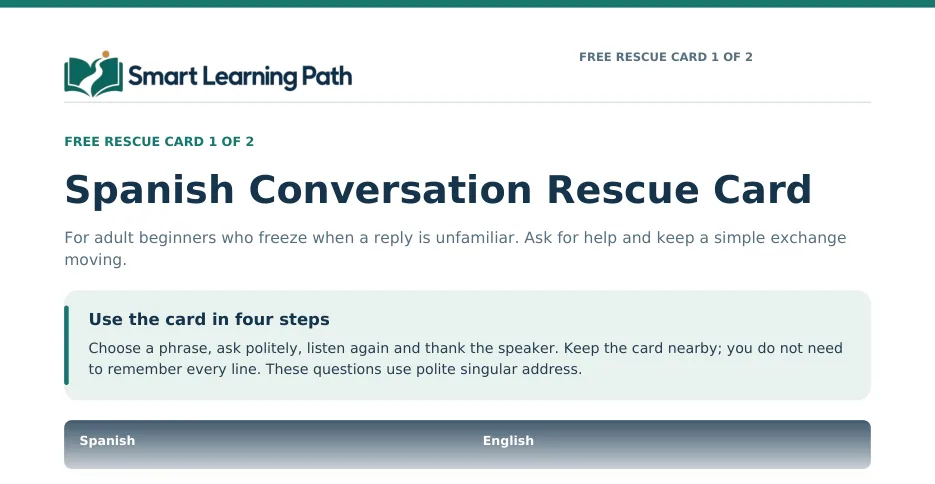
What it costs: nothing to read. This page, the seven-day plan (Day 2 is the clarification day), the scenarios with audio, the 120-phrase deck and the Rescue Card are all on the site. PDFs and Word files come by email: a download click opens a sign-up box for a first name and email, we send a short email, and the file arrives once you reply VERIFY.
What we sell: three phrase packs at $9 each or $19 for all three, and a $49 self-paced course with no live sessions. One-time payments, full refund within 30 days — see pricing and the refund policy. If the free material carries you through the next six weeks, that is a good outcome, not a missed sale.
Run it once now.
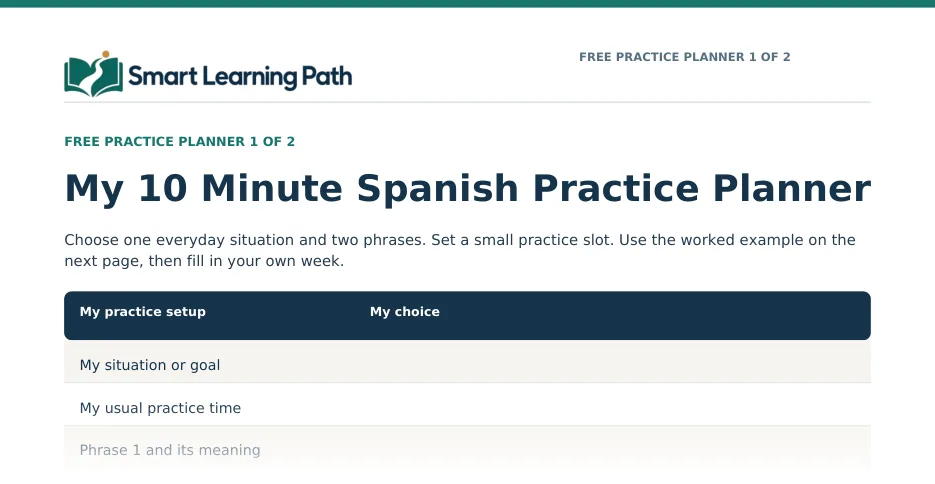
One pass a day for a week, a few minutes each: whisper on Monday, timer on Tuesday, prompts from Wednesday, then swap in ¿Puede hablar más despacio? and ¿Puede escribirlo?. A suggestion, not a rule.
Start now: two minutes of whispering, one against the timer, three of prompts. Tomorrow’s second pass is where the pair starts to settle. Then ask someone to repeat before you actually need to; the guide to asking someone to repeat or slow down adds the lines that go around this one.
Read the seven-day plan Open the scenarios
The plan page is free in your browser. An email is only needed for the printable PDF and Word copy.
Practice, not a promise. These tasks help you rehearse everyday Spanish at your own pace. Individual progress varies; nothing here promises a level, a qualification or a fixed learning speed. How we write and check our Spanish
Common questions.
What does no entiendo mean in English?
It means I don’t understand: no (not) plus entiendo (I understand), from the verb entender. Nothing changes with the person you are speaking to, so it works with anyone.
Is no lo entiendo different from no entiendo?
No lo entiendo adds lo, the word for “it”, so it means I don’t understand it. Use it when a specific form, sentence or instruction is in front of you. No entiendo on its own is never wrong.
How strong is no entiendo nada?
It means I don’t understand anything. The double negative is standard Spanish, used for emphasis. Keep it for the moment the whole exchange has gone past you.
Do I need a microphone or an account?
No. The drill is said aloud and the prompts play in your browser from the free scenarios page. No account, no microphone, no score.
Sources and editorial notes
- Content basis: the Smart Learning Path 7 Day Spanish Starter Plan (Day 2, asking for clarification) and the Conversation Rescue Card.
- Real Academia Española, Diccionario panhispánico de dudas: tilde o sin tilde, retrieved October 18, 2026. Consulted on when question words keep a written accent, as in ¿Puede…?
- Usage notes on puede (usted), no lo entiendo and Mexican no le entiendo checked automatically with AI and rule-based checks; no teacher review.
The dialogue and the week are illustrative. Nobody has measured how quickly these phrases become automatic, and progress varies; this is practice, not a fluency test. Spanish checked with AI review. See our Editorial Policy. Spotted a mistake? Suggest a correction.
Related reading.
Visit the blogHow to Ask Someone to Repeat or Slow Down in Spanish
Polite phrases for a fast or unclear reply.
How to Remember Spanish When You Are Nervous
Drill four rescue phrases aloud until they come out fast.
Remember Spanish Phrases with Spaced Practice
Revisit phrases on later days to keep them.
Four words, said until they come out.
The seven-day starter plan is free to read in your browser. Day 2 is the clarification day, with the repair lines on this page.
No account or payment needed.