
Practice habits
How to remember Spanish when you are nervous: four phrases, five rungs.
The reply comes back fast and the phrase you knew a second ago turns into a jumble of sounds. Here is a small drill that makes those phrases easier to reach for when you are flustered.
Pages read without an account; the PDFs are optional.
The phrase disappears when it matters.
Someone answers you quickly, and the phrase you had ready a moment ago turns into a jumble of sounds. No entiendo. ¿Puede repetir, por favor? comes out half-swallowed, or not at all. Then the conversation slides into English and the preparation feels wasted.
Recognising a phrase is not the same as saying it.
You have read the phrase a dozen times and understood it every time. That is recognition. In a real exchange someone is waiting, your heart is going and there is no page to look at, so the words have to be produced rather than spotted.
What this page asks you to do.
Take four short phrases and say them aloud: calmly first, then from memory, then with a small clock, a distraction and a person. Call it a pressure ladder. Each rung adds one difficulty, so a phrase has already been said under mild pressure before it meets the real thing.

Practise with a seven-day plan.
The free 7 Day Spanish Starter Plan gives you a pronunciation day, seven days of phrases with a dialogue, a listening task and recall prompts, three goal tracks, an answer key and a tracker, 10 to 15 minutes a day. Use it on the web or download the 18-page PDF.
The complete plan is free and open on the web. Enter your email for the printable copy.
Learn four phrases that buy you time.
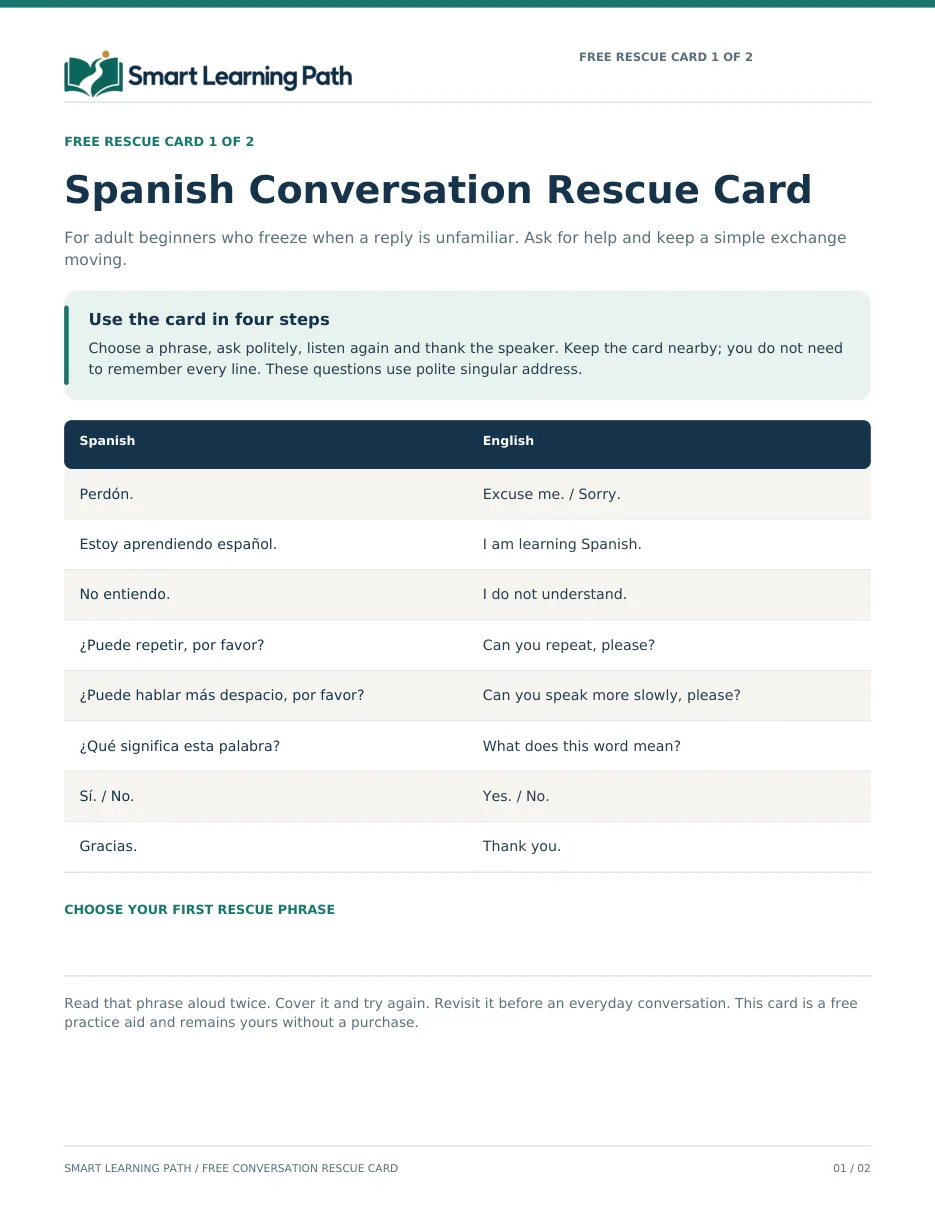
Keep the set small. Four phrases and a thank-you cover most moments when a reply runs past you.
| Spanish | English |
|---|---|
| Perdón. | Sorry. / Excuse me. |
| No entiendo. | I don't understand. |
| ¿Puede repetir, por favor? | Can you repeat, please? |
| ¿Puede hablar más despacio, por favor? | Can you speak more slowly, please? |
| Gracias. | Thank you. |
Perdón gets attention. No entiendo says the meaning was lost. The two questions ask for another go at the same words, and gracias closes it politely.
Use the polite form first.
Puede is the usted form: polite singular, a safe choice with a stranger or a new colleague. The Real Academia Española notes that usted takes a third-person verb (so usted puede) and that it is the standard formal form in Spain and Latin America. With friends, say ¿Puedes repetir, por favor?; with a group, ¿Pueden repetir, por favor?
A: Un café, por favor. · B: ¿Para aquí o para llevar? · A: Perdón, no entiendo. ¿Puede repetir, por favor? · B: ¿Para aquí o para llevar? · A: Para llevar, gracias.
A: A coffee, please. B: Here or to take away? A: Sorry, I don't understand. Can you repeat, please? B: Here or to take away? A: To take away, thank you. An original practice dialogue, not a recording; a real exchange may be different.
In Mexico you may also hear ¿Mande? as a polite ‘pardon?’. ¿Puede repetir, por favor? is understood everywhere and is the safer phrase to drill.
Climb the five-rung pressure ladder.
The aim is not perfect pronunciation. It is to say the phrases when conditions are not perfect, because that is roughly what the moment will feel like.
Rung 1: say them calmly.
Page in front of you. Read each phrase aloud, check the meaning, say it twice more.
Rung 2: say them from memory.
Page face down. Say each phrase aloud, then check. Repeat only the one that wobbled.
Rung 3: add a small clock.
Count silently to three, then speak. Or allow yourself thirty seconds for all four.
Rung 4: add a distraction.
Say them while walking, washing up, or with a radio on. A split attention is closer to a busy café than a silent kitchen.
Rung 5: add a person.
Say them to a friend who does not speak Spanish, record yourself and listen once, or use one for real.
| What goes wrong | A practical fix |
|---|---|
| You freeze on the first word | Shrink the task to that one phrase and do rung 2 again. |
| The ending disappears | Say repetir and despacio slowly on their own, then inside the full phrase. |
| You need a moment to think | Prepare a holding phrase: Un momento, por favor. (One moment, please.) |
These are practice suggestions, not a scoring system.
Make it daily Spanish practice, not a streak.
A ladder works only if you climb it more than once. Ten minutes is enough: two minutes reading the phrases aloud, three from memory, three on today’s rung, two noting the one that wobbled. That is the shape of the free 10 Minute Practice Planner, and the 10-minute routine walks through it step by step.
There are no points, badges or streaks here. Return to the same four phrases on a later day instead of adding new ones. Saying something from memory does more work than re-reading it: a US practice guide recommends spacing review over time and using quizzing to re-expose learners to key content. Treat that as general background, not a promise about your progress. Day 2 of the free 7 Day Spanish Starter Plan is this phrase set, and Day 6 asks for five phrases from memory.
Add a little Spanish small talk.
Clarification phrases keep you afloat; small talk starts something. Prepare Buenos días (good morning), Hola, ¿qué tal? (hi, how’s it going?), Mucho gusto (nice to meet you) and Bien, gracias. ¿Y usted? (well, thank you, and you?), then put them on the same ladder.
¿Qué tal? is friendly rather than formal, so Buenos días is the safer opener with a stranger. The small talk guide has openers for a first day at work in a new city.

Spanish conversation practice with nobody to talk to.
You do not need a partner. Say both parts of the café dialogue aloud, swap roles and repeat until the exchange runs without the page, then change one word: un té instead of un café, or para aquí instead of para llevar. Day 7 of the free plan has three role plays and a short self-check, and the Conversation Rescue Card keeps the clarification phrases in one place while you work.
Is this just another app that teases a plan?
A fair question, so here is a plain answer.
- No app, no streaks. This is a website. There is no account to create before reading a lesson or a phrase page.
- The free plan is the content, not a trailer. The 7 Day Spanish Starter Plan is five pages, and the whole plan is also on its page. The PDF download asks for a first name, an email and an optional learning goal; signing up is the opt-in (there is no checkbox). The plan email arrives straight away, then four more on days 2, 4, 7 and 10, and every email has an unsubscribe link.
- The paid options are planned, not on sale. A toolkit (planned $39 one-time), a four-week conversation course (planned $249) and a monthly membership (planned $39) are described on the pricing page. Nothing is booked or charged, there is no checkout, and dates and a coach have not been confirmed.
Behind the free material sits a published refund policy and an editorial policy explaining how content is checked. If a free page is enough for now, use it and skip the rest.
Your task for today.
Write the four phrases on a card. Tonight, do rungs 1 and 2 once: calmly with the card, then from memory. Tomorrow, put ten minutes in your calendar and do rung 3.
Recall prompt: cover the card and say the polite request for repetition, then the polite request for slower speech. If either stalls, that is tomorrow’s phrase, not a reason to start again.
Questions beginners ask.
How do I remember Spanish words when I am nervous?
Rehearse fewer phrases, out loud, in slightly awkward conditions: calmly first, then from memory, then with a silent count of three, then with background noise. Short phrases you have said many times are easier to reach for than long ones you have only read.
How can I get Spanish conversation practice with nobody to talk to?
Say both parts of a short dialogue aloud, swap roles and repeat until the exchange runs without the page. Day 7 of the free plan has three role plays and a short self-check.
What Spanish small talk should I prepare first?
Buenos días, Hola, ¿qué tal? and Mucho gusto, plus Bien, gracias. ¿Y usted? for polite situations or ¿Y tú? with friends.
How much daily Spanish practice do I need?
There is no set amount. Ten minutes with a few phrases, said aloud, follows the pattern in the free planner. A short session you actually do beats a long one you skip.
Is this another site that teases a seven-day plan and then upsells me?
The whole plan is on its page. The PDF download asks for a first name, an email and an optional learning goal; signing up is the opt-in. The paid options are planned, not open for booking, and there is no checkout.
Practice, not a promise. These tasks help you rehearse everyday Spanish at your own pace. Individual progress varies; nothing here promises a level, a qualification or a fixed learning speed. How we write and check our Spanish
Sources and editorial notes
- Content basis: the Smart Learning Path 7 Day Spanish Starter Plan (Day 2, Day 6 and Day 7), the Conversation Rescue Card and the 10 Minute Practice Planner.
- Real Academia Española and Asociación de Academias de la Lengua Española, Diccionario panhispánico de dudas: usted, retrieved October 18, 2026. Used for the note on polite address and verb agreement.
- Institute of Education Sciences, What Works Clearinghouse, Organizing Instruction and Study to Improve Student Learning (practice guide, 2007), retrieved October 18, 2026. General background on spacing review and using quizzing; it was not written about this ladder.
The rungs and timings are a practice suggestion. Outcomes for this approach have not been measured, and every example is illustrative. Spanish checked by our editors; there has been no independent teacher review. See our Editorial Policy. Spotted a mistake? Suggest a correction.
Related reading.
Visit the blogHow to Ask Someone to Repeat or Slow Down in Spanish
Polite phrases for a fast or unclear reply.
Remember Spanish Phrases with Spaced Practice
Revisit phrases on later days to keep them.
How to Practise Speaking Spanish Alone
Role plays and recall prompts without a partner.
Small practice. Said out loud.
Take the four clarification phrases into the free seven-day plan and practise them at your own pace.
No account or payment needed.