
Everyday situations
Spanish small talk on your first day at work.
Learn a three-turn workplace exchange, choose between tú and usted, and rehearse two follow-up questions so the first friendly conversation does not stall.
The conversation stops at the second line.
You can say Buenos días. Then a colleague smiles and asks ¿Cómo estás?, and the reply you rehearsed disappears. You manage something short, they switch to English to be kind, and the moment is gone. A few of those in your first week and the office starts to feel like a place you watch rather than join.
This page works on one small piece of that: three turns you can rehearse today, a clear choice between tú and usted, and two follow-up questions that keep the other person talking.
Your task: greet a colleague, answer ¿Cómo está?, hand the question back and ask one follow-up — out loud, three times.

Learn three turns, not thirty phrases.
A friendly exchange at a desk is usually three moves: you greet, you answer, you ask one thing back. That is a complete exchange. It needs no fourth turn and no interesting opinion.
| Spanish | English | The turn |
|---|---|---|
| Buenos días. | Good morning. | 1. Greet |
| Muy bien, gracias. ¿Y usted? | Very well, thanks. And you? | 2. Answer, then return |
| ¿Lleva mucho tiempo aquí? | Have you been here long? | 3. Follow up |
| Mucho gusto. | Pleased to meet you. | Close |
Use Buenas tardes after midday and Buenas noches in the evening; a plain Buenas works at any time. The third turn is the one that saves you: it is not clever and it is not about you, but it gives the other person something easy to answer.
Choose tú or usted before you speak.
Spanish makes you pick a level of formality with every “you”. With tú the verb is familiar: ¿Cómo estás? With usted it stays in the third person: ¿Cómo está? The Real Academia Española notes that usted is grammatically a third-person pronoun, so pairing it with a second-person verb is incorrect, and describes it as the form that signals courtesy and a degree of distance.
| With usted | With tú | English |
|---|---|---|
| ¿Cómo está? | ¿Cómo estás? | How are you? |
| ¿Y usted? | ¿Y tú? | And you? |
| ¿Lleva mucho tiempo aquí? | ¿Llevas mucho tiempo aquí? | Have you been here long? |
| ¿De dónde es? | ¿De dónde eres? | Where are you from? |
On a first day, use usted with anyone you have not met, then follow their lead. If a colleague uses your first name and asks ¿Cómo estás?, switching to tú is usually welcome. Some teams relax within a week; others stay formal for months. Both are normal, and nobody minds a newcomer who starts politely.
Plural point. In Mexico and across the Americas, ustedes is the plural for both formal and informal groups; vosotros belongs mainly to Spain. A group greeting is Buenos días, ¿cómo están?
Two follow-up questions that are safe.
Pick follow-ups that are easy to answer and not too personal for a first day. These two work.
The first invites a story, and most people are happy to tell it. The second gives you something useful back, usually a café or a lunch place. With tú: ¿Llevas mucho tiempo aquí? and ¿Qué me recomiendas cerca de la oficina?
| You hear | English | A short answer |
|---|---|---|
| ¿De dónde eres? | Where are you from? | Soy de Bristol. Soy nuevo aquí. |
| ¿Es tu primer día? | Is it your first day? | Sí, hoy es mi primer día. |
| ¿Hablas español? | Do you speak Spanish? | Un poco. Estoy aprendiendo. |
Illustrative answers, not a script. Soy nuevo aquí is for a man, Soy nueva aquí for a woman. Estoy aprendiendo means “I am learning”, which is honest and usually buys you patience.
Rehearse the exchange out loud.
Read it twice: once as yourself, once as the colleague. It is a practice dialogue written for this page, not a recording.
A: Buenos días. · B: Buenos días, ¿cómo está? · A: Muy bien, gracias. ¿Y usted? · B: Bien. ¿Es su primer día? · A: Sí. ¿Lleva mucho tiempo aquí? · B: Dos años. Mucho gusto.
A: Good morning. B: Good morning, how are you? A: Very well, thanks. And you? B: Fine. Is it your first day? A: Yes. Have you been here long? B: Two years. Pleased to meet you.
Say each line aloud twice.
Spanish, then English. Reading silently will not tell you whether the words come out.
Cover the Spanish.
Read the English and say the Spanish before you check.
Play both parts, no looking.
Answer as A, then swap and answer as B.
If your colleagues use tú from the start, keep the same shape and change the endings: ¿cómo estás?, ¿y tú?, ¿llevas mucho tiempo aquí?. Day 1 of the free 7 Day Spanish Starter Plan covers the same greeting and introduction lines, and the greetings guide adds the variants you will hear in the lift.

If the reply arrives too fast.
You will not catch everything on day one. Keep four short lines ready and a blank moment becomes a pause.
| Spanish | English |
|---|---|
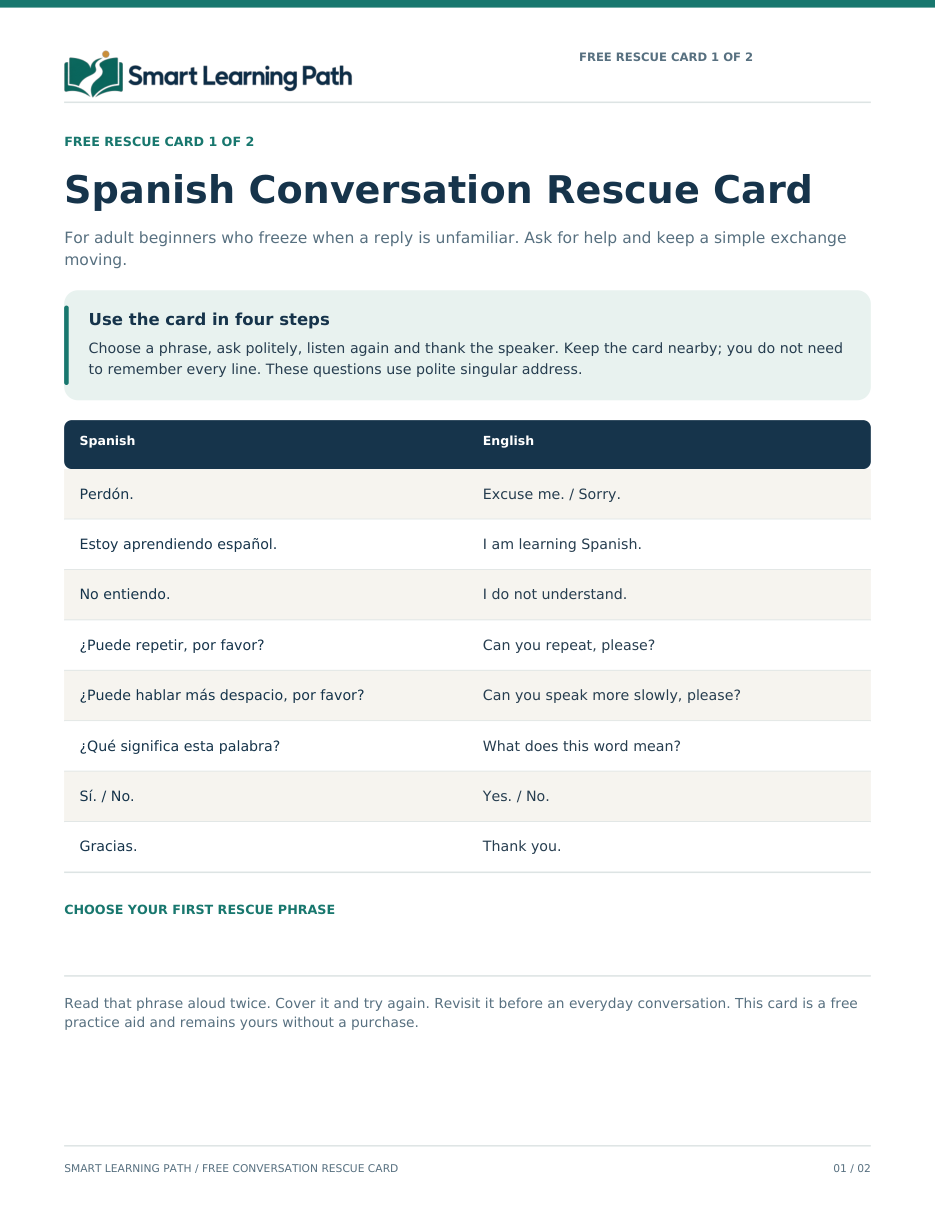
| Perdón, ¿puede repetir, por favor? | Sorry, can you repeat that, please? |
| ¿Puede hablar más despacio, por favor? | Can you speak more slowly, please? |
| No entiendo. | I don’t understand. |
| ¿Cómo se dice ... en español? | How do you say ... in Spanish? |
Those use usted. After switching to tú they become ¿Puedes repetir, por favor? and ¿Puedes hablar más despacio, por favor? Both sets are on the free Conversation Rescue Card, and they match Day 2 of the free plan.
Small habit. When someone switches to English, Gracias, pero quiero practicar (thanks, but I want to practise) is polite, short and keeps the turn yours. Use it at the coffee machine, not in a deadline meeting.
Is this just another app that teases you?
Fair question. The honest answer is short: these are free pages you read and say aloud, not a game with a progress bar. No streaks, no account before you start reading, nothing listening through a microphone. If you do want the plan as a file, the PDF and Word copies ask for a first name and email; you then get the plan and four short emails over ten days, the last mentioning our paid materials, with an unsubscribe link in every one. No payment is taken anywhere on this site, and the course, toolkit and membership we have planned are not open for booking.
Spanish is checked by our editors. We do not have an independent teacher review yet and we say so in the Editorial Policy. Nothing here promises a level or a timeline.
Cover the Spanish and recall it tomorrow.
Reading a phrase five times feels productive and fades quickly. Producing it once from memory does more. A US practice guide for teachers recommends spacing study over time and using short quizzes that make learners retrieve information.
| English prompt | Your Spanish |
|---|---|
| How are you? (polite) | your phrase |
| Very well, thanks. And you? (polite) | your phrase |
| Have you been here long? (polite) | your phrase |
| Pleased to meet you. | your phrase |
Check your answers: ¿Cómo está? · Muy bien, gracias. ¿Y usted? · ¿Lleva mucho tiempo aquí? · Mucho gusto.
- I can answer ¿Cómo está? and hand the question back.
- I can choose tú or usted and keep the verb right.
- I can ask for a repeat or a slower reply.
This is practice, not a proficiency test.
Your next small step: run the script again tomorrow and on Thursday, and note both dates in the 10 Minute Practice Planner. Coming back after a gap is the point.
Common questions.
How do I make small talk in Spanish at work?
Keep it to three turns: greet, answer ¿Cómo está? or ¿Cómo estás?, hand the question back with ¿Y usted? or ¿Y tú?, then ask one easy follow-up such as ¿Lleva mucho tiempo aquí? Three turns is a complete exchange.
Which Spanish small talk phrases should I learn first?
Buenos días, ¿Cómo está?, Muy bien, gracias. ¿Y usted?, Mucho gusto, ¿Lleva mucho tiempo aquí? and Perdón, ¿puede repetir, por favor? Those six cover a greeting, a reply, a follow-up and a rescue.
Should I use tú or usted with new colleagues?
Start with usted for anyone you have not met, then switch to tú if they do. Usted takes a third-person verb, so it is ¿Cómo está?, not ¿Cómo estás usted? In Mexico and across the Americas you will hear ustedes for both formal and informal groups.
Do I need an account, an app or a microphone?
Not for this page. It is text you read aloud, and the free plan is published in full on its web page. The PDF and Word copies ask for a first name and email.
Practice, not a promise. These tasks help you rehearse everyday Spanish at your own pace. Individual progress varies; nothing here promises a level, a qualification or a fixed learning speed. How we write and check our Spanish
Sources and editorial notes
- Smart Learning Path, 7 Day Spanish Starter Plan (Day 1 greetings, Day 2 clarification) and the Spanish Conversation Rescue Card, our own free materials.
- Real Academia Española and ASALE, Diccionario panhispánico de dudas, «usted» (third-person grammar, courtesy and formality, ustedes in the Americas), retrieved October 18, 2026.
- Institute of Education Sciences, What Works Clearinghouse practice guide, Organizing Instruction and Study to Improve Student Learning (2007), recommendations on spacing learning over time and on using quizzing to promote retrieval, retrieved October 18, 2026.
Dialogues and answers are original practice examples written for this page, not recorded conversations. Workplace habits and regional usage differ, so watch what your colleagues do. Spanish checked by our editors. See our Editorial Policy. Spotted a mistake? Suggest a correction.
Related reading.
Back to the blogSpanish Greetings for Your First Conversation
Key phrases and when to use them.
How to Ask Someone to Repeat or Slow Down in Spanish
Polite phrases for a fast or unclear reply.
Spanish for Relocation
Everyday questions for a new place.
Try one useful task.
Open the free seven-day plan and practise about ten minutes a day, at your own pace.
No account or payment needed.