
Practice habits
Remember Spanish phrases with spaced practice.
Try a phrase from memory, check it and return to it on another day. Build a flexible review plan around two useful phrases.
Two ideas, one small practice task.
Choose two phrases you might use. Read their meanings, try them without looking, then check. Write down when you will come back to them. That is the whole method; the two ideas behind it are simple.
Retrieval practice
Try to recall the Spanish before you look at the answer.
Spaced practice
Return to the same phrases on different days instead of all at once.
Recalling a phrase can feel slower than rereading it. That is normal. A partial answer still tells you which word to check, and that note decides what you revisit next time.
Practise with a seven-day plan.
The free 7 Day Spanish Starter Plan gives you seven short tasks, two dialogues and a tracker, about ten minutes a day. Open it on the web or download the 5-page PDF.
The complete plan is free and open. No account or email needed; an emailed copy is optional.
Choose two useful phrases.
Original practice example. Situation: asking where the station is and requesting repetition.
| Spanish to check | English cue |
|---|---|
| ¿Dónde está la estación? | Where is the station? |
| ¿Puede repetir, por favor? | Can you repeat, please? |
Cover the Spanish column with a piece of paper and use the English as your cue.
The repetition question uses polite singular address (usted). Asking the question is the task here; you do not need to understand full directions yet. Ask for clarification if a reply is unclear.
Try, check and try again.
Read and say.
Read both phrases, check the meanings and say them aloud.
Cover and recall.
Look at one English cue and say the Spanish without uncovering it.
Check and retry.
Compare with the example. Say any difficult part again, then try the whole phrase once more.
Note the help you used: the example, a small prompt or memory. This is a practice note, not a score.
Plan your review dates.
This illustrative schedule comes from the free 10 Minute Practice Planner. These are flexible review days, not a tested best schedule.
| Day | Task | My date |
|---|---|---|
| Day 1: first attempt | Read, recall and check both phrases. | date |
| Day 3: return to them | Try from the English cues before checking. | date |
| Day 6: use and review | Ask the question, add the repetition request and note what needs another try. | date |
Choose dates that fit your week and change them when you need to.
Keep a simple review record.
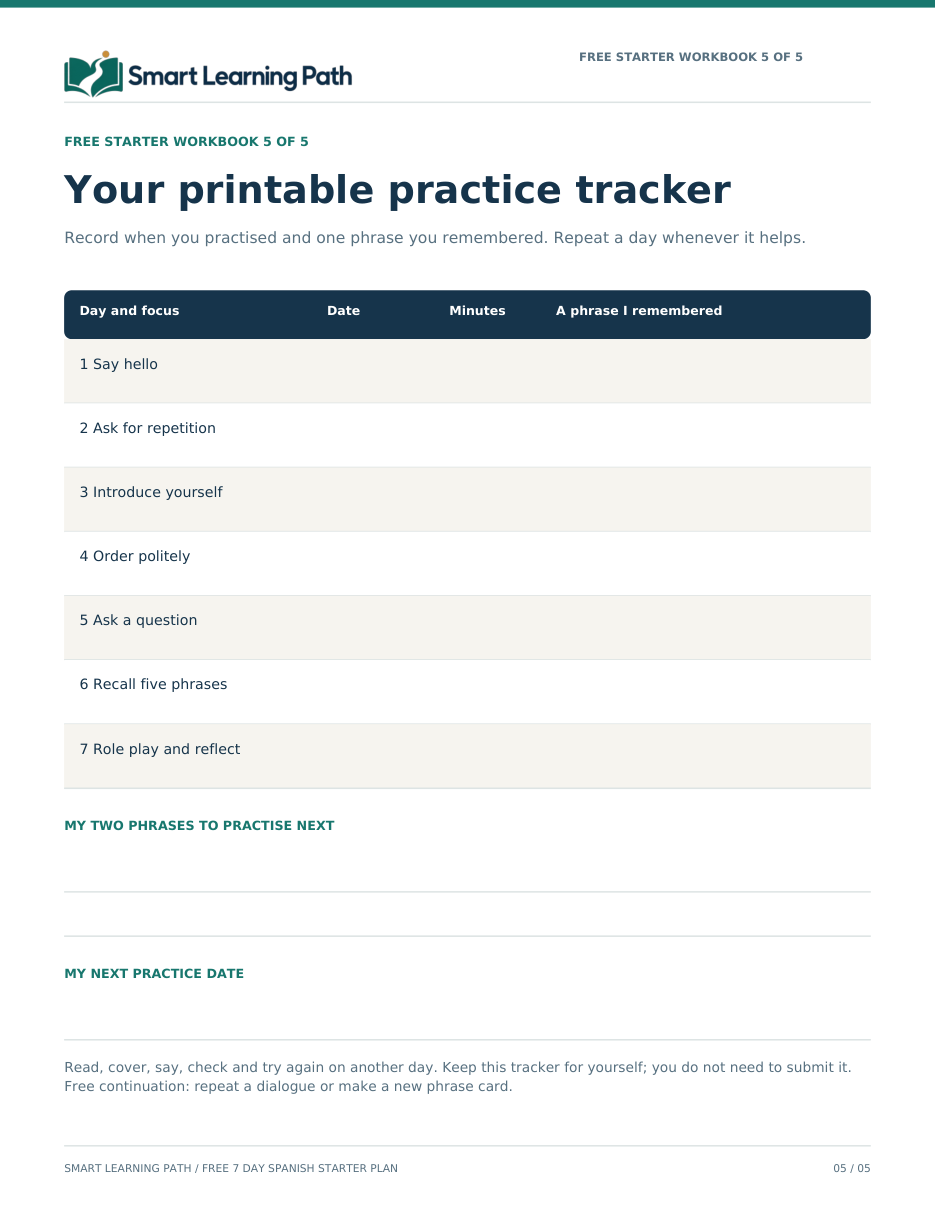
Write down what happened after you practise. A note such as needed the example is enough. The printable tracker on page 5 of the free plan has a row for each day: the date, the minutes you practised and one phrase you remembered.
| Date | Phrase or task | Help used | Next review |
|---|---|---|---|
| date | ¿Dónde está la estación? | example / prompt / memory | date |
| date | ¿Puede repetir, por favor? | example / prompt / memory | date |
Your task: try both phrases from memory today and fill in the first row. Then write your Day 3 date in your calendar or on the tracker.
When recall is difficult.
Cannot recall it?
Uncover the phrase, check it and try one more time.
Need a clearer cue?
Use a specific English prompt for the phrase you chose.
Missed a review?
Continue at your next practice time and choose a new date.
Keep the task manageable. One phrase or a shorter session still counts.
Research context and limits.
The What Works Clearinghouse, part of the US Institute of Education Sciences, published a practice guide in 2007 called Organizing Instruction and Study to Improve Student Learning. Written mainly for teachers and school leaders, it recommends spacing learning over time, which the guide rates as supported by moderate evidence. It also recommends using quizzes to re-expose students to key content, which it rates as supported by strong evidence.
That guide is about school and college study in general, not adult beginners practising Spanish conversation. The two-phrase task and the Day 1, 3 and 6 schedule on this page have not been tested for Spanish outcomes. Treat the dates as adjustable suggestions.
Practice, not a promise. These tasks help you rehearse everyday Spanish at your own pace. Individual progress varies; nothing here promises a level, a qualification or a fixed learning speed. How we write and check our Spanish
Sources and editorial notes
- Institute of Education Sciences, What Works Clearinghouse, Organizing Instruction and Study to Improve Student Learning (practice guide, 2007), retrieved October 18, 2026.
- Real Academia Española, Diccionario panhispánico de dudas: usted, retrieved October 18, 2026.
- Content basis: the Smart Learning Path 10 Minute Practice Planner, 7 Day Spanish Starter Plan and Conversation Rescue Card.
Examples are illustrative. Spanish checked by our editors. See our Editorial Policy. Spotted a mistake? Suggest a correction.
Related reading.
Visit the blogA 10-Minute Spanish Practice Routine
Read, cover, say, check, and repeat.
How to Practise Speaking Spanish Alone
Role plays and recall prompts without a partner.
How to Ask Someone to Repeat or Slow Down in Spanish
Polite phrases for a fast or unclear reply.
Choose a date. Revisit a useful phrase.
Keep your next small practice step in view with the free seven-day plan and its tracker.
No account or payment needed.