
Free workbook · adult beginners
Rescue your next Spanish conversation.
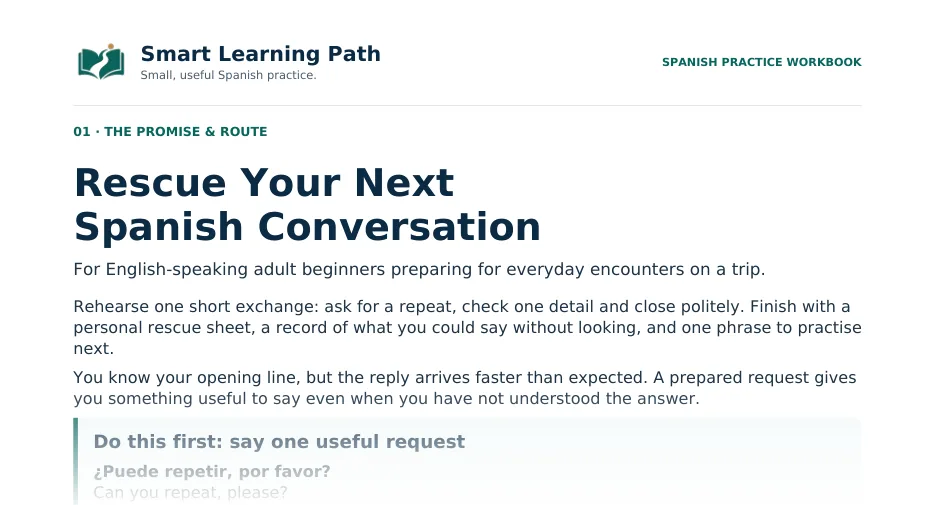
The reply comes faster than you expected, and the reflex is to apologise and switch to English. This six-page workbook walks you through one short rehearsal: ask for a repeat, check one detail, close politely. You finish with your own one-page rescue sheet and an honest note of what you could say without looking.
Free. Enter your first name and email, reply VERIFY to our short email, and we email you both PDFs.
Start here · two minutes
Say one useful request.
This is the first task in the workbook, and you can do it now. You need only your voice; nothing is recorded.
¿Puede repetir, por favor?
Can you repeat, please?
Puede is the polite form (usted), right for staff and strangers. With a friend you would say ¿Puedes repetir, por favor?
Computer-generated voices. The second line is one of the workbook’s backups: “Can you write it down, please?”
Read it aloud.
Play the recording once, then say the line at an easy pace.
Cover the Spanish.
Look only at “Can you repeat, please?” and say the Spanish from the English.
Check and note it.
Uncover and compare. Write W (without help), P (with a prompt) or N (not yet). That is your starting point.
Now hear it inside a short exchange.
Someone answers a question too fast. Listen for how the request, a slower repeat and ¿Puede escribirlo, por favor? work together. Play the normal speed first; use the slower version only to catch what you missed.
The same dialogue is in the free repeat or slow down scenario, with a role play.
Asking a stranger to slow down
- APerdón. ¿Dónde está la parada de autobús?Excuse me. Where is the bus stop?
- BEstá enfrente del museo.It is opposite the museum.
- APerdón, no entiendo. ¿Puede hablar más despacio, por favor?Sorry, I do not understand. Can you speak more slowly, please?
- BSí, claro. Enfrente del museo.Yes, of course. Opposite the museum.
- A¿Puede escribirlo, por favor?Can you write it down, please?
- BSí, claro. Aquí tiene.Yes, of course. Here you are.
- AMuchas gracias.Thank you very much.
- BDe nada.You're welcome.
Why rehearse it
A request you have said aloud comes back under pressure.
Switching to English is not a failure; often it is the kind thing to do. But if it happens every time, you never get the second hearing that would have been enough. One prepared request buys that second hearing while the person is still in front of you.
An app can teach you to recognise ¿Puede repetir, por favor? on a screen. This workbook asks for something different: you say it aloud with the page covered, check one detail and close the exchange, then write down honestly how it went. That is the part that has to work at a counter.
The first exercise above needs no account, app or microphone. The full workbook and sheet come by email.
Pick the scene you will meet first.
| Scene | The detail to catch | Check it like this |
|---|---|---|
| Reception desk or a class | A time | ¿A las seis? (At six?) |
| Café or market till | A price | ¿Cuarenta pesos? (Forty pesos?) |
| Landlord or neighbour at the door | A day | ¿El jueves? (On Thursday?) |
| Taxi or bus | A place | ¿A la estación? (To the station?) |
The workbook’s worked dialogue uses the first scene; the method is the same for the others. Say back only what you heard, as a question, and wait for a yes or a correction.
The free workbook
Get both files by email.
Two PDFs you can print or read on screen. Page 2 of the workbook is the same rescue sheet, so print the separate sheet when you want a fresh copy.
Get the Spanish Conversation Rescue Workbook.
| File | Pages | What you finish with |
|---|---|---|
| Rescue Workbook (PDF) | 6 | One scene prepared, a main request and a backup, one rehearsed exchange, a short log, a review date and one change for next time. |
| Rescue Sheet (PDF) | 1 | A fill-in page: your scene, your request, your backup, the detail you check, your closing line and a W/P/N record. |
The confirmation email comes from Smart Learning Path, hello@mail.thesmartlearningpath.com, with a subject that starts “Reply VERIFY”. After your reply, the next email links to a page with both downloads.
The four practice emails each take one page of the workbook further: choosing a backup (page 3), the ask-check-continue exchange (page 4), the rehearsal log (page 5) and the practice week (page 6).
Page by page
What is inside.
Five short steps. Do them in order on one scene, such as a hotel reception, a café counter or a class you are booking.
| Page | Step | What you do |
|---|---|---|
| 1 | Start here | Say one useful request, then see the route through the workbook. |
| 2 | Choose one scene | Fill in your rescue sheet: the scene and the one detail you need, such as a time, a number or a place. |
| 3 | Select your requests | Pick a main request and a backup from four: ¿Puede repetir, por favor?, Más despacio, por favor., ¿Puede escribirlo, por favor? or No entiendo. |
| 4 | Rehearse an exchange | A short fictional reception dialogue: ask for a repeat, check the time with ¿A las seis?, then close with Gracias. |
| 5 | Make it reusable | Three templates: brief a practice partner, ask for a written detail, keep a rehearsal log. |
| 6 | Review and adjust | A week of small rehearsals, what to do when a line will not come, and a worked example of an honest log. |
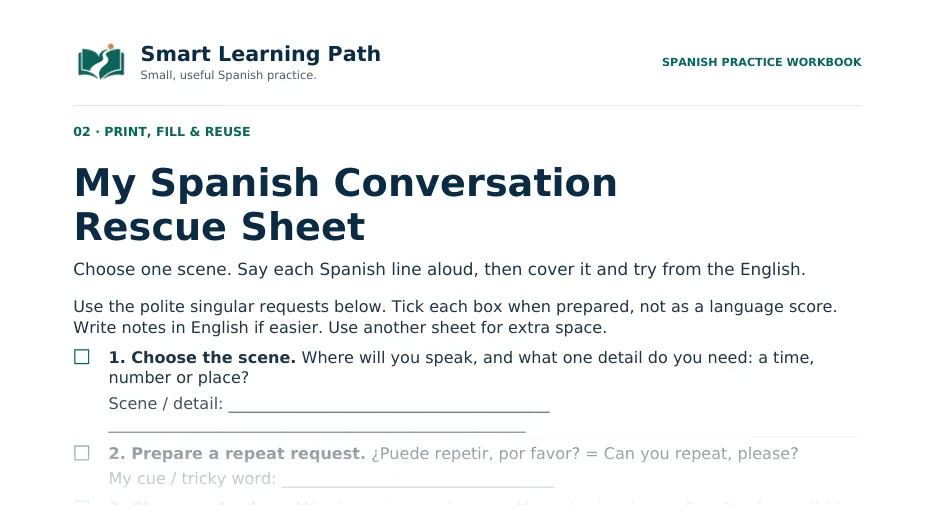
What the marks mean. W means you said the line without help, P means you looked or needed a cue, N means not yet. They describe one rehearsal, not your pronunciation or your level. Reading aloud counts as P, and that is fine.
Which free resource first
Workbook, card or plan?
They overlap on purpose: the same polite requests, used three ways.
| Resource | What it is | Start with it if |
|---|---|---|
| Rescue Workbook (this page) | A six-page guided rehearsal of one exchange, with a fill-in sheet and a log. | You have one situation coming up and want to rehearse it properly once. |
| Conversation Rescue Card | A two-page phrase card: eight rescue phrases with audio links, a café example and a cut-out pocket card. | You want the phrases to hand, in your wallet or on your phone. |
| 7 Day Spanish Starter Plan | A full first week: pronunciation, seven days of phrases with dialogues at two speeds, an answer key and a tracker. | You are starting from zero and want a whole week laid out for you. |
A good order for a trip: rehearse your scene with the workbook, keep the card with you, and use the plan’s Day 2 for more practice with the same requests.
Questions
Before you start.
Do I need to sign up to get the workbook?
Yes: your first name and email. We send a short email first; reply VERIFY to it and we email you the link to both PDFs. Four short practice emails follow on days 2, 5, 9 and 13, then at most one email a week, when we publish a new guide; every email has an unsubscribe link.
How is this different from the Conversation Rescue Card?
The Rescue Card is a two-page phrase card to keep with you: eight phrases, a café example and a pocket card. The Rescue Workbook is a six-page guided rehearsal: you choose one scene, prepare a main request and a backup, rehearse a short exchange, log how it went and set a review date.
Do I need audio, a partner or an app?
No. You need the pages, a pen and somewhere to speak aloud. A partner and the free audio on the site help, but they are optional.
Is it a Spanish test?
No. The marks you write (without help, with a prompt, not yet) describe one rehearsal. They do not measure pronunciation or a level, and the workbook has not had independent teacher review.
Hear a request inside a conversation
The repeat-or-slow-down scenario: two dialogues at normal and slower speed and a role play.
How to ask someone to repeat or slow down
When to ask for a repeat, slower speech or a written detail.
Sources and editorial notes
- Real Academia Española and ASALE, Diccionario panhispánico de dudas: usted, retrieved October 25, 2026 (the polite form used in the requests).
- Institute of Education Sciences, What Works Clearinghouse, Organizing Instruction and Study to Improve Student Learning, retrieved October 25, 2026 (general practice principles; the workbook’s seven-day schedule is our suggestion, not a tested timetable).
The dialogues are fictional. Spanish checked with AI review; no independent teacher review yet. See our Editorial Policy and Privacy Policy.
Practice, not a promise. These tasks help you rehearse everyday Spanish at your own pace. Individual progress varies; nothing here promises a level, a qualification or a fixed learning speed. How we write and check our Spanish
Want a guided week as well?
The free 7 Day Spanish Starter Plan teaches the same requests on Day 2, inside a full first week with audio.
No account or payment needed.