
Everyday situations
Spanish phone call phrases: confirm a flat viewing.
One short call, four lines from you, and a fallback for the moment when only half the reply lands. Here is the script, the questions that come back, and how to ask for the key.
Practice dialogue written for this page, not a recording.
You have run the call in your head already. The landlord picks up, says something friendly, and folded into that first greeting is a quick question — about the flat, about the time — and the only reply that arrives is a silent smile. The smile of someone building a sentence who cannot find the first word.
A call is harder than a counter. No menu to point at, no mouth to watch, and the line goes quiet while you think. That quiet is the fear: you open your mouth, nothing comes out, then they switch to English and the practice is over.
So here is a fixed script instead of a phrase list: four lines from you, the questions that come back, one fallback for when only half the reply lands, and a short drill you say aloud.
What this page is. A script and a repeat-aloud drill — free to read, no account, nothing recording your voice, and no affiliate links. The site does sell optional extras; the pricing page states what each costs. The test is simple: by the end you should be able to say the call out loud without reading it.
Your task: say the four-line call aloud, then answer two possible replies to it, in about ten minutes.
Practise with a seven-day plan.
The free 7 Day Spanish Starter Plan gives you a pronunciation day, seven days of phrases with a dialogue, a listening task and recall prompts, three goal tracks, an answer key and a tracker, 10 to 15 minutes a day. Use it on the web or download the 18-page PDF.
The complete plan is free and open on the web. Enter your email for the printable copy.
Four lines carry the whole call.
Keep to the greeting, your name, the reason for calling and the time. Everything else on the call is a bonus.
| Spanish | English | When you say it |
|---|---|---|
| Buenas tardes. | Good afternoon. | First thing, after they pick up. |
| Soy Ana. | It’s Ana. | Straight after the greeting. Use your own name. |
| Llamo para confirmar la visita de hoy. | I’m calling to confirm today’s viewing. | The reason for the call. |
| ¿A las cinco, verdad? | At five, is that right? | Checking the time back to them. |
| Muchas gracias. Hasta luego. | Thank you very much. See you later. | Closing, before you hang up. |
Match the greeting to the clock: Buenos días until about midday, Buenas tardes after it, Buenas noches in the evening. If the person answering says only ¿Bueno?, that is how a phone is picked up in Mexico, not a question to answer carefully. In Spain you are more likely to hear ¿Diga? or ¿Sí?.
A: ¿Bueno? · B: Buenas tardes. Soy Ana. Llamo para confirmar la visita de hoy. · A: Sí, claro. · B: ¿A las cinco, verdad? · A: Sí, a las cinco. · B: Perfecto. Muchas gracias. Hasta luego.
An original practice dialogue written for this page, not a recorded conversation.
Notice what the fourth line does. Instead of asking ¿A qué hora? — which invites a whole sentence you may not catch — you offer your guess and let them say yes or no. A guessed answer is easier to hear, and ¿verdad? turns the line into a question without any extra grammar.
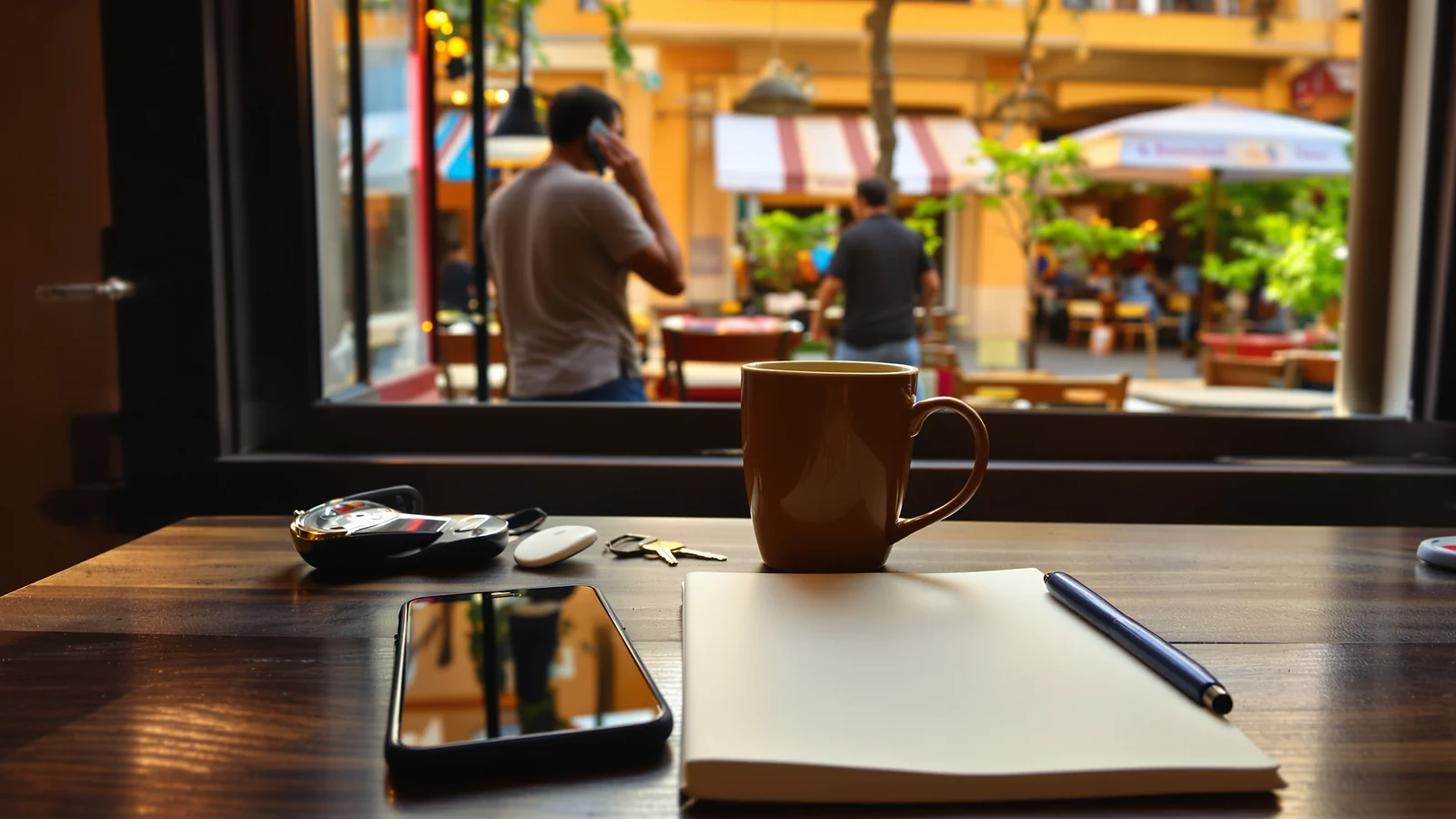
The question that comes first.
Often the first thing you hear is not a name but a question about you: ¿De parte de quién? — who is calling? It is how a phone is answered when nobody knows who has rung, not suspicion.
| Spanish | English |
|---|---|
| ¿De parte de quién? | Who’s calling? |
| De parte de Ana. | It’s Ana. (the fuller answer) |
| Un momento, por favor. | One moment, please. |
The last line is worth keeping. When a reply arrives too fast, un momento, por favor gives you two seconds of silence that belong to you.
When you catch half the reply.
On a call you cannot watch a mouth move, and the parts that blur first are the ones you need most: the time, the street, the floor. The fix is one line you can say fast, before the silence grows.
| Spanish | English |
|---|---|
| Perdón, no entiendo bien. | Sorry, I don’t quite understand. |
| ¿Puede repetirlo más despacio, por favor? | Could you repeat that more slowly, please? |
| ¿Cómo dice? | What did you say? |
| ¿Mande? | Pardon? (common in Mexico; rare in Spain) |
| ¿Me lo manda por mensaje, por favor? | Could you send it to me by message, please? |
Saying one of these is not a failure; it is how a conversation keeps going. The last line suits a phone call in particular: an address or a floor number you cannot catch by ear is easy to read as a text message. There is a fuller set in the repeat-and-slow-down guide.
Ask for the key: ¿Me da la llave?
The line that finishes the job is short. ¿Me da la llave, por favor? — will you give me the key, please? Direct, polite, done. Softer: ¿Me podría dar la llave, por favor?
| Spanish | English |
|---|---|
| ¿Me da la llave, por favor? | Will you give me the key, please? |
| ¿Me podría dar la llave, por favor? | Could you give me the key, please? (softer) |
| ¿Hay portero? | Is there a doorman? |
| Estoy en la entrada. | I’m at the entrance. |
Two words worth knowing around this call. La visita is the viewing or appointment; in Mexico you will also hear la cita. El departamento is the flat in Mexico, often shortened to el depa in speech, while Spain says el piso. Use whichever word the landlord used; it costs nothing and saves a moment of confusion.
Polite Spanish phrases that matter on a call.
Politeness on the phone is mostly a few words and one choice of form: usted, the polite singular for a landlord or agent you have not met. It takes the same verb form as él and ella, which is why the request is ¿Me puede...? and not ¿Me puedes...?
| Spanish | English |
|---|---|
| Disculpe. | Excuse me. |
| Por favor. | Please. |
| ¿Me podría...? | Could you...? (the softest opener) |
| Muchas gracias. | Thank you very much. |
| Muy amable. | Very kind. |
If the landlord addresses you with tú first — ¿Me puedes mandar...? — you can mirror it back with puedes. Mirroring is ordinary courtesy, not a mistake. More on this in the polite phrases guide.
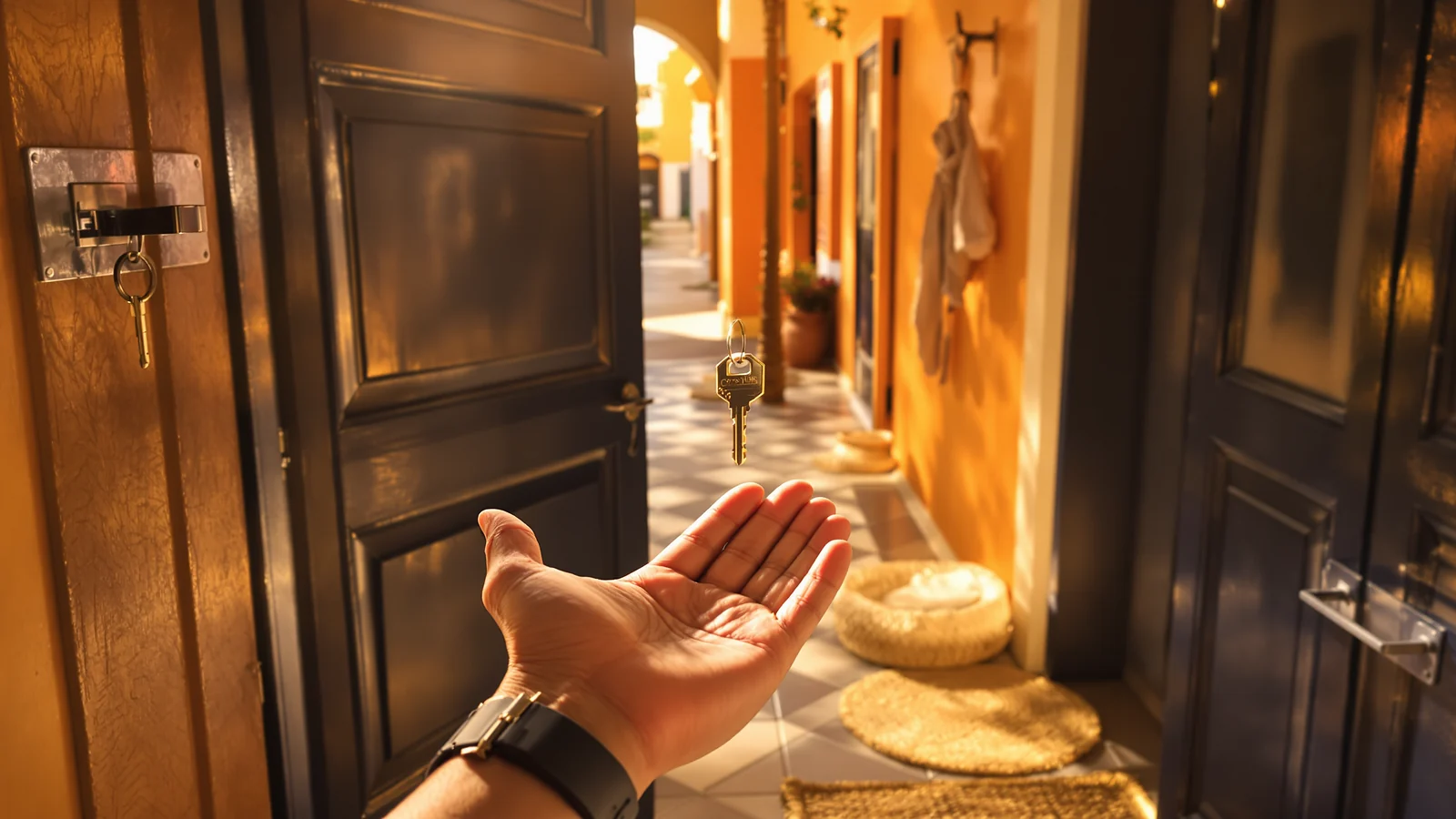
Rehearse the call out loud.
Read the dialogue above, both parts, once. Then do this, with nobody listening.
Say your four lines from memory.
Greeting, name, reason, time. Cover the table with your hand if it helps. Check only after all four are out.
Answer the two replies you might get.
Say Sí, claro (yes, of course) and No, es a las seis (no, it’s at six) aloud, then answer each as if you had heard it on the line.
Repeat on three separate days.
Not three times tonight. Three short rounds across the week, each starting from memory.
Cover the tables and answer these prompts out loud. Check only after you have tried all four.
| English prompt | Your Spanish |
|---|---|
| Good afternoon, it’s Ana. | your line |
| I’m calling to confirm today’s viewing. | your line |
| At five, is that right? | your line |
| Will you give me the key, please? | your line |
Check your answers: Buenas tardes, soy Ana. · Llamo para confirmar la visita de hoy. · ¿A las cinco, verdad? · ¿Me da la llave, por favor?
- I can greet and give my name on the phone.
- I can say why I am calling in one sentence.
- I can check the time without asking an open question.
- I can ask for the key.
Is this just another app that teases, then upsells?
There is nothing to score here. No points, no streak, no microphone listening. You say the lines aloud and decide whether they came out. That is less flattering than a green tick, and more useful: on the call the sentence has to arrive from memory.
The free part is not a sample. The 7 Day Spanish Starter Plan is an 18-page PDF, and the whole plan also sits on the web page, so you can read Day 1 in the browser before deciding anything. Day 1 is the greeting set this page starts from; Day 2 is the clarification set it borrows.
There is a paid side, said plainly. Three phrase packs (Travel, Family and Relocation) at $9 each or $19 for all three, and the self-paced course Spanish Conversation Foundations, 28 lessons in 8 modules at $49. One-time payments through Stripe, with a full refund within 30 days; the pricing page lists it all. Nothing on this page sits behind any of that.
Whether it helps is something you answer by doing the drill, not by trusting the page. If the four lines come out with the page closed, you have sentences you can say aloud.
One next step.
Tonight, close every tab and say the four lines out loud with nothing in front of you: greeting, name, reason, time. Then answer the two replies again. That is the whole job for today, and it takes less time than scrolling a phrase list.
Handle the time without guessing
Also useful, one link each: Day 2 of the free 7 Day Spanish Starter Plan for the clarification lines, and the Conversation Rescue Card for the phrases that buy you time, on one printable page.
Common questions.
What are the most useful Spanish phone call phrases?
Four lines do most of a short call: Buenas tardes (the greeting), Soy Ana (your name), Llamo para confirmar la visita de hoy (I am calling to confirm today’s viewing) and ¿A las cinco, verdad? (at five, is that right?). Add ¿Me da la llave, por favor? when you need the key.
How do I say I am calling to confirm in Spanish?
Llamo para confirmar la visita de hoy. Change de hoy to de mañana for tomorrow, or swap la visita for la cita if that is the word the landlord used.
How do I ask for the key in Spanish?
¿Me da la llave, por favor? is direct and polite. The softer version is ¿Me podría dar la llave, por favor? Both use usted, the polite form for someone you have not met.
Which polite Spanish phrases should I use on the phone?
Disculpe to open, por favor with any request, ¿Me podría...? for the request itself, and muchas gracias to close. Perdón or ¿Mande? buys you a repeat without switching to English.
Do I need to use usted on the phone?
With a landlord, agent or porter you have not met, usted is the safe default. If they address you with tú first, you can mirror it with ¿Me puedes...?
Practice, not a promise. These tasks help you rehearse everyday Spanish at your own pace. Individual progress varies; nothing here promises a level, a qualification or a fixed learning speed. How we write and check our Spanish
Sources and editorial notes
- Real Academia Española and Asociación de Academias de la Lengua Española, Diccionario panhispánico de dudas, entry for usted (on usted as the formal form of address, which takes a third-person verb), retrieved October 18, 2026.
- Smart Learning Path, 7 Day Spanish Starter Plan (Day 1, greetings; Day 2, asking for clarification) and Spanish Conversation Rescue Card (the rescue phrases that buy you time), our own free materials.
All dialogues here are illustrative practice examples written for this page, not recordings of real conversations, and they are not tenancy advice. Phone habits differ by country and by person, so treat the replies above as likely lines rather than a fixed script. Spanish checked with automated AI and rule-based checks; no teacher review. See our Editorial Policy. Spotted a mistake? Suggest a correction.
Related reading.
Back to the blogSpanish for Moving Abroad: First Everyday Questions
Short questions for a new setting.
Polite Spanish Phrases: Más Lento vs Despacio
Choose a soft phrase for asking someone to slow down.
How to Ask Someone to Repeat or Slow Down in Spanish
Polite phrases for a fast or unclear reply.
Try one useful task.
Open the free seven-day plan and practise about ten minutes a day, at your own pace.
No account or payment needed.