
Conversation basics
How to tell the time in Spanish.
A time said at normal speed can arrive as one long sound. Here are the phrases for asking, a short way to catch the number, and two dialogues to rehearse before the moment comes.
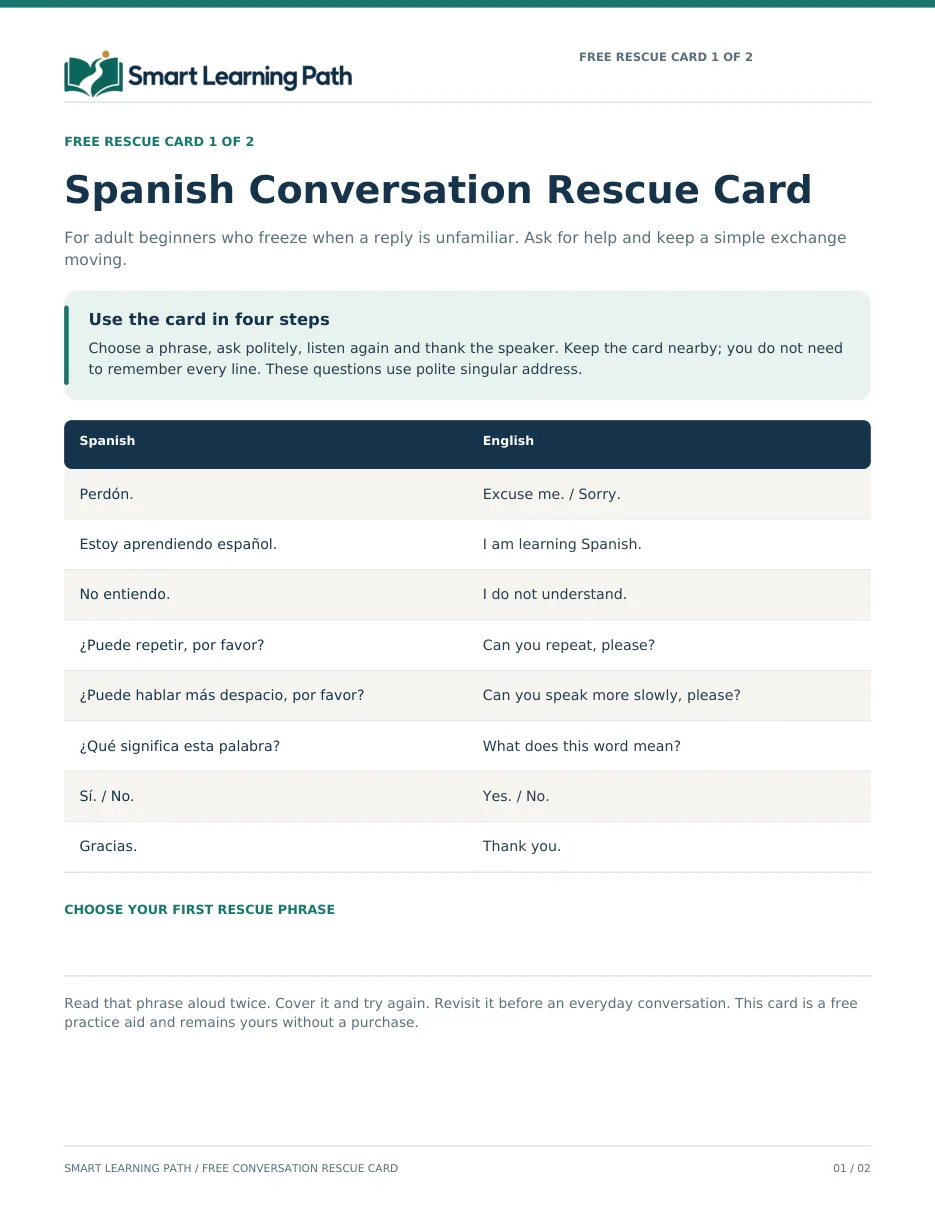
Your task: ask the time, catch the number in the reply, then say it back to check. Read every line aloud; two short dialogues follow.
When a normal-speed reply blurs.
A café counter in Mexico City. Your order is ready in your head. The person behind the till says something quick and friendly and it arrives as one sound: sonlasdiezymedia. You catch diez, maybe, and nothing else. Two seconds later the moment has gone and you are nodding at something you did not understand.
That is not a memory problem. Speech does not arrive in tidy words: Son las diez y media runs together in a busy mouth, and the small words after the number are the first to disappear. You do not need the whole sentence back. You need two things: the number, and the tail that follows it - y media, menos cuarto, en punto.
This page gives you the question, the answer, and a short routine for practising a time at speaking speed. It is a set of lines you say aloud, then cover and recall, then use in an imagined scene. Times turn up everywhere in a move abroad - the technician, the café closing, a viewing, a delivery - so a small amount of practice goes a long way.

Ask with ¿Qué hora es?
Start with the question on its own. Say it aloud five times before you look at any answer. The opening mark ¿ shows where the question begins, and the accent on qué belongs there.
| Spanish | English | When to use it |
|---|---|---|
| ¿Qué hora es? | What time is it? | The standard question, understood everywhere. |
| Perdón, ¿qué hora es? | Excuse me, what time is it? | Open politely before asking a stranger. |
| ¿Tiene hora, por favor? | Do you have the time, please? | Polite singular (usted) - safe with anyone. |
| ¿Tienes hora? | Do you have the time? | Familiar singular (tú) - friends, neighbours who use tú. |
The polite form with tiene is the safe default with staff, a landlord or a stranger on the street. Switch to tienes only when the other person uses tú with you.
In Mexico you will often hear ¿Mande? used as a polite pardon?. It is very common in Mexico City. ¿Puede repetir, por favor? is understood everywhere and gives you a second hearing.
Practise with a seven-day plan.
The free 7 Day Spanish Starter Plan gives you a pronunciation day, seven days of phrases with a dialogue, a listening task and recall prompts, three goal tracks, an answer key and a tracker, 10 to 15 minutes a day. Use it on the web or download the 18-page PDF.
The complete plan is free and open on the web. Enter your email for the printable copy.
Answer with son las, and es la una.
The word hora is feminine, and Spanish treats the expression as plural for every hour except one. So one o'clock is singular, and the rest take las.
Minutes count forward with y up to the half hour. After that, many speakers count back from the next hour with menos. Both patterns are heard across the Spanish-speaking world, so learn to say one and to recognise the other.
| Spanish | English | Clock time |
|---|---|---|
| Son las seis y cinco. | It is five past six. | 6:05 |
| Son las seis y cuarto. | It is quarter past six. | 6:15 |
| Son las seis y media. | It is half past six. | 6:30 |
| Son las siete menos veinte. | It is twenty to seven. | 6:40 |
| Son las siete menos cuarto. | It is quarter to seven. | 6:45 |
| Son las diez en punto. | It is ten o'clock exactly. | 10:00 |
Add de la mañana, de la tarde or de la noche when the hour alone would be ambiguous: son las diez de la mañana is clearly morning. Noon and midnight are short: Es mediodía and Es medianoche. Watch the small difference: por la mañana means in the morning in general, while de la mañana attaches to a clock time.
Catch the number at speed.
Reading a phrase and hearing it are different skills, so practise them separately. The routine below moves you from slow and clean to joined-up, which is closer to how a busy person actually speaks.
Read it in chunks, slowly.
Son las · diez · y media. Pause between the pieces. This is the version your eyes can follow.
Join it up at normal speed.
Say it as one block, without gaps: sonlasdiezymedia. That run-together sound is what you will hear at a counter.
Cover the page and answer.
Look at any clock, cover the Spanish, and say the time aloud from memory. Check, then pick another hour.
Do it with the day parts attached.
Answer twice: once alone - Son las diez - then with the day part - Son las diez de la mañana.
When you hear a time in real life, do not try to hold the whole sentence. Listen for three things.
| Listen for | Example | Why it matters |
|---|---|---|
| The number | diez / once / doce | Usually the loudest, clearest part. |
| The tail after it | y media / menos cuarto / en punto | Moves the time by up to half an hour. |
| A day part | de la mañana / de la noche | Separates ten in the morning from ten at night. |
Then buy yourself certainty with three words. Repeat the time back with a rising tone: ¿A las diez? This is a yes-or-no check, not a guess, and it gives the other person a chance to correct you kindly. If you still miss it, slow the exchange down: Más despacio, por favor or ¿Puede repetir, por favor?
There are more rescue lines in our guide to asking someone to repeat or slow down in Spanish.
Two scenes worth rehearsing.
The question ¿A qué hora...? asks when something happens. The answer uses a las for most hours and a la una for one o'clock. Read the learner's lines aloud first, then swap roles with the page.
| At the café: closing time and the bill | English |
|---|---|
| Learner: Perdón, ¿qué hora es? | Excuse me, what time is it? |
| Staff: Son las diez y cuarto. | It is quarter past ten. |
| Learner: Gracias. ¿A qué hora cierran? | Thank you. What time do you close? |
| Staff: A las once. | At eleven. |
| Learner: ¿A las once? Vale, la cuenta, por favor. | At eleven? Fine, the bill, please. |
| Staff: Ahora mismo. | Right away. |
Now a slower, more pressing situation: someone is coming to your flat and you need the time exactly. Notice how the learner misses it once, then asks again.
| At home: when the technician arrives | English |
|---|---|
| Learner: ¿A qué hora llega el técnico? | What time does the technician arrive? |
| Landlord: Llega a las diez de la mañana. | He arrives at ten in the morning. |
| Learner: Perdón, ¿puede repetir, por favor? | Sorry, can you repeat, please? |
| Landlord: Sí, a las diez. | Yes, at ten. |
| Learner: ¿A las diez? Muy bien, gracias. | At ten? Very good, thank you. |
A: ¿Qué hora es? · B: Son las diez y cuarto. · A: Gracias. ¿A qué hora cierran? · B: A las once.
An original practice dialogue written for this page, not a recording of a real conversation. Both scenes are illustrative; a real counter will say something else.
For the ordering half of that café scene, see order coffee in Spanish with a simple dialogue. For the moving side - landlord, address, delivery - our guide to Spanish for moving abroad covers the first everyday questions.

Read. Cover. Say. Check.
Read the English prompt, cover the right-hand column, say your answer aloud, then check.
| English prompt | Your Spanish |
|---|---|
| What time is it? | your phrase |
| It is half past eight. | your phrase |
| It is quarter to nine. | your phrase |
| What time does it arrive? | your phrase |
| Slower, please. | your phrase |
Check your answers: ¿Qué hora es? · Son las ocho y media. · Son las nueve menos cuarto. · ¿A qué hora llega? · Más despacio, por favor.
- I can ask what time it is.
- I can answer with son las and with es la una.
- I can ask when something happens.
- I can repeat a time back to check it.
Use the answers whenever you need them. This is practice, not a proficiency test.
Three short sessions this week.
Short repeats beat one long evening. The IES What Works Clearinghouse practice guide on organising instruction and study recommends spacing learning over time and using quizzing to re-expose learners to key content. In plain terms: three five-minute sessions on three days, each ending with a covered recall, will serve you better than one heroic Sunday.
Day one
Ask the question and answer three hours, slowly, in chunks.
Day two
Say the same times joined up at normal speed, then cover and recall.
Day three
Play both roles in the café scene, then the technician scene.
Day 5 of the free plan adds ¿Dónde está la estación?, which pairs naturally with asking a train or bus time. The 10 Minute Practice Planner has a weekly template for the routine, and our guide to a 10-minute Spanish practice routine explains how to keep a session that short.
Your next small step: say "¿A qué hora llega?" aloud twice, answer it with a time that suits tomorrow, then say the time back as a question.
Is this another app that leaves you silent?
Fair question, and worth answering plainly. There is no streak counter here, no points and no microphone. This page is text: phrases with their English, two short dialogues and a recall table. The work that turns them into speech is you saying them aloud, which is also the part an app cannot do for you.
Nothing on this page asks you to sign up first. The free 7 Day Spanish Starter Plan is five pages and you can read the whole plan on its web page. If you want the PDF and editable Word copy by email, you give a first name and an email address, and that starts four short follow-up emails on days 2, 4, 7 and 10; one of them mentions optional paid materials. You can ignore it, and every email has an unsubscribe link.
The paid options on this site are planned, not open: a starter toolkit, a four-week conversation course and a monthly practice membership. Dates and a coach have not been confirmed and booking is not open, so no checkout appears while you are reading. Our Editorial Policy explains how the Spanish is checked: by our editors, with no independent teacher review yet.
One honest limit. Nobody can promise that you will speak on your first day in Mexico City, and progress varies. What you can do today is rehearse a handful of lines until they come out without hunting for them.
Common questions.
Why is it son las dos and not es las dos?
Hora is feminine, and the expression is plural for every hour except one: es la una, then son las dos and so on.
What if the person speaks too fast for me?
Listen for the number and the small word after it, then repeat back what you think you heard - ¿A las diez? If it is still unclear, say más despacio, por favor or ¿Puede repetir, por favor?
Do I need the 24-hour clock?
No. Conversation usually uses the 12-hour clock with de la mañana, de la tarde or de la noche. A timetable may print 21:30; you can say las nueve y media de la noche.
Practice, not a promise. These tasks help you rehearse everyday Spanish at your own pace. Individual progress varies; nothing here promises a level, a qualification or a fixed learning speed. How we write and check our Spanish
Sources and editorial notes
- Institute of Education Sciences, What Works Clearinghouse, Organizing Instruction and Study to Improve Student Learning - the guide's recommendations include spacing learning over time and using quizzing to re-expose learners to key content. The guide is about study in general, not about Spanish, retrieved October 18, 2026.
- Smart Learning Path, 7 Day Spanish Starter Plan, Day 5, Spanish Conversation Rescue Card and 10 Minute Practice Planner (our own free materials).
Both dialogues are original practice examples written for this page, not recorded conversations. Spanish checked by our editors; no independent teacher review yet. See our Editorial Policy. Spotted a mistake? Suggest a correction.
Related reading.
Back to the blogHow to Ask Someone to Repeat or Slow Down in Spanish
Polite phrases for a fast or unclear reply.
Order Coffee in Spanish with a Simple Dialogue
A short café exchange you can adapt.
Spanish Numbers Listening Quiz at the Till
Drill 15 to 100 so the total lands the first time.
Try one useful task.
Open the free seven-day plan and practise about ten minutes a day, at your own pace.
No account or payment needed.