
Everyday situations
Catch the total: a Spanish numbers listening quiz.
The total arrives fast. Drill 15 to 100, catch three spoken prices and learn the question to ask when one slips past.
Your task: hear a price between 15 and 100, write the figure down, then pay with the note you chose on purpose. Free to try here in your browser.
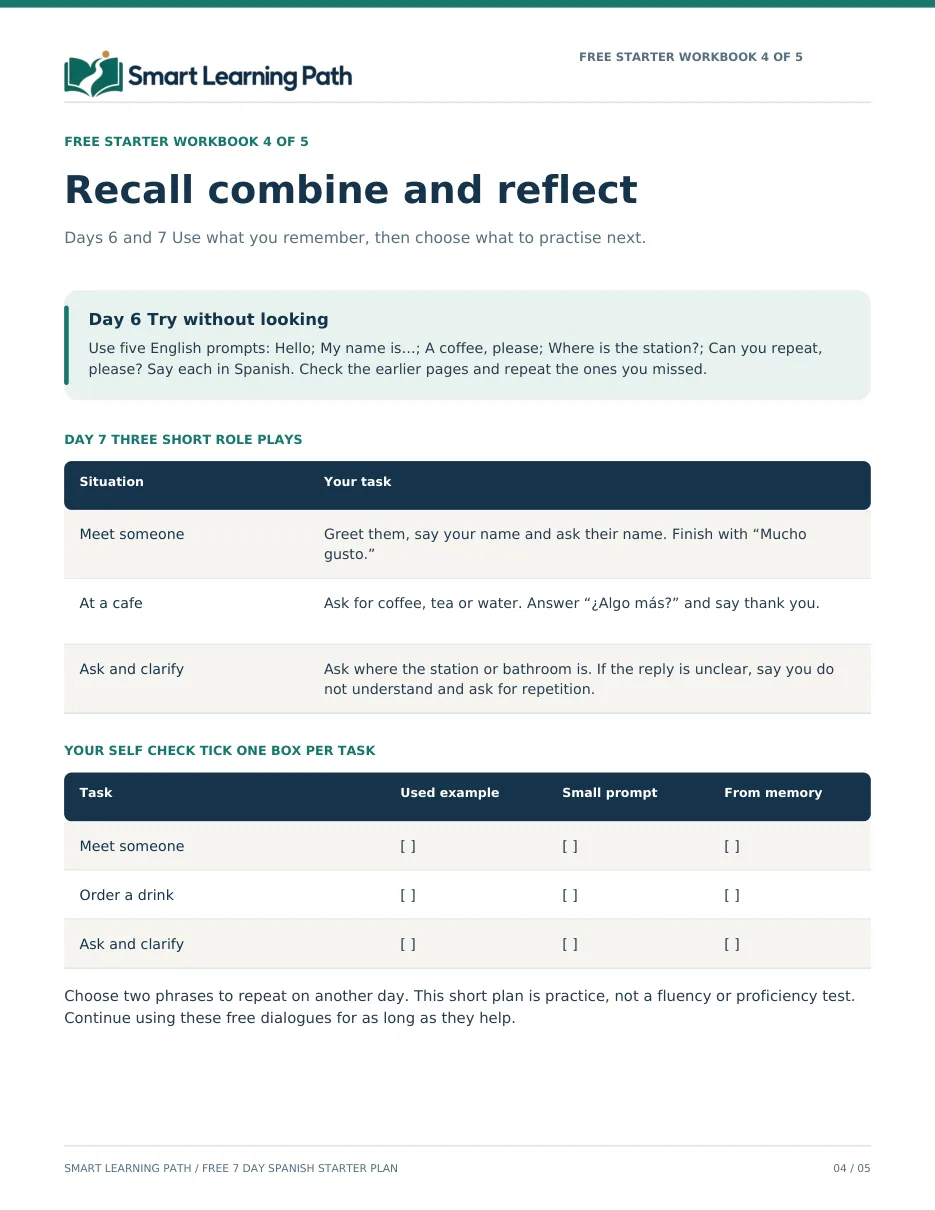
The total arrives faster than you do.
You can order without thinking. Then the person at the till says Son cincuenta pesos, it is over in a second, and your hand is already reaching for the biggest note you have. That is not a character flaw. It is a listening gap with a very small set of numbers in it.
Cafés, pharmacies, market stalls and taxis reuse the same totals, mostly between 15 and 100, and the sentence around them barely changes: Son… plus an amount. So this page drills only that: a ladder, three spoken totals, one question for when a number slips past, and a routine for paying without guessing.
If an app has given you points and streaks but no speaking, the fix is not another points screen. And if you are wary of free material that ends in an upsell: the 7 Day Spanish Starter Plan is printed in full on its own page, the practice tools are free downloads, and the paid options are planned rather than on sale.
Build the number ladder from 15 to 100.
If you have met numbers in Spanish 1–20, you know the awkward part: uno to quince is mostly irregular and just has to be said aloud. From 16 a pattern starts: dieciséis, diecisiete, dieciocho, diecinueve, veinte. The twenties are written as one word (veintiuno, veintidós, veinticinco), never veinte y uno. From 31 the tens and units are joined with y: treinta y uno.
Read the ladder aloud downwards, then upwards. A till gives you numbers in no particular order.
| Spanish | English |
|---|---|
| quince | fifteen |
| dieciséis | sixteen |
| dieciocho | eighteen |
| veinte | twenty |
| veintiuno | twenty-one |
| veintidós | twenty-two |
| veinticinco | twenty-five |
| treinta | thirty |
| treinta y cinco | thirty-five |
| cuarenta | forty |
| cincuenta | fifty |
| sesenta | sixty |
| setenta | seventy |
| ochenta | eighty |
| noventa | ninety |
| cien | one hundred |
Cien is exactly a hundred (cien pesos); above that it becomes ciento (ciento veinte pesos). The currency word changes by country — pesos in Mexico, euros in Spain — but the number stays the same.
Number pronunciation in Spanish is regular: you say what you see, with the stress on the next-to-last syllable unless a written accent says otherwise. Three pairs still catch beginners at a counter, so practise them side by side rather than in a long list.
| Pair | Spanish | English |
|---|---|---|
| 15 and 50 | quince / cincuenta | fifteen / fifty |
| 14 and 40 | catorce / cuarenta | fourteen / forty |
| 60 and 70 | sesenta / setenta | sixty / seventy |
The accents are not decoration. Dieciséis, veintidós, veintitrés and veintiséis carry one because the stress falls there; without it the word reads flat. Say each pair slowly, then at the speed a cashier would use.
If two numbers sound alike, repeat both back: ¿Son sesenta o setenta? It is an ordinary, polite check and it takes two seconds.
Catch three spoken totals.
This is the Spanish numbers listening practice part. Cover the right-hand column, read each Spanish line aloud once at normal speed, and write the figure before you look. Reading aloud yourself is not cheating: it builds the same sound-to-number link you need at a till.
| Total you hear | Write the figure |
|---|---|
| Son sesenta pesos. | your figure |
| Son setenta pesos. | your figure |
| Son noventa y cinco pesos. | your figure |
Check your figures: 60 · 70 · 95. If you mixed up the first two, you are in good company: sesenta and setenta differ by one consonant.
Notice the verb. With pesos the total usually comes as Son… because the amount is plural; a single unit takes Es un peso. Often you hear the number alone: Cincuenta. For spoken lines you can replay, the free café scenario plays the ordering and bill exchange at normal and slower speed, with a transcript and a role play.
Ask ¿Cuánto es? when it slips past.
Missing a number is normal; freezing after it is the problem. ¿Cuánto es? means “how much is it?” and it is the shortest way to hear the total again.
| Spanish | English |
|---|---|
| ¿Cuánto es? | How much is it? |
| ¿Cuánto es en total? | How much is it altogether? |
| ¿Cuánto cuesta? | How much does it cost? (one item) |
| ¿Puede repetir, por favor? | Can you repeat, please? |
| ¿Puede escribirlo, por favor? | Can you write it down, please? |
Puede is the polite singular form, used with usted, the usual choice between a customer and shop staff. If the total is on a screen, point at it and read the figure back aloud: you get the check and the pronunciation practice in one go. These clarification lines are collected on the free Conversation Rescue Card.

Pay with a note you chose, not a guess.
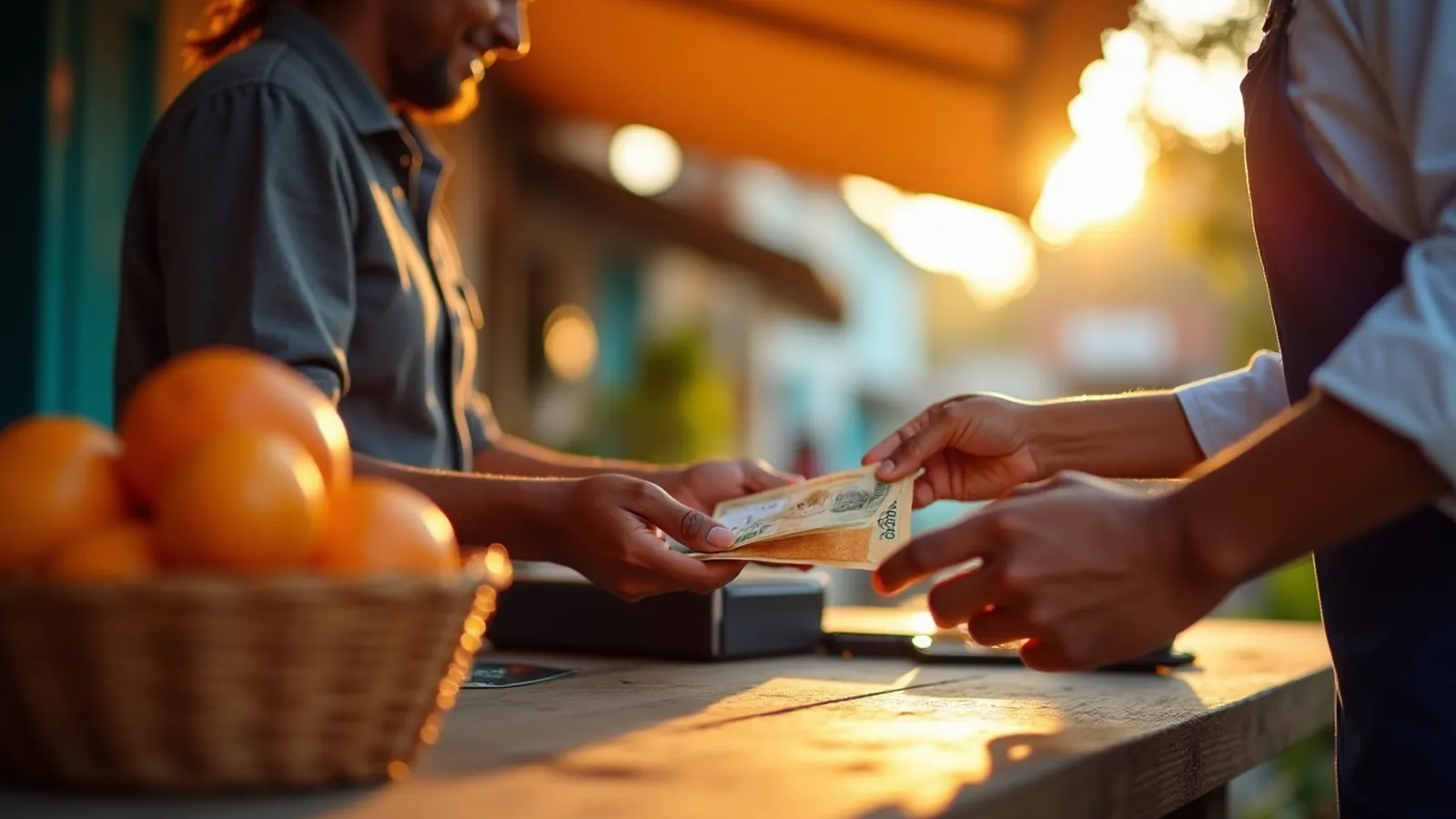
Hearing the total is half the job. The other half is handing over money without the small panic of not knowing what the change should look like.
Name your notes before you go out.
Hold each one and say its value aloud: cien pesos, doscientos pesos. Two minutes, once.
Decide the note in advance.
A total of 60 pesos gets paid with a 100 note. Knowing that before you order stops the change being a surprise.
Repeat the total as you hand it over.
Sesenta pesos. Aquí tiene. This confirms what you heard and lets the cashier correct you.
Count the change at the counter.
Not at the door. Counting in front of someone is ordinary, not rude.
Only have a large note?
Ask ¿Tiene cambio de doscientos? (Do you have change for two hundred?) or pay by card with ¿Puedo pagar con tarjeta?
A practice script, not a rule. Shops vary, and some will simply hand you the change.
Cover the Spanish and recall it.
Say the Spanish for each prompt without looking back. Check only after you have tried all five.
| English prompt | Your Spanish |
|---|---|
| Fifty pesos. | your phrase |
| Sixty pesos. | your phrase |
| Ninety-five pesos. | your phrase |
| How much is it? | your phrase |
| Can you repeat, please? | your phrase |
Check your answers: Cincuenta pesos. · Sesenta pesos. · Noventa y cinco pesos. · ¿Cuánto es? · ¿Puede repetir, por favor?
- I can hear the difference between 60 and 70.
- I can ask for the total again without apologising for it.
- I can hand over a note and say the total back.
Use the examples whenever you need them. This is practice, not a proficiency test.
Then book the second run: one line in the 10 Minute Practice Planner for three days from now is worth more than repeating this whole page tonight. Spacing review over time and using short quizzes to bring key content back are both habits the IES practice guide recommends, and both cost minutes rather than hours.
Common questions.
How do I practise Spanish numbers for listening?
Keep the set small and say it aloud. Work the ladder from 15 to 100, then read three totals at normal speed and write the figures down. A few minutes a day beats one long list you never return to.
Can I learn numbers in Spanish 1–100 quickly?
The pattern is quick to read: veintiuno to veintinueve are written as one word, and from 31 the tens and units are joined with y. Hearing them at speed takes longer than reading them, so drill the tens aloud.
Do I need numbers in Spanish 1–20 first?
Yes, but not for long. Uno to quince are mostly irregular and need saying aloud. Dieciséis to diecinueve follow a pattern, and veinte opens the twenties.
How do I check number pronunciation in Spanish?
Three pairs cause most trouble: quince and cincuenta, catorce and cuarenta, sesenta and setenta. Say each pair slowly, then at normal speed, and keep the written accents on dieciséis, veintidós, veintitrés and veintiséis.
What should I say if I miss the total?
Ask ¿Cuánto es? and, if it is still unclear, ¿Puede repetir, por favor? or ¿Puede escribirlo, por favor? Repeating both numbers back, as in ¿Son sesenta o setenta?, also works.
Practice, not a promise. These tasks help you rehearse everyday Spanish at your own pace. Individual progress varies; nothing here promises a level, a qualification or a fixed learning speed. How we write and check our Spanish
Sources and editorial notes
- Institute of Education Sciences, What Works Clearinghouse, Organizing Instruction and Study to Improve Student Learning (practice guide, 2007): recommendation 1, space learning over time, and recommendations 5a and 5b, use quizzing to promote learning, retrieved October 18, 2026.
- Smart Learning Path, 7 Day Spanish Starter Plan (Day 4, the café dialogue) and 10 Minute Practice Planner, our own free materials.
The totals, the ladder and the paying routine are illustrative examples written for this page, not recordings of a real shop. Prices, notes, card rules and tipping customs differ between countries, so check locally. Spanish checked by our editors. See our Editorial Policy. Spotted a mistake? Suggest a correction.
Related reading.
Back to the blogHow to Ask Someone to Repeat or Slow Down in Spanish
Polite phrases for a fast or unclear reply.
Order Coffee in Spanish with a Simple Dialogue
A short café exchange you can adapt.
Ten Everyday Scenarios
Dialogues with audio and scripted role plays for real situations.
Try one useful task.
Open the free seven-day plan and practise about ten minutes a day, at your own pace.
No account or payment needed.