
Getting started
Last-minute Spanish before moving? Stretch the seven days.
The plan is seven days and the flight is six weeks away. Here is how to repeat the week, one fifteen-minute speaking task a day, with a different everyday scene each time.
Six weeks left, and the plan says seven days.
You open the free plan, count the days, and it says seven. Two thoughts arrive together: that is too short to matter, and I have already left it too late. So the tab stays open and nothing starts.
Seven days is not a deadline. It is a cycle you can run six times before you fly, with one new everyday scene each week and one fifteen-minute speaking task a day. The shape stays the same, so you never wonder what to do today. The words change, so it never becomes a chant.
What six cycles give you: six scenes said aloud many times — a café, a station, a shop, a pharmacy, a flat, a neighbour — plus a small set of phrases for when an answer arrives too fast.
Practise with a seven-day plan.
The free 7 Day Spanish Starter Plan gives you a pronunciation day, seven days of phrases with a dialogue, a listening task and recall prompts, three goal tracks, an answer key and a tracker, 10 to 15 minutes a day. Use it on the web or download the 18-page PDF.
The complete plan is free and open on the web. Enter your email for the printable copy.
One week is a cycle. Repeat it; do not restart from zero.
The free plan already has the right shape: greetings, rescue phrases, your own details, a dialogue, one question you will really ask, recall, role plays. Keep that order every week and change only the scene.
| Week | Scene | The question that carries it |
|---|---|---|
| 1 | Order and pay in a café | Un café, por favor. |
| 2 | Find your way | ¿Dónde está la estación? |
| 3 | Shop and catch the price | ¿Cuánto cuesta? |
| 4 | The pharmacy | ¿Tiene algo para el dolor de cabeza? |
| 5 | The flat: rent, deposit, wifi | ¿Cuál es la contraseña del wifi? |
| 6 | The neighbour and the building | Soy su nuevo vecino. / Soy su nueva vecina. |
An illustrative order, not a syllabus. Move the scenes to match what your first fortnight will actually contain.
Short of scenes? Our ten everyday scenarios add more dialogues with audio, so week 4 does not have to be invented from nothing.
What fifteen minutes a day looks like.
One task a day. If a day collapses, do the first five minutes and stop; tomorrow is a new day, not a debt.
| Day | Fifteen-minute task |
|---|---|
| 1 | Listen to one exchange at slower speed, then normal, and repeat it aloud |
| 2 | The five rescue phrases — the same every week |
| 3 | Make Day 1 yours: change the name, the city, the job |
| 4 | The week’s dialogue, both parts, alternating |
| 5 | The one question your scene needs |
| 6 | Recall five phrases with the English covered |
| 7 | Three role plays and a two-minute self-check |
Week 1 in full: Day 1 is greetings (Hola. Me llamo Ana. ¿Cómo te llamas? Mucho gusto.), Day 4 is the café dialogue, Day 5 is ¿Dónde está la estación? Day 6 is the one people skip. Cover the English and say the phrase from the Spanish. A phrase you can only read is a phrase that will not come out at a counter.
A US Institute of Education Sciences practice guide recommends spacing learning over time and using quizzes to re-expose learners to key content. The weekly cycle borrows both ideas in a small way: the same phrases return on days 2 and 6, and the scene changes. It is a planning suggestion, not a claim about how quickly you will learn.
Day 1 in full, so you can start in ten minutes.
Say each line aloud twice, then read the dialogue and take both parts.
| Spanish | English |
|---|---|
| Hola. | Hello. |
| Buenos días. | Good morning. |
| Me llamo Ana. | My name is Ana. |
| ¿Cómo te llamas? | What is your name? (familiar) |
| Mucho gusto. | Nice to meet you. |
Watch the register. ¿Cómo te llamas? is familiar, for someone your own age or a new colleague. With an older neighbour or a landlord, use ¿Cómo se llama usted? If you are unsure, the polite form is never wrong.
A: Buenos días. Me llamo Ana. ¿Cómo te llamas? · B: Hola, Ana. Me llamo Carlos. Mucho gusto. · A: Igualmente.
A: Good morning. My name is Ana. What is your name? B: Hello, Ana. My name is Carlos. Nice to meet you. A: Likewise. An original practice dialogue, not a recorded conversation.
On Day 3, swap in your own details and add one sentence you will really need: Soy de Leeds. (I am from Leeds.) Trabajo en informática. (I work in IT.) Keep it to one new sentence, or Day 3 becomes homework.
Day 2 never changes. That is the whole point.
Every cycle, Day 2 is the same five phrases. They keep you in a conversation when the other person speeds up.
| Spanish | English |
|---|---|
| Perdón. | Sorry. / Excuse me. |
| ¿Puede repetir, por favor? | Can you repeat, please? |
| ¿Puede hablar más despacio, por favor? | Can you speak more slowly, please? |
| No entiendo. | I do not understand. |
| Gracias. | Thank you. |
¿Puede repetir? uses the polite usted form, so it is safe with a stranger, a shop assistant or a landlord. The familiar version is ¿Puedes repetir, por favor? — keep that one for people you know.
Accents are part of the phrase. Más (more) is written with an accent, and tú (you) is a different word from tu (your); the Diccionario panhispánico de dudas sets out these pairs.
Build a week without buying anything.
Choose the scene.
One place you will stand in during your first fortnight: a pharmacy counter, a phone shop, a neighbour’s door.
Write five lines.
A greeting, your question, the answer you expect, one rescue phrase and thank you. Five is enough.
Find the audio.
Play the scenario dialogue at slower speed, then normal, and copy the rhythm aloud.
Run the seven days.
Day 4 becomes this dialogue, Day 5 this question, Day 7 the role play.
Use both speeds properly.
The slower track is a stepping stone, not the goal. Listen once slowly to catch the shape, twice at normal speed, then say it aloud three times in your own voice. Normal speed is what you will meet in Mexico City.
No microphone, no account, no streak, and nothing records you. Speaking practice here means sound leaving your mouth, not a score on a screen — and a kitchen is a perfectly good café for a role play.
Straight answer: is this another app that teases you?
You have used apps that gave you points and a streak and left you unable to order a coffee. Fair. Here is exactly what this is.
- No points, no streaks, no feed. You get seven tasks and a scene. When the fifteen minutes are up, the page has nothing else to give you, and that is deliberate.
- The plan is on the web. All seven days are readable without an account, with a dialogue a day at normal and slower speed. Only the downloadable files open a short form: first name and email, then a short email from us, then a reply with VERIFY, then the file. Every email has an unsubscribe link.
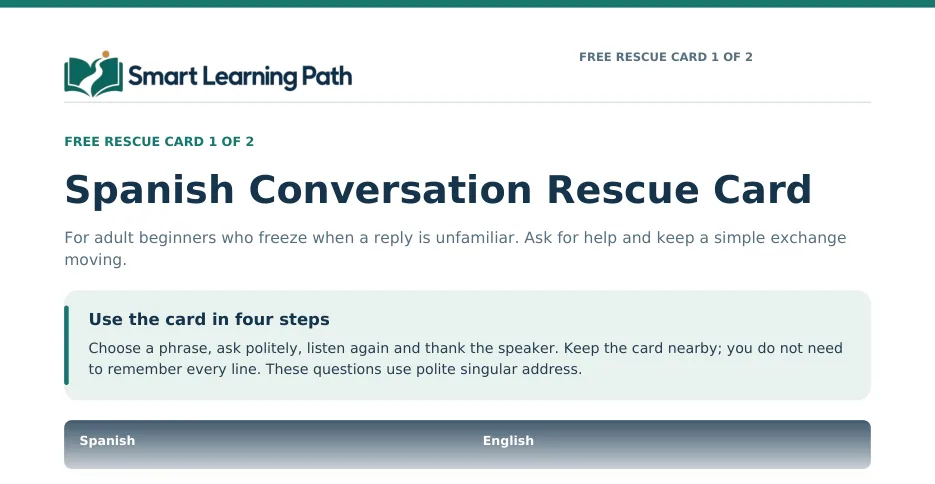
- The free material stands on its own. The Conversation Rescue Card and the 10 Minute Practice Planner are extras, not the missing half.
- We do sell things. Three phrase packs cost $9 each, or $19 for all three, and the self-paced course Spanish Conversation Foundations costs $49 with no live sessions. Both are one-time payments with a 30-day refund. This six-week cycle needs neither; if you ever look, read pricing and the refund policy first.
- No teacher review. The Spanish here is checked with automated checks, not by a teacher. Our Editorial Policy says how that works.
The honest promise is small: fifteen minutes a day, one scene a week, out loud. No page can promise how you will speak on arrival, because that depends on far too much. What you control is how many times you have said these six scenes aloud before you land.
How you know a cycle worked.
On Day 7, mark each phrase in one of three ways: from memory, with a prompt, not yet. Move the “not yet” phrases into next week’s Day 2 and Day 6. Two minutes of honest marking beats any badge.
A recall prompt for the end of week 1: cover this page, say the five greetings, then the five rescue phrases, then order a coffee and answer yourself as the waiter. Whatever sticks halfway is tomorrow’s first minute.
Write the stubborn phrases in one place. The free 10 Minute Practice Planner has a seven-day log with from memory, with a prompt and not yet ticks, plus a phrases-to-revisit list. It is a static file; nothing you type into it reaches us.
Common questions.
Is seven days enough before a move?
Not for everything, and this page does not claim it is. Seven days is one cycle. Six cycles before you fly give you six everyday scenes and one set of rescue phrases, said aloud many times.
Do I need a microphone or an account to start?
No. The plan and the scenario dialogues are web pages you can open without signing in, and nothing records your voice. Only the downloadable files ask for a first name, an email address and a VERIFY reply.
Why is Day 2 the same every week?
Because the phrases that rescue a conversation are few and fixed: Perdón, ¿Puede repetir, por favor?, ¿Puede hablar más despacio, por favor?, No entiendo, Gracias. Repeating them each week is what makes them come out first when someone speaks quickly.
What does it cost?
The plan, the scenarios and the practice tools are free. Optional extras are three phrase packs at $9 each or $19 for all three, and a $49 self-paced course. Both are one-time payments with a 30-day refund, and this page works without them.
Practice, not a promise. These tasks help you rehearse everyday Spanish at your own pace. Individual progress varies; nothing here promises a level, a qualification or a fixed learning speed. How we write and check our Spanish
Sources and editorial notes
- Smart Learning Path, 7 Day Spanish Starter Plan (Days 1 to 7: greetings, clarification phrases, the café dialogue, asking where things are, recall and role plays) and free practice tools (our own free materials).
- Institute of Education Sciences, What Works Clearinghouse, Organizing Instruction and Study to Improve Student Learning (practice guide recommending that learning be spaced over time and that quizzing re-expose learners to key content), retrieved October 18, 2026.
- Real Academia Española and ASALE, Diccionario panhispánico de dudas, «tilde» (accented pairs such as tú and tu, and the accent on más), retrieved October 18, 2026.
Examples are illustrative, and the weekly order is a planning suggestion. Progress varies. Spanish checked with AI review. See our Editorial Policy. Spotted a mistake? Suggest a correction.
Related reading.
Back to the blogA 10-Minute Spanish Practice Routine
Read, cover, say, check, and repeat.
How to Start Learning Spanish as an Adult Beginner
Your first seven days, one small task at a time.
Spanish for Relocation
Everyday questions for a new place.
More on the same idea: Spanish for Mexico: A Daily Practice Plan · Spanish Study Plan: Six Weeks Before You Move · A Daily Spanish Routine for Moving Abroad
Start the first cycle today.
The 7 Day Spanish Starter Plan is on the web, with a dialogue a day at normal and slower speed. Fifteen minutes is one day of the cycle.
No account or payment needed.