
Practice habits
A daily Spanish routine for moving abroad.
Six weeks out, the evenings go on app points that never turn into a sentence you can say to a landlord. Here is a twelve-minute block that practises the phrases your move will actually ask for.
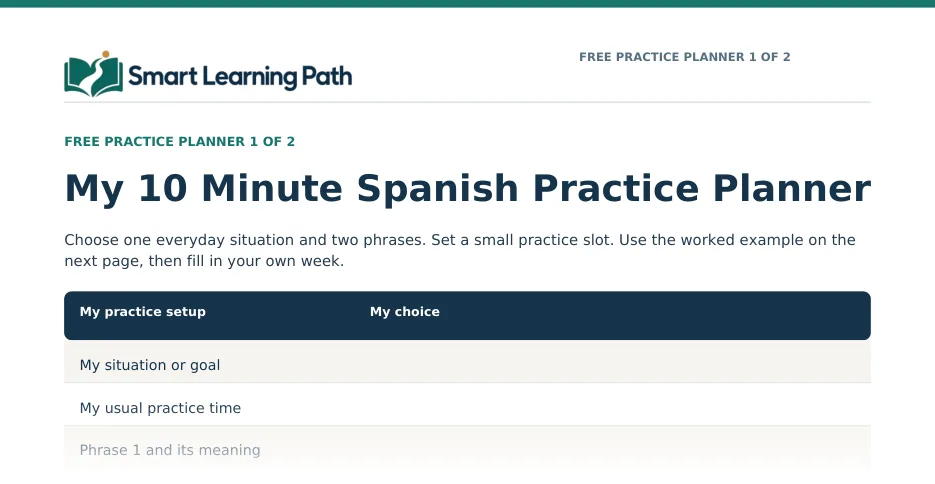
Practise with a seven-day plan.
The free 7 Day Spanish Starter Plan gives you a pronunciation day, seven days of phrases with a dialogue, a listening task and recall prompts, three goal tracks, an answer key and a tracker, 10 to 15 minutes a day. Use it on the web or download the 18-page PDF.
The complete plan is free and open on the web. Enter your email for the printable copy.
Six weeks out, the evenings are full of points.
You finish work, eat, sit down with good intentions and open the app. Eleven minutes later you have a streak, a cheerful chime and a number in the corner of the screen. You close it. The flight is still coming, and you cannot yet ask a taxi driver to take you to an address.
The worry underneath is not vocabulary. It is: I’ll arrive, open my mouth, and nothing will come out. Someone asks an ordinary question, hears your accent, switches to English, and you are the newcomer who cannot order a coffee after weeks of daily practice.
That fear usually means your daily practice never asked you to say a sentence aloud, hear a reply and carry on. The twelve-minute block below does exactly that, aimed at the situations waiting for you in Mexico City.

Points are not phrases.
An app drill mostly asks you to recognise: tap the right tile, match the pair, choose between two options. A café counter or a taxi rank asks you to produce a sentence from nothing, at speed, while somebody waits. A loop that rewards quick tapping can keep you busy for months without pushing you into the harder task, because it does not measure it.
Two ideas from research on learning cost nothing: coming back to the same items over time (spacing), and pulling them out of memory rather than looking at them again (active retrieval). The IES practice guide Organizing Instruction and Study to Improve Student Learning lists both among its recommendations. It was written for school subjects, not adult language practice, so treat it as a sensible principle rather than proof about this routine.
Your block uses both: the same three phrases return tomorrow evening, and you say them with the page covered.
Run the twelve-minute daily practice block.
Five steps, one job each. The warm-up is the only place an app belongs.
| Time | Step | What to do |
|---|---|---|
| 2 minutes | Warm-up | One short app drill, or read your three phrases once. Skip it and the block is ten minutes. |
| 4 minutes | Say it aloud | Read each phrase, cover the Spanish, say it from the English, uncover and check. Do the hardest one twice. |
| 3 minutes | Role play | Play both parts out loud: your line, the likely reply, then a repair phrase. |
| 2 minutes | Voice note | Record the role play on your phone and listen to it once. |
| 1 minute | One note | Write the phrase that stumbled and the evening you will repeat it. |
Twelve minutes is a planning suggestion, not a rule. A shorter block still counts; the speaking steps are what matter.
Put the block in the same slot each evening — after dinner, before the washing-up — so you stop negotiating with yourself about it. Fifteen minutes works too: give the extra three to listening twice, once slow and once at normal speed.
Take three phrases from the free plan.
The seven-day starter plan is written out in full on its page: core phrases on Day 1, repair phrases on Day 2, directions on Day 5. Take three of them, and add the relocation lines for the door of your flat and the taxi rank.
| Spanish | English |
|---|---|
| Hola. Me llamo… | Hello. My name is… |
| Mucho gusto. | Nice to meet you. |
| ¿Puede repetir, por favor? | Can you repeat, please? |
| ¿Dónde está el baño? | Where is the bathroom? |
| Soy el nuevo inquilino. | I am the new tenant. |
| ¿Puede llevarme a esta dirección, por favor? | Can you take me to this address, please? |
If you are a woman, say la nueva inquilina instead of el nuevo inquilino. ¿Puede…? is the polite singular used with usted. The RAE’s Diccionario panhispánico de dudas describes usted as the formal form in the educated norm of Spain and America, and it takes a third-person verb. So ¿Puede repetir? with a stranger; ¿Puedes repetir? with friends and family.
Say one role play out loud.
Reading a phrase is not the same as saying it to a person. The three-minute role play is where you practise being interrupted, and it is the part we are all tempted to skip.
You: Buenos días. ¿Puede llevarme a esta dirección, por favor? · Driver: Claro, suba. · You: ¿Cuánto cuesta, más o menos? · Driver: Depende del tráfico. · You: Perdón, ¿puede repetir, por favor? · Driver: El precio depende del tráfico.
You: Good morning. Can you take me to this address, please? Driver: Of course, get in. You: About how much does it cost? Driver: It depends on the traffic. You: Sorry, can you repeat, please? Driver: The price depends on the traffic. An original practice dialogue, not a recorded conversation; a real taxi may go differently.
You: Buenos días. Soy el nuevo inquilino. Mucho gusto. · Landlord: Mucho gusto. Pase, por favor. · You: Gracias. ¿Dónde está el baño? · Landlord: Al fondo, a la derecha. · You: Gracias. ¿Puede hablar más despacio, por favor?
You: Good morning. I am the new tenant. Nice to meet you. Landlord: Nice to meet you. Come in, please. You: Thank you. Where is the bathroom? Landlord: At the back, on the right. You: Thank you. Can you speak more slowly, please? An original practice dialogue, not a recorded conversation.
Do not read the dialogue. Say your line, say the other person’s reply yourself in a different voice, then answer it. Run the exchange twice: once with the page in front of you, once without. Then swap one thing — a different address, a different reply — so you are not reciting.
The everyday scenarios take one situation at a time, with a short dialogue you can reuse in the role play. If a reply arrives too fast, keep the repair phrases from the Conversation Rescue Card in the role play.
Record one voice note.
Two minutes, one take, no editing. Record the role play on your phone, then listen once. Listen for three things: did the sentence come out whole, did you pause where a person would pause, and did the reply still make sense at speed. Write down one thing to fix — not five. Tomorrow’s block starts with that phrase.
Your task tonight: choose three phrases, play the role play once, record it, and write down the one phrase that stumbled. That is the whole first session.
No account and no microphone are needed here; the voice note stays on your phone.
A week of relocation situations.
Keep the same phrases for three evenings before you change them; the repetition is where they settle.
| Evening | Situation | Phrases to keep |
|---|---|---|
| Monday | The taxi from the airport | ¿Puede llevarme a esta dirección, por favor? ¿Cuánto cuesta, más o menos? |
| Tuesday | The landlord at the door | Soy el nuevo inquilino. Mucho gusto. |
| Wednesday | The café counter | Un café, por favor. La cuenta, por favor. |
| Thursday | The till in a shop | ¿Cuánto cuesta? ¿Puede repetir, por favor? |
| Friday | The street | ¿Dónde está la estación? No entiendo. |
| Saturday | A reply that comes back too fast | ¿Puede hablar más despacio, por favor? ¿Puede escribirlo, por favor? |
| Sunday | Repeat the one that stumbled | The phrase from your note, said five times |
Examples are illustrative; a real exchange may be shorter, longer or different.
If you like writing it down, the free 10 Minute Practice Planner has a seven-day log with ticks for from memory, with a prompt and not yet. The relocation page sorts the same phrases by your first month after landing.
Let the app be the warm-up.
Keep the app if you enjoy it. It is a reasonable two-minute warm-up, and the first row of the block has a place for it. What changes is that it no longer counts as the session: the session is the four minutes of saying, the three of role play and the voice note. A simple check at the end of the evening: if the only thing your mouth did was read a tile aloud, you had a warm-up, not a session.
Is this another free site that upsells?
Fair question. Here is the whole arrangement, without a sales page in between.
Free in the browser, no account: this article and the seven-day plan written out phrase by phrase, with a café dialogue on Day 4. No microphone needed.
Free files, email asked: the printables — the seven-day plan, the Conversation Rescue Card, the Practice Planner and the 120-phrase deck — open a sign-up box when you click download. You give a first name and email, get one short email with no link, reply VERIFY, and then the file arrives. No payment details are asked for.
What follows: the file, then four emails on days 2, 4, 7 and 10 — three practice tips, then one about our paid packs and course. After that, at most one email a week, when we publish a new guide. Every email has an unsubscribe link.
What we charge for: nothing on this page. There is no checkout on the site today. The options described on the pricing page are planned and not open for booking, and this block and the free plan are complete without them. See also our editorial policy.
Tonight, twelve minutes.
Take the first row of the week table — the taxi — and pick three phrases from it. Say each aloud twice, cover the page, say them from the English, play both parts of the dialogue, record it once. Write down what stumbled, then stop. Tomorrow the same three phrases come back; on the fourth evening, change the situation and keep the routine.
Read the seven-day plan See the practice tools
The plan page is free to read in your browser. An email is only asked if you want a printable PDF or Word copy.
Practice, not a promise. These tasks help you rehearse everyday Spanish at your own pace. Individual progress varies; nothing here promises a level, a qualification or a fixed learning speed. How we write and check our Spanish
Common questions.
How much daily Spanish practice do I need before moving abroad?
Twelve minutes most evenings is a block you can keep, and enough to move three phrases from the page to your mouth. It will not cover everything you meet in Mexico City, progress varies, and a shorter block still counts. The speaking steps matter more than the total time.
How is this different from using an app every day?
An app drill usually asks you to recognise the right answer. This block asks you to say phrases aloud from memory, play both parts of a short role play and record yourself once. Keep the app for the two-minute warm-up; it is no longer the session.
Do I need an account or a microphone to try it?
No. Read this article and the seven-day plan in the browser without an account. A first name and email are asked only when you click a download: reply VERIFY to the short email and the file arrives. The voice note is recorded on your own phone.
Sources and editorial notes
- Content basis: the Smart Learning Path 7 Day Spanish Starter Plan (Days 1, 2 and 5) and the 10 Minute Practice Planner.
- Institute of Education Sciences, What Works Clearinghouse, Organizing Instruction and Study to Improve Student Learning (practice guide, 2007), retrieved October 18, 2026. Lists recommendations on spacing learning over time and on using quizzing with active retrieval. It was written for school subjects and says nothing about this routine.
- Real Academia Española and Asociación de Academias de la Lengua Española, Diccionario panhispánico de dudas: usted, retrieved October 18, 2026. Used for the note that usted is the formal form in the educated norm of Spain and America and takes a third-person verb.
Examples are illustrative: a real taxi, landlord or café may go differently. The timings are a flexible planning aid, and outcomes from this routine have not been measured. Spanish checked with AI review; no independent teacher review yet. This is practice, not a fluency test. See our Editorial Policy. Spotted a mistake? Suggest a correction.
Related reading.
Visit the blogA 10-Minute Spanish Practice Routine
Read, cover, say, check, and repeat.
Spanish for Moving Abroad: First Everyday Questions
Short questions for a new setting.
Remember Spanish Phrases with Spaced Practice
Revisit phrases on later days to keep them.
Twelve minutes, three phrases, one role play.
The seven-day starter plan is free to read in your browser, phrase by phrase, with repair phrases on Day 2 and a café dialogue on Day 4.
No account or payment needed.