
Getting started
Six weeks before you move: a Spanish study plan with a speaking task every day.
Seven plan days, six weeks, and one named speaking task for every day left on the calendar.
Free to read on the web. Nothing to install.
Six weeks out, the seven-day plan looks too small.
Your move is six weeks away and the free plan is seven days. It looks tidy and small next to the size of the worry, so one evening goes by, then a week, and nothing gets said aloud.
The worry is specific: you land, someone says something friendly, and nothing comes out. That is rarely about vocabulary. It is about never having said the words out loud, paused, and waited for an answer.
Six weeks is a timetable, not a verdict. The plan gives you seven scenes; six weeks gives you forty-two days. Stretch the seven across the six and every remaining day gets a named speaking task: something you say aloud before you close the laptop.
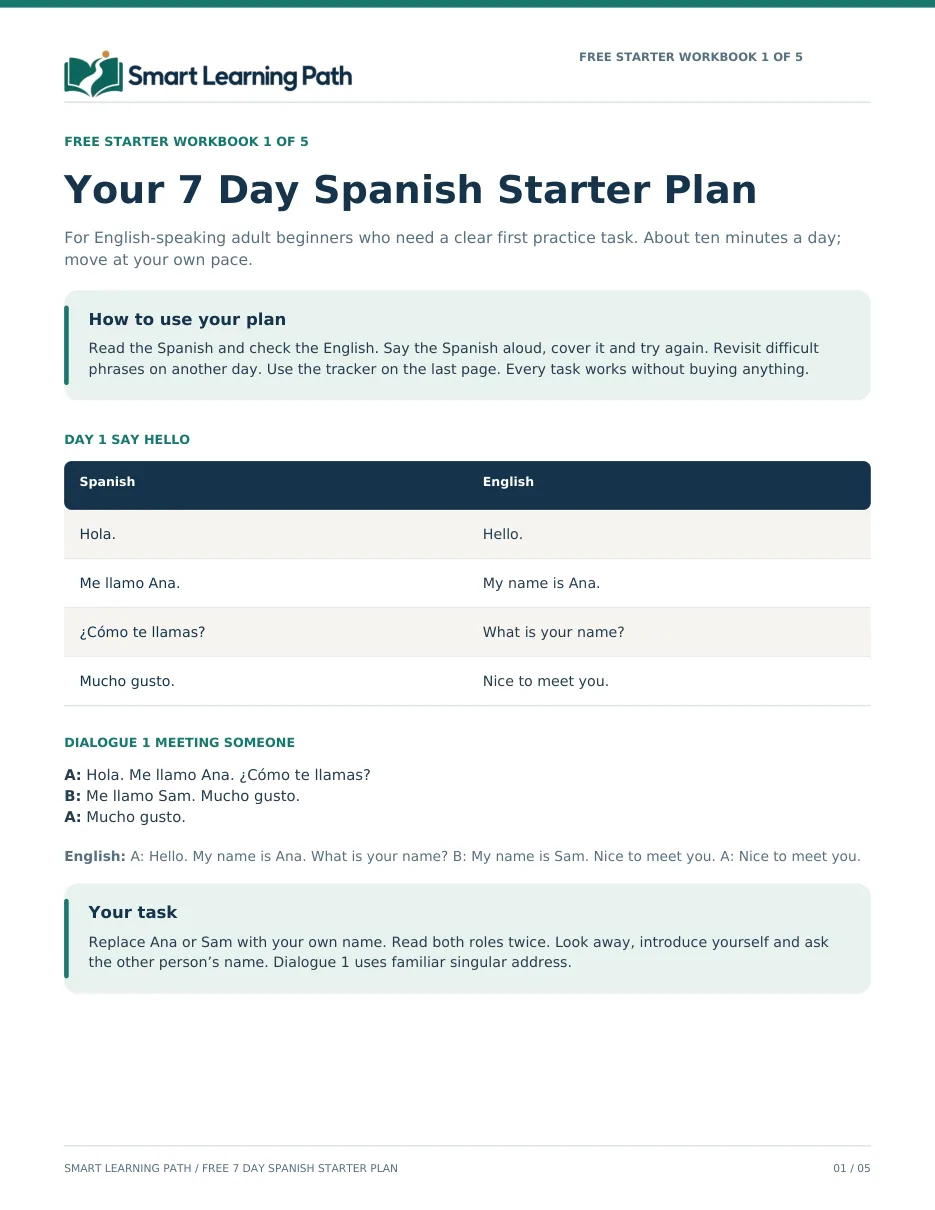
Tonight’s task: open Day 1 of the free plan, read the four phrases aloud twice, then once with the page closed.

Practise with a seven-day plan.
The free 7 Day Spanish Starter Plan gives you a pronunciation day, seven days of phrases with a dialogue, a listening task and recall prompts, three goal tracks, an answer key and a tracker, 10 to 15 minutes a day. Use it on the web or download the 18-page PDF.
The complete plan is free and open on the web. Enter your email for the printable copy.
The map: seven plan days across six weeks.
The order stays as the plan sets it. Nothing is skipped; week 6 holds the plan’s recall day and its three role plays.
| Week | Plan day | The scene | What you say aloud |
|---|---|---|---|
| 1 | Day 1 | Say hello | Hola. Me llamo… Mucho gusto. |
| 2 | Day 2 | Ask someone to repeat | Perdón. ¿Puede repetir, por favor? |
| 3 | Day 3 | Your own introduction | Me llamo… y soy de… |
| 4 | Day 4 | Order at a café | Un café, por favor. No, gracias. |
| 5 | Day 5 | Ask where things are | ¿Dónde está la estación? |
| 6 | Days 6 and 7 | Recall, then three role plays | Five phrases from memory, then all of it in order |
Inside each week the shape repeats, so you never have to decide what to do at nine at night. That is your daily Spanish practice: ten minutes, one task, said aloud.
| Day | The ten-minute task |
|---|---|
| Monday | Read the week’s phrases aloud twice. |
| Tuesday | Cover the English and say each phrase from the Spanish. |
| Wednesday | Read part A of the dialogue and answer as B. |
| Thursday | The same phrases, faster, notes face down. |
| Friday | Three phrases from this week, two from last. |
| Saturday | Write them by hand, then say them without looking. |
| Sunday | Recall: five phrases, no notes, and note the one that escaped. |
A planning suggestion built on our own free materials, not a tested programme. Move a day if life gets in the way; keep the order.
Weeks 1 and 2: hello, then buy yourself time.
Greetings look too easy, which is why they get skipped, and they are the words most likely to vanish at a doorway.
| Spanish | English |
|---|---|
| Hola. | Hello. |
| Buenos días. | Good morning. |
| Me llamo Ana. | My name is Ana. |
| ¿Cómo te llamas? | What is your name? (familiar) |
| Mucho gusto. | Pleased to meet you. |
Register matters. ¿Cómo te llamas? is familiar, fine with people your own age; with a landlord or a new colleague ask ¿Cómo se llama?. A man says Encantado; a woman says Encantada.
Week 2 answers your worst-case scene. People switch to English because the pause has stretched, not because your Spanish is hopeless. One polite question buys a second hearing: Perdón. ¿Puede repetir, por favor? ¿Puede hablar más despacio, por favor? No entiendo. Use puede, the polite form. The free Conversation Rescue Card keeps the set on two printable pages.
Weeks 3 and 4: your own introduction, then a coffee.
Day 3 asks you to make the introduction your own, which is the version you will use at work.
| Spanish | English |
|---|---|
| Me llamo… y soy de… | My name is… and I am from… |
| Trabajo en tecnología. | I work in technology. |
| Soy gerente de proyectos. | I am a project manager. |
| Me mudé a la Ciudad de México. | I moved to Mexico City. |
Keep each sentence short and stop. Me mudé is past tense: I moved. A short true sentence beats a long half-remembered one.
Week 4 is the café: the scene you picture when you imagine embarrassing yourself.
A: Un café, por favor. · B: ¿Algo más? · A: No, gracias. · B: Aquí tiene. · A: Gracias.
A: A coffee, please. B: Anything else? A: No, thank you. B: Here you are. A: Thank you. An original practice dialogue from the free plan, not a recorded conversation.
Swap one detail per session: Un té, por favor. or Un vaso de agua, por favor. Later in the week, read only your part and let the English stand in for the other speaker. For more on this scene, see ordering coffee in Spanish.
Weeks 5 and 6: find your way, then put it together.
Day 5 is two questions: ¿Dónde está la estación? and ¿Dónde está el baño? Put Perdón in front and the question sounds polite even when your accent is thick. Learn the answers too: a la derecha, a la izquierda, and straight on — todo recto in Spain, more often todo derecho in Mexico. Use whichever you hear.
Week 6 is consolidation. Day 6 is a recall day: five phrases, page closed. Not ten. Then Day 7, which is all speaking, one role play per session.
Greet a neighbour.
Week 1’s lines, plus a clarification question if the answer comes too fast.
Order at a café.
Both parts, then your part alone with the drink swapped.
Ask for the station.
Perdón first, then repeat the answer back.
Finish with the plan’s self-check: which three phrases came out without the page, and which one still needed it? Write the difficult one on the printable tracker and make it the first thing you say on your first morning in Mexico City.

What there is to listen to today.
The dialogues here and in the plan are written, not recorded — better to say that now than let you find out at the end. A written dialogue still trains the mouth and the ear in this order: read both parts aloud slowly, read them again at normal speed, read only your part, then close the page and say it once from memory. That is the closest thing to a slow pass and a normal-speed pass you can do alone today. Nothing here records your voice: no microphone, no score.
Why the recall days earn their place.
The US Institute of Education Sciences practice guide Organizing Instruction and Study to Improve Student Learning recommends spacing learning over time and using quizzes to re-expose learners to key content. That is the shape here: the greetings return in weeks 5 and 6 with a little less support each time. The aim is not a score; it is a phrase that arrives when someone is standing in front of you. The 10 Minute Practice Planner puts this weekly template on two pages, and our guide to spaced practice explains why the gaps help.
“I have been burned by apps. What is different here?”
Here is what you can use in the next ten minutes.
- Seven days you can read in full, free. Both dialogues, the tracker and the self-check sit on one web page. No account, no install.
- Every task ends in a sentence said aloud. No streak to protect and no points to collect, so the only thing you can miss is a day, and the timetable absorbs that.
- Our own materials, checked by our editors. No independent teacher review yet; the Editorial Policy says how pages are checked.
Two limits worth knowing. The PDF and Word downloads open a short form (first name and email); the plan email follows, with four more on days 2, 4, 7 and 10, and every email has an unsubscribe link. The options on the pricing page — a toolkit, a four-week course, a membership — are planned and not open: no checkout, nothing starts automatically. If you never buy anything, the free pages still work exactly as described.
Common questions.
How do I build a Spanish self study plan in six weeks?
Take one scene a week from the free 7 Day Spanish Starter Plan, keep the days in order, and give each session ten minutes and one speaking task. End each week with five phrases said with no notes.
What should a study plan to learn Spanish include?
Named speaking tasks rather than a list of grammar topics: what you will say, to whom, and how many times. A learning Spanish study plan with no speaking tasks is a reading list.
How much daily Spanish practice is enough before a move?
Ten minutes a day fits around a job and a house move. Progress varies from person to person, so treat the minutes as the part you control.
Do I need an account or a microphone to follow this?
No. The plan and this article are ordinary web pages. Nothing records your voice and there is no streak to keep. Only the downloadable files ask for a first name and email.
Is there audio for the dialogues?
Not yet. The dialogues are written examples, not recordings. Read both parts aloud slowly, again at normal speed, then your part alone with the page closed.
Practice, not a promise. These tasks help you rehearse everyday Spanish at your own pace. Individual progress varies; nothing here promises a level, a qualification or a fixed learning speed. How we write and check our Spanish
Sources and editorial notes
- Smart Learning Path, 7 Day Spanish Starter Plan (Days 1 to 7, both dialogues and the page 5 tracker), Conversation Rescue Card and 10 Minute Practice Planner: our own free materials.
- Institute of Education Sciences, What Works Clearinghouse, Organizing Instruction and Study to Improve Student Learning (space learning over time; use quizzes to re-expose learners to key content), retrieved October 18, 2026.
- Real Academia Española and ASALE, Diccionario panhispánico de dudas, “tilde” (the written accent on interrogatives such as dónde), retrieved October 18, 2026.
Examples are illustrative, and the six-week spread is a planning suggestion from our own materials. Spanish checked by our editors; no independent teacher review yet. See our Editorial Policy. Spotted a mistake? Suggest a correction.
Related reading.
Back to the blog7 Day Spanish Starter Plan
Pronunciation, seven days with audio, goal tracks and an answer key. Free and open.
Remember Spanish Phrases with Spaced Practice
Revisit phrases on later days to keep them.
A 10-Minute Spanish Practice Routine
Read, cover, say, check, and repeat.
Start week one tonight.
Day 1 is four phrases and one short dialogue. Ten minutes, and nothing to install.
No account or payment needed.