
Getting started
How to start learning Spanish: your first seven days.
Choose one useful goal, try a short greeting and build a practice routine you can repeat. About ten minutes a day, at your own pace.
One situation
Pick one everyday moment.
About ten minutes
Adjust the time to fit your day.
Practice first
Not a fluency promise.
Choose a moment that matters.
Many adult beginners stall because Spanish feels enormous. Start with one small interaction you actually want to manage: introducing yourself, ordering a drink or asking where something is. Keep the first goal narrow enough to try today.
Think about why you are learning. A trip, a move abroad or a partner’s family each suggests a different first conversation. Write your goal in one sentence.
My first goal: introduce myself and ask someone’s name.
Practise with a seven-day plan.
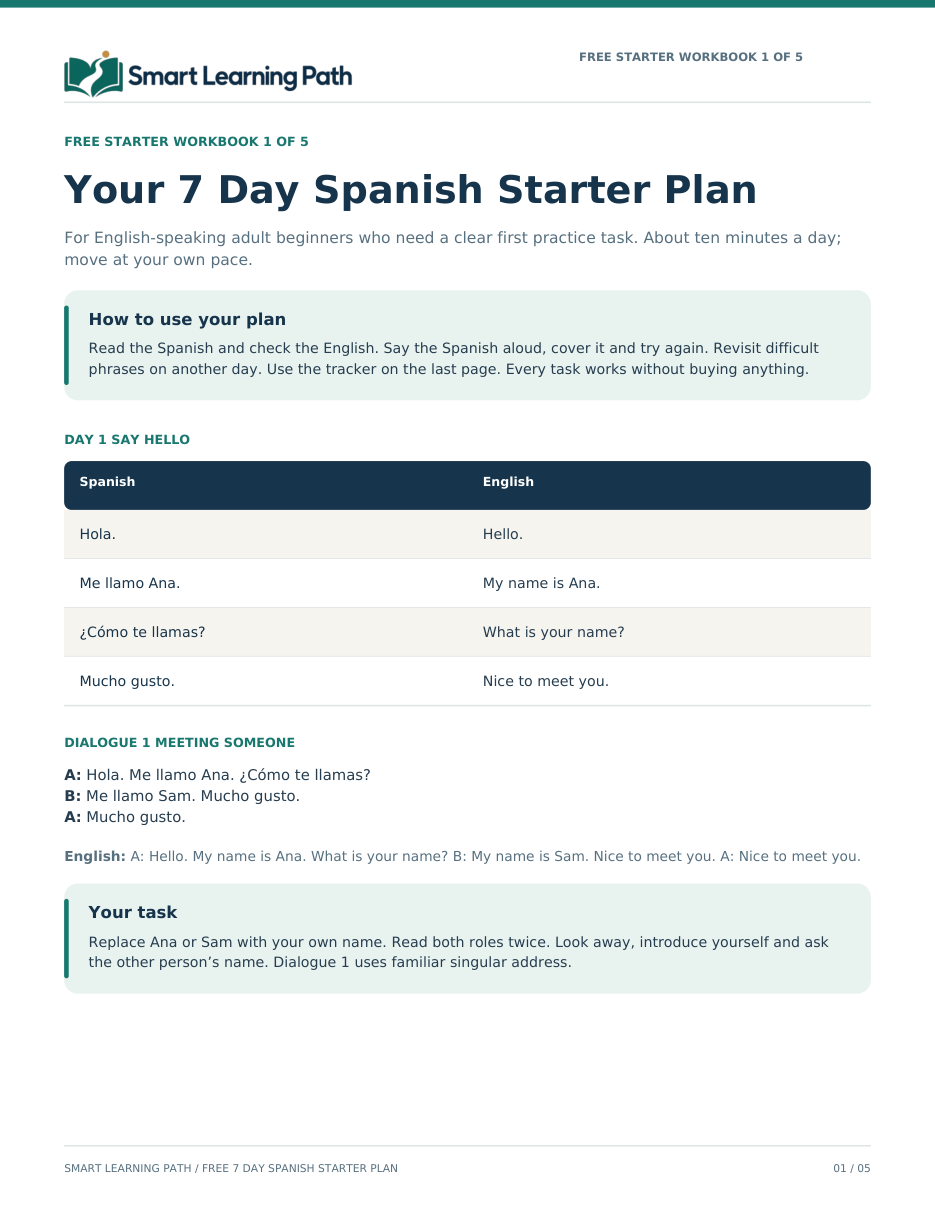
The free 7 Day Spanish Starter Plan gives you seven short tasks, two dialogues and a tracker, about ten minutes a day. Open it on the web or download the 5-page PDF.
The complete plan is free and open. No account or email needed; an emailed copy is optional.
Try your first greeting.
Four phrases are enough for a first short exchange. Read the Spanish, check the English and say each phrase aloud.
| Spanish | English |
|---|---|
| Hola. | Hello. |
| Me llamo Ana. | My name is Ana. |
| ¿Cómo te llamas? | What is your name? |
| Mucho gusto. | Nice to meet you. |
Replace Ana with your own name. Read the phrases aloud, cover them and try again. Notice the opening question mark in ¿Cómo te llamas?: Spanish marks where a question begins as well as where it ends.
The name question uses familiar singular address (tú, shown by te), the usual choice in relaxed, friendly settings. A polite version is in our greetings guide.
Give each day one simple task.
A plan removes the daily question of what to practise. Each task in the free plan builds on the one before.
| Day | Focus | What to try |
|---|---|---|
| 1 | Say hello | Introduce yourself and ask a name. |
| 2 | Ask for clarification | ¿Puede repetir, por favor? (Can you repeat, please?) |
| 3 | Make it your own | Repeat the introduction using your name. |
| 4 | Order politely | Un café, por favor. (A coffee, please.) |
| 5 | Ask a question | ¿Dónde está la estación? (Where is the station?) |
| 6 | Recall | Use five English prompts and check your Spanish. |
| 7 | Role play and reflect | Meet someone, order a drink and ask for help. |
Open the full plan from Day 1 for both dialogues and every instruction. Repeat a day whenever it helps.
Make a routine that fits your day.
Here is a ten-minute routine, taken from the free 10 Minute Practice Planner. Adjust it to fit your time.
2 minutes: read and say.
Read your two phrases, check their meaning and say them aloud.
3 minutes: cover and recall.
Cover the Spanish, recall it, check and try the difficult phrase again.
3 minutes: try both roles.
Use the phrases in a short role play: ask, then answer.
2 minutes: note and review.
Record the attempt and choose a phrase to revisit on another day.
Coming back to a phrase on a later day, and trying to recall it before you look, are both habits that education research has examined. A US Department of Education practice guide recommends spacing learning over time and using quizzes to re-expose learners to key content. Our routine borrows those ideas in a very small way; it is a flexible planning example, not a promise about learning speed. If ten minutes does not fit, choose one phrase and a shorter slot.
Put it together in a short dialogue.
A: Hola. Me llamo Ana. ¿Cómo te llamas? · B: Me llamo Sam. Mucho gusto. · A: Mucho gusto.
A: Hello. My name is Ana. What is your name? B: My name is Sam. Nice to meet you. A: Nice to meet you. An original practice dialogue, not a recorded conversation.
Read both roles twice. Personalise them with your own name, then look away and say your part. Note one phrase you want to repeat tomorrow.
Check what you can recall.
Use these quick checks to see what you can do today. A difficult phrase is a useful choice for your next session; this is not a proficiency test.
- I can greet someone.
- I can say my name.
- I can ask a name or request repetition.
Your task: say “Hola. Me llamo…” with your name. Then ask “¿Cómo te llamas?” Look back to check, and choose when you will try again.
Common questions.
Do I need a textbook or an app to start?
No. You can start with four greeting phrases, a short dialogue and ten minutes a day. The free seven-day plan has everything on one page.
What if I miss a day?
Continue at your next available practice time. Repeat the last day you finished before moving on.
How do I know if I am making progress?
Use the self-check: did you need the example, a small prompt, or could you say it from memory? This is practice, not a fluency test.
Practice, not a promise. These tasks help you rehearse everyday Spanish at your own pace. Individual progress varies; nothing here promises a level, a qualification or a fixed learning speed. How we write and check our Spanish
Sources and editorial notes
- Smart Learning Path, 7 Day Spanish Starter Plan and 10 Minute Practice Planner (our own free workbook materials).
- Real Academia Española and ASALE, Diccionario panhispánico de dudas, “tú” (informal address), retrieved October 18, 2026.
- Real Academia Española and ASALE, Diccionario panhispánico de dudas, “signos de interrogación y exclamación”, retrieved October 18, 2026.
- Institute of Education Sciences, What Works Clearinghouse, Organizing Instruction and Study to Improve Student Learning (practice guide), retrieved October 18, 2026.
Examples are illustrative. Spanish checked by our editors. See our Editorial Policy. Spotted a mistake? Suggest a correction.
Related reading.
Back to the blogSpanish Greetings for Your First Conversation
Key phrases and when to use them.
A 10-Minute Spanish Practice Routine
Read, cover, say, check, and repeat.
Free Practice Tools
The Conversation Rescue Card and the 10 Minute Practice Planner.
Try one useful task.
Open the free seven-day plan and practise about ten minutes a day, at your own pace.
No account or payment needed.