
Practice habits
Track Spanish progress with a backlog, not a streak.
Points and streaks record taps. A backlog records what you can say. Here is a one-page way to log ten real situations, set a definition of done for each 10-15 minute block, and review the lot in one line a week.
A streak counts taps. You need situations.
Points, streaks, a cartoon character who is very pleased with you. Then the plane lands, someone at the counter asks a question at normal speed, and your mouth is empty. The app said you were doing well. The room says otherwise.
That gap is not a discipline problem. It is a reporting problem. If you run projects, you know the difference between hours logged and a deliverable signed off. A streak is hours logged: it records that the app was open, not that you can say something to a person.
A backlog records the other thing. Ten rows on one page, each row a real situation you will meet after you land, each row with a definition of done. You work a row in 10-15 minutes, mark it, and by Friday the page tells you something true about what comes out of your mouth.

The backlog: ten rows from your own calendar.
Start from the diary, not from a syllabus. What will you actually do in your first month? Order the rows by when you meet them, because the near ones deserve the practice time.
| Scenario | When you meet it | Status |
|---|---|---|
| Café counter | Week 1, most mornings | In progress |
| Ride from the airport | Arrival day | To do |
| Pharmacy | Week 1 | To do |
| Landlord at the door | Weeks 1-2 | To do |
| First Monday at the office | Day one of work | To do |
Sample rows for illustration. Yours come from your own month.
Ten rows is plenty. Twenty is a wish list, and a wish list is what you already have in the app. Every row should name a place and a person, so you can picture the moment and rehearse it properly.
Then give each row its three phrases, starting with the ones you will say first:
| Spanish | English |
|---|---|
| Un café, por favor. | A coffee, please. |
| La cuenta, por favor. | The bill, please. |
| Al centro, por favor. | To the centre of town, please. |
| ¿Cuánto cuesta? | How much is it? |
| ¿Tiene algo para el dolor de cabeza? | Do you have anything for a headache? |
| ¿Puede repetir, por favor? | Can you repeat, please? |
Notice the last one. Two rows in your backlog are repair rows, and ¿Puede repetir, por favor? does more work than any other phrase there, because every other row depends on it. ¿Puede…? is the polite singular, used with usted: the safe default with a stranger behind a counter or someone at an official desk. With friends and family you would say ¿Puedes…?
Every block needs a definition of done.
A block is not finished because the timer ran out. It is finished when three things exist and you can point at them.
| Part of the block | What you do | Done when |
|---|---|---|
| Three phrases | Read each phrase, check the English once, then say it aloud. | All three come out from the English side with the Spanish covered. |
| One dialogue | Say both parts aloud: your line, the likely reply, your answer. | You get through it twice without stopping to read. |
| One self-check line | Write the phrase that stumbled and the day you will run this row again. | One line is in your notes, with a day attached. |
A sensible size, not a rule. Two phrases said aloud beat six recognised on screen.
The dialogue is the part people skip, and it is the part that matters. Un café, por favor on its own is a line. Answering ¿Algo más? and closing with La cuenta, por favor is a conversation, and the reply is the half you cannot control. If your row has no dialogue yet, write four lines in your notes: your line, the likely reply, your answer, the close.
The three steps fit inside the four timers in the 10-minute Spanish practice routine: read and say, cover and recall, role play, note one thing. Use the card to keep time; the definition of done is what makes the block count.
A worked row: the café counter.
One row, filled in, so you can see how small a row is meant to be. Three phrases, one dialogue, one line of notes.
You: Un café, por favor. · Staff: ¿Algo más? · You: No, gracias. · Staff: Aquí tiene. · You: Gracias. ¿La cuenta, por favor?
You: A coffee, please. Staff: Anything else? You: No, thank you. Staff: Here you are. You: Thank you. The bill, please. An original practice dialogue, not a recorded conversation; a real café may go differently.
Done when: you can order, answer ¿Algo más? with No, gracias, and ask for the bill, twice, with the page covered. Self-check line: La cuenta, por favor came out slowly on the first run, so run it again on Thursday. Status: in progress until the second run.
Want milk? Ask for un café con leche. The café scenario has this exchange with audio at slow and normal speed, and Day 4 of the seven-day starter plan is the same counter.
Self-check in three levels, not a score.
You do not need a test. You need to know how the phrase came out, so that next week you know whether to move the row on or run it again. Mark the lowest level that was true during the block.
- With the phrase in front of me
- With a small prompt, such as the first word
- From memory, out loud
A phrase counts as from memory only if you did not glance at it first in that attempt. That rule is what stops the page flattering you. It is also why a backlog beats a streak: a streak cannot tell recognition from recall.
Progress here is a row moving from To do to In progress to Done, or one phrase moving up a level. Nothing else needs counting. If a row sits in progress for three weeks, split it: the café counter becomes order, then pay, then ask a question.

One review line a week.
Ten minutes, same slot each week. Read the backlog, then write one line: what moved, and what you will run next.
| Week 1 | Café counter: from memory, twice, page covered. Next: pharmacy. |
|---|---|
| Week 2 | the row that moved, and the row for next week |
| Week 3 | the row that stalled, and the piece you will split off it |
A sample format, not a template to copy exactly.
Two questions do all the work. What moved? Name the row and the level. What is next? Name one row only; a review that lists five next actions is a review you will skip next Sunday.
Spacing rows across weeks is not laziness. The IES practice guide Organizing Instruction and Study to Improve Student Learning recommends spacing study over time and testing yourself with active retrieval rather than rereading, and both fit a backlog naturally. It was written for school subjects, so treat it as a sensible principle, not evidence about your page.
You have been burned before. Fair.
A free site that hands you a seven-day plan and then pushes a course is a real pattern, so check this one before you give it an evening.
Free in the browser, no account: the plan is written out in full, phrase by phrase, with the café dialogue on Day 4. The ten everyday scenarios have audio at slow and normal speed and a role play for each. Nothing on this page is paid, and none of it needs a microphone.
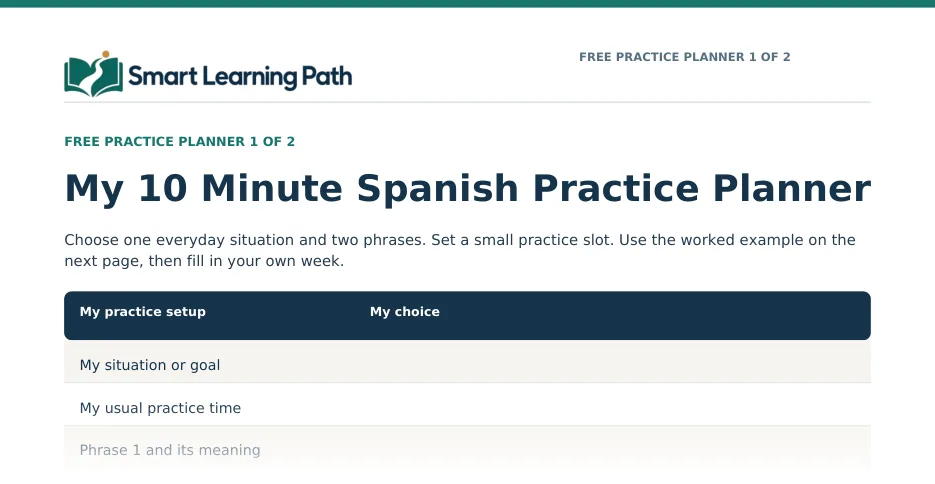
Free files, email asked: the plan, the Conversation Rescue Card and the 10 Minute Practice Planner are PDFs with editable Word copies. A download click opens a sign-up box for a first name and email, and the file comes after you reply to a short confirmation email. That is the only place an address is asked for; the web pages work without it.
What we sell, separately: three phrase packs at $9 each or $19 for all three, and a $49 self-paced course. One-time payments, full refund within 30 days — see pricing and the refund policy. The free practice is complete without either.
What is not here: no tutor, no speaking partner, no feedback on your accent, no exam that grades your level. The Spanish is checked automatically with AI and rule-based checks, with no teacher review. So this page cannot tell you that you sound good. It can only give you an honest record of when a phrase stops needing the page.
Your next task.
Take fifteen minutes now. Write ten rows from your own month, put the repair phrase in two of them, and run the café row once with the timer. Then write one review line, even though nothing has moved yet: that line is what starts the habit.
Practice, not a promise. These tasks help you rehearse everyday Spanish at your own pace. Individual progress varies; nothing here promises a level, a qualification or a fixed learning speed. How we write and check our Spanish
Common questions.
How quickly will I see progress?
The backlog gives you evidence per block, not a timeline. After one block you can say whether three phrases came out from memory; after a few weeks of rows the page shows which situations are done and which still stall. How fast that happens varies by person, and a date on a page cannot change that.
Do I need an app or a file to keep this?
No. A notebook page or a notes file is enough: ten rows with a status, and one review line a week. The free 10 Minute Practice Planner has a printable log if you prefer a form, but the backlog in this article works without it.
Is this another free plan with an upsell at the end?
Nothing on this page is paid. The seven-day plan is written out in full in your browser, the ten scenarios have audio at slow and normal speed, and no account is needed. The paid items are separate and optional: three phrase packs at $9 each or $19 for all three, and a $49 self-paced course, one-time payment with a full refund within 30 days.
Sources and editorial notes
- Content basis: the Smart Learning Path 7 Day Spanish Starter Plan, the 10 Minute Practice Planner and the ten everyday scenarios.
- Institute of Education Sciences, What Works Clearinghouse, Organizing Instruction and Study to Improve Student Learning, retrieved October 18, 2026. Listed recommendations on spacing study over time and on quizzing with active retrieval; the guide was written for school subjects and says nothing about this backlog.
- Usage notes on usted and tú checked automatically with AI and rule-based checks; no teacher review.
The backlog is a way to keep your own record. It does not grade your speaking, outcomes from using it have not been measured, and progress varies. Examples are illustrative. Spanish checked with AI review. See our Editorial Policy. Spotted a mistake? Suggest a correction.
Related reading.
Visit the blogA 10-Minute Spanish Practice Routine
Read, cover, say, check, and repeat.
Remember Spanish Phrases with Spaced Practice
Revisit phrases on later days to keep them.
Spanish Study Plan: Six Weeks Before You Move
Stretch the 7-day method across the weeks you have left.
Ten rows. One line a week.
The seven-day starter plan is written out in full on its page, phrase by phrase, with the café counter on Day 4.
No account or payment needed.