
Getting started
Beginner Spanish phrases: what to learn first.
A short list you can recall beats a long list you can only recognise. Here are twelve Spanish phrases in the order your first week needs them, with a check to pass before you add anything else.
Random vocabulary will not survive week one.
You have a move date, a folder of saved Spanish links and a short study window each day. What you do not have is an order. So the time goes on colours, animals, the days of the week and three ways to say “the pen is on the table” — and none of it is there when someone behind a counter asks ¿Algo más?
That is a sorting problem, not a talent problem. A list organised by grammar or by the alphabet does not match how your first week in Mexico City runs: a greeting, a name, a drink, a question you miss, a price you need twice, and the quiet fear that your mouth will open and nothing will come out.
So this page fixes the order: twelve phrases, a recall check before you add a thirteenth, and one café dialogue that puts them to work.
This week’s task: say all twelve aloud, cover the English and recall the meaning, then cover the Spanish and say each phrase from the English cue. Do not add a thirteenth phrase until ten of the twelve come back without looking.
Practise with a seven-day plan.
The free 7 Day Spanish Starter Plan gives you a pronunciation day, seven days of phrases with a dialogue, a listening task and recall prompts, three goal tracks, an answer key and a tracker, 10 to 15 minutes a day. Use it on the web or download the 18-page PDF.
The complete plan is free and open on the web. Enter your email for the printable copy.
The twelve Spanish beginner phrases, in order.
A short list you can recall beats a long list you can only recognise. Twelve phrases are small enough to say aloud in one sitting, and wide enough to carry a greeting, an introduction, an order and a misunderstanding. The order matters: greeting, name, courtesy, then repair, then place and price. Repair phrases come early because in your first month you will need ¿Puede repetir? more often than you expect. Learn each one as a block you can say without building it: No entiendo is three sounds, not a conjugation exercise.
| Spanish | English | Use it when |
|---|---|---|
| Hola. | Hello. | Doorstep, lift, shop counter. |
| Buenos días. | Good morning. | Before midday; Buenas tardes after midday, Buenas noches in the evening. |
| Me llamo Ana. | My name is Ana. | Introducing yourself; swap in your own name. |
| Mucho gusto. | Nice to meet you. | Straight after a name. |
| Por favor. | Please. | Any request. |
| Gracias. | Thank you. | Any time; the usual reply is De nada. |
| Perdón. | Sorry. / Excuse me. | Getting attention or covering a small mistake. |
| No entiendo. | I don’t understand. | When the answer arrives too fast. |
| ¿Puede repetir, por favor? | Can you repeat that, please? | The same moment, politely. |
| ¿Puede hablar más despacio, por favor? | Can you speak more slowly, please? | When the repeat is still too quick. |
| ¿Dónde está el baño? | Where is the toilet? | Any building, first day. |
| ¿Cuánto cuesta? | How much does it cost? | Café, market, till. |
Phrases nine and ten use the polite form: puede, not puedes. The RAE’s Diccionario panhispánico de dudas explains that usted behaves grammatically like a third-person pronoun, so the verb follows the él / ella pattern. With a stranger at a counter or a new colleague, that is the safer choice; switch to tú forms (puedes, ¿Cómo te llamas?) when someone uses them with you first.
Accents and the opening ¿ are part of the spelling, not decoration. The RAE covers the accent that marks question words such as cómo, cuánto and dónde — write them in, even in a text message.
Run the cover-and-recall check.
Reading the Spanish column and nodding is the trap that makes study feel productive. Recognition is not recall, so use a folded sheet of paper, not a screen, for the first pass.
Say all twelve aloud twice.
Spanish first, then the English, so your mouth meets the sounds.
Cover the English.
Read each Spanish phrase and say what it means. Mark any hesitation.
Cover the Spanish.
Read only the English and say the Spanish. This is the pass that counts.
Count, then decide.
Ten or more from memory: add the five phrases below. Fewer: run the same twelve tomorrow and add nothing.
The count is a filter, not a grade. A US Department of Education practice guide recommends spacing learning over time and using quizzes to re-expose learners to key content; this is a five-minute version of that idea, and it is practice, not a fluency test.
1. Hello. · 2. Good morning. · 3. My name is (your name). · 4. Nice to meet you. · 5. Please. · 6. Thank you.
Cover the table and answer these six aloud in Spanish before you check. An illustrative prompt for your own practice, not a test you submit.
Repeat the check after a gap: tomorrow, then in three days, then in a week. Each pass takes less time, and the phrases you keep failing are the ones to say first.
Use them in one café dialogue.
A: Buenos días. Un café, por favor. · B: ¿Algo más? · A: No, gracias. ¿Cuánto es? · B: Cuarenta pesos. · A: Perdón, ¿puede repetir, por favor? · B: Cuarenta pesos. · A: Gracias. ¿Dónde está el baño? · B: Al fondo, a la derecha.
A: Good morning. A coffee, please. B: Anything else? A: No, thank you. How much is it? B: Forty pesos. A: Sorry, can you repeat that, please? B: Forty pesos. A: Thank you. Where is the toilet? B: At the back, on the right. An original practice dialogue, not a recorded conversation; the price is an example, not a price guide.
You did not need a thirteenth phrase to order: Un café, por favor is a drink plus number five, and ¿Cuánto es? asks the same thing as ¿Cuánto cuesta? at a till. Read both parts aloud twice, then read only A and let the English stand in for B. Finally change one detail: Un té, por favor or Un vaso de agua, por favor. Day 4 of the free 7 Day Spanish Starter Plan is this exchange with audio at normal and slower speed, and the café ordering guide walks through it line by line.
What to add once ten come back.
Then add these five. Each reuses a pattern you already have, so the load is one word, not a new structure.
- Un café, por favor. (A coffee, please.) A new noun, the same request.
- La cuenta, por favor. (The bill, please.) For the end of a meal.
- ¿Dónde está la estación? (Where is the station?) The same frame as the toilet question.
- ¿Puede escribirlo? (Can you write it down?) The same puede as phrases nine and ten, handy for addresses.
- Muchas gracias. / De nada. (Many thanks. / You’re welcome.) The polite pair you will hear back.
That is seventeen phrases: a first-week set, not a wish list. Day 1 of the free plan covers the greeting and the name, Day 2 the repair phrases, Day 5 the place questions. The 10 Minute Practice Planner has a seven-day log for a set this size.
Is this another app that gives points, not speech?
Fair question, and it deserves a plain answer rather than a slogan.
- No account, no microphone, no score. The twelve phrases, the check and the dialogue are on this page. Nothing here counts streaks or asks you to speak into your phone to continue.
- The free plan is complete on the web. All seven days of the 7 Day Spanish Starter Plan are readable without signing in, with a dialogue a day at normal and slower speed. The ten everyday scenarios add role plays for a shop, a pharmacy and a building entrance.
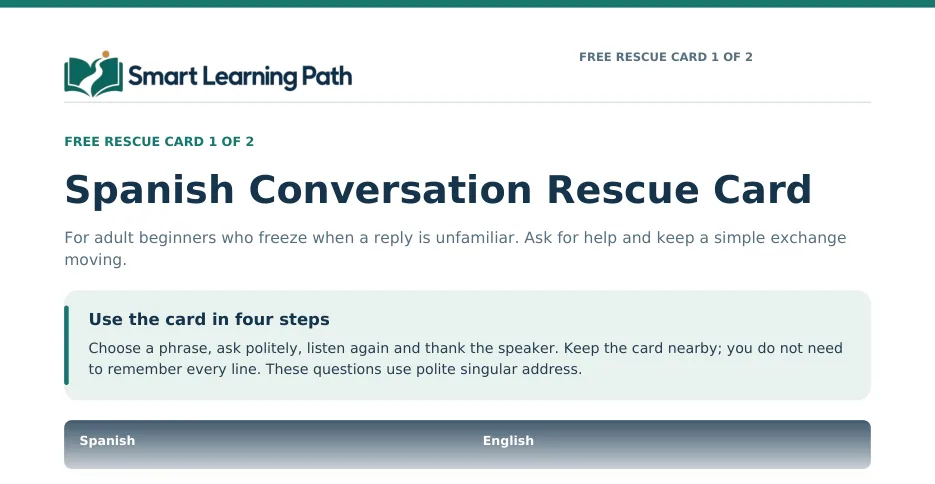
- Downloads are separate from reading. The free Conversation Rescue Card and Practice Planner are PDFs, and a download click opens a short form (first name and email). We send a short email with no link; reply VERIFY and the file follows. Every email has an unsubscribe link.
- Spanish checked automatically. AI and rule-based checks, no teacher review; our Editorial Policy explains exactly what is done.
If you later want more than a page, there are three phrase packs at $9 each or $19 for all three, and the self-paced course Spanish Conversation Foundations is $49 for 28 lessons in 8 modules, with no live sessions, teacher or feedback. Payments are one-time through Stripe, with a full refund within 30 days. See pricing and the refund policy; this page and the seven-day plan work without either.
What this page cannot do is make the first morning easy. Twelve phrases will not carry a whole conversation. What it can do is make the first fifteen seconds predictable, so your mouth has something to do while your ears catch up.
Common questions.
What are the most useful beginner Spanish phrases?
The twelve above, in this order: Hola; Buenos días; Me llamo…; Mucho gusto; Por favor; Gracias; Perdón; No entiendo; ¿Puede repetir, por favor?; ¿Puede hablar más despacio, por favor?; ¿Dónde está el baño?; ¿Cuánto cuesta? Greeting and courtesy come first, repair phrases next, place and price last.
How many beginner Spanish words and phrases do I need before I move?
Twelve phrases are enough to start, plus five additions once ten of the twelve come back without looking. A longer list is not automatically better: what matters is what you can say aloud with the English covered. Needs vary by person and by situation.
Do I need an account or a microphone to use this?
No. The twelve phrases, the check and the dialogue are on this page, and the seven-day plan is readable without signing in. Only the downloadable files ask for a first name and email, and the file arrives after you reply VERIFY to a short email.
Practice, not a promise. These tasks help you rehearse everyday Spanish at your own pace. Individual progress varies; nothing here promises a level, a qualification or a fixed learning speed. How we write and check our Spanish
Sources and editorial notes
- Smart Learning Path, 7 Day Spanish Starter Plan (Day 1 saying hello, Day 2 asking for clarification, Day 4 ordering at a café, Day 5 asking where things are) and 10 Minute Practice Planner (our own free materials).
- Real Academia Española and ASALE, Diccionario panhispánico de dudas, «usted» (usted takes third-person verb forms: ¿Cómo está?, ¿Puede repetir?), retrieved October 18, 2026.
- Real Academia Española and ASALE, Diccionario panhispánico de dudas, «tilde» (the written accent that marks interrogative words such as cómo, cuánto and dónde), retrieved October 18, 2026.
- Institute of Education Sciences, What Works Clearinghouse, Organizing Instruction and Study to Improve Student Learning (practice guide: space learning over time; use quizzes to re-expose learners to key content), retrieved October 18, 2026.
Examples are illustrative. Spanish checked with AI and rule-based checks. See our Editorial Policy. Spotted a mistake? Suggest a correction.
Related reading.
Back to the blogSpanish Greetings for Your First Conversation
Key phrases and when to use them.
How to Ask Someone to Repeat or Slow Down in Spanish
Polite phrases for a fast or unclear reply.
How to Start Learning Spanish as an Adult Beginner
Your first seven days, one small task at a time.
Practise the twelve phrases free.
The 7 Day Spanish Starter Plan is on the web: Day 1 is saying hello, Day 2 is asking someone to repeat, Day 4 is ordering at a café.
No account or payment needed.