
Everyday situations
Follow directions in Spanish by saying them back.
The answer to ¿Dónde está el metro? arrives at full speed and is gone before the first turn. Here are the words inside it, four street chunks, and the sentence that hands an instruction back.
Practice dialogues written for this page, not recordings.
It goes like this. Perdón, ¿dónde está el metro? — that part you can say. Then the answer arrives at full speed: a hand points, a la derecha, a number word you miss, a street name, junto al semáforo. You nod, thank them, walk twenty metres, and stop, because the only part you still have is the nod.
The words were never the problem. A direction answer is one long sound with three or four instructions stacked inside it, delivered by someone who gives it ten times a day. What fixes this is not more vocabulary but a habit: say the answer back — Entonces, ¿a la derecha y luego todo recto? — and let the person confirm or correct it. This page gives you the words inside that sentence, chunks for the streets, and a ten-minute drill you say aloud.
What this page is. A short direction kit: the words you will hear, the sentence that hands an instruction back, and a drill. Free to read, no account, no microphone, and no affiliate links on this page. The site does sell optional extras — three phrase packs at $9 each or $19 for all three, and the $49 self-paced course; the pricing page says what each includes, and nothing here sits behind them.
Your task: hear one direction sentence, say it back with Entonces, ¿…?, and answer four prompts aloud in about ten minutes.
Practise with a seven-day plan.
The free 7 Day Spanish Starter Plan gives you a pronunciation day, seven days of phrases with a dialogue, a listening task and recall prompts, three goal tracks, an answer key and a tracker, 10 to 15 minutes a day. Use it on the web or download the 18-page PDF.
The complete plan is free and open on the web. Enter your email for the printable copy.
What the answer is made of.
A direction answer is short: three or four chunks and a landmark. Todo recto, la segunda calle, a la derecha, en la esquina. It feels like a flood because you are listening for every word instead of the three that carry the route.
Listen for a direction word (derecha, izquierda, recto), a number word (primera, segunda, siguiente) and a landmark (esquina, semáforo, parque). Catch those and you have a route; the rest you can ask about.
| Spanish | English |
|---|---|
| ¿Dónde está el metro? | Where is the metro? |
| A la derecha. | To the right. |
| A la izquierda. | To the left. |
| Todo recto. | Straight ahead. |
| Doble a la derecha. | Turn right. (usted) |
| Dobla a la izquierda. | Turn left. (tú) |
| Cruce la calle. | Cross the street. (usted) |
| En la esquina. / En el semáforo. | At the corner. / At the traffic lights. |
One pair to sort out early: derecha, ending in -a, is the right-hand side, as in a la derecha. Derecho, ending in -o, means straight ahead in Mexico, so todo derecho and todo recto both mean carry straight on. Learn a la derecha and todo recto first and you cannot mix them up.
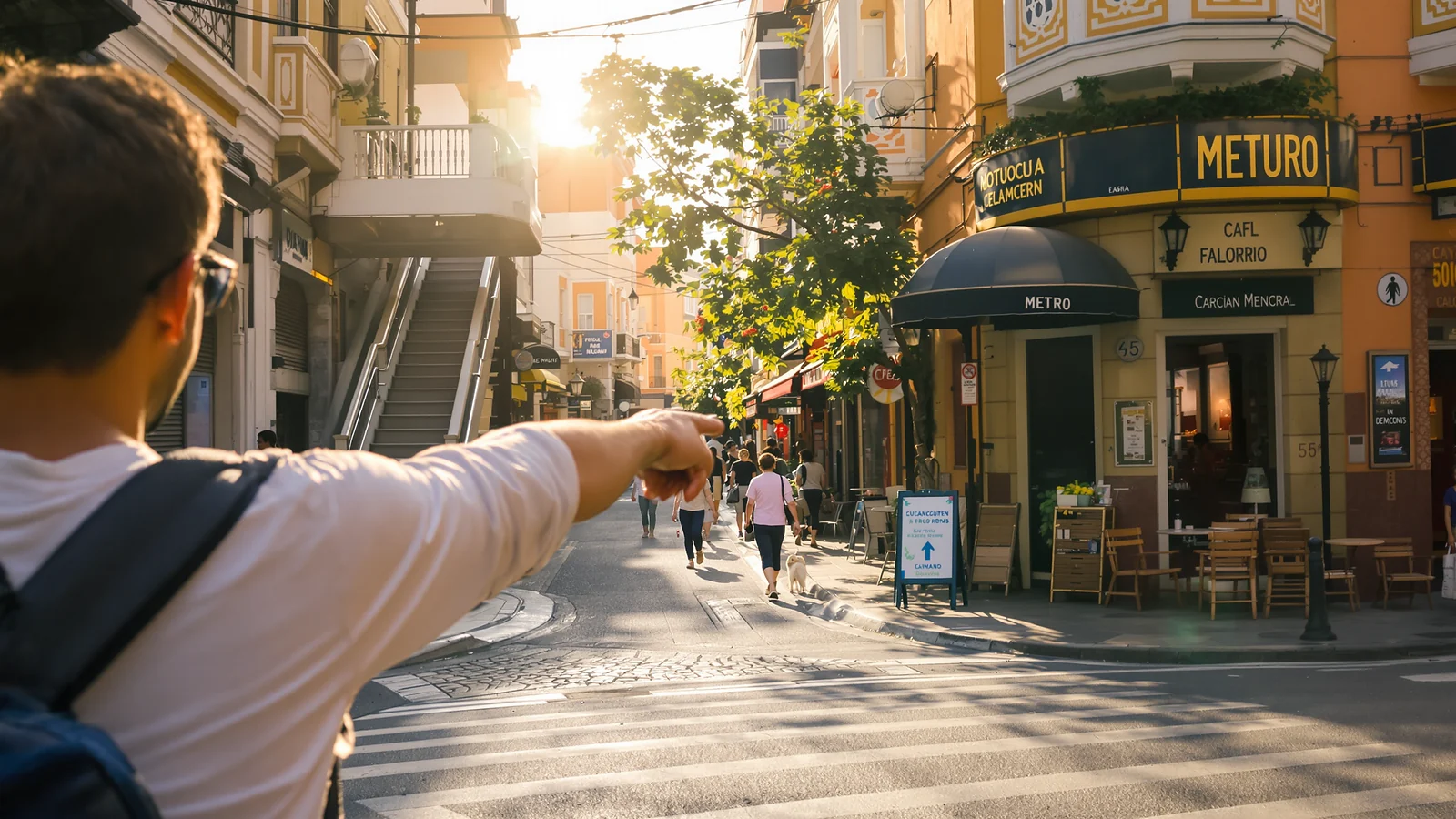
First street, second street, next street.
Most answers put one of these after en: en la primera calle, en la segunda, en la siguiente. The endings carry the meaning, so listen for them rather than for the whole phrase.
| Spanish | English |
|---|---|
| La primera calle. | The first street. |
| La segunda calle. | The second street. |
| La tercera calle. | The third street. |
| La siguiente calle. | The next street. |
| Dos cuadras y luego a la izquierda. | Two blocks and then left. |
| Al lado de la farmacia. | Next to the pharmacy. |
Cuadra is the usual word for a block in Mexico and much of Latin America; in Spain you are more likely to hear manzana. The word for first changes with the noun too: la primera calle but el primer semáforo, la segunda esquina but el segundo cruce.
The sentence that saves the turn.
Here it is whole: Entonces, ¿a la derecha y luego todo recto? — so, right and then straight ahead? Entonces is so or then, a la derecha is to the right, y luego is and then, todo recto is straight ahead. The question lives in your voice: the last word rises.
Say it back even when you are only half sure. Two things can happen. They say Sí, exacto, and now you have heard the route twice. Or they say No, no: la segunda, and the correction is worth more than the first answer, because it is aimed at the exact word you dropped.
| Spanish | English |
|---|---|
| Entonces, ¿a la derecha y luego todo recto? | So, right and then straight ahead? |
| ¿En la primera o en la segunda? | The first or the second? |
| ¿Todo recto hasta el semáforo? | Straight on to the traffic lights? |
| ¿Y después? | And after that? |
| Sí, exacto. | Yes, exactly. |
O sea is very common in Mexico for that is; entonces works everywhere. The point is not to memorise the route. It is to hand the route back and let the other person check it.
Ask for a repeat, or for slower.
Two dials, and they are separate: ask them to say it again, or ask them to say it more slowly. The polite forms use usted, with puede; the familiar forms use tú, with puedes. With a stranger or a shopkeeper in Mexico, polite is the safe default.
| Spanish | English |
|---|---|
| ¿Puede repetir, por favor? | Could you repeat that, please? (usted) |
| ¿Puedes repetir, por favor? | Could you repeat that, please? (tú) |
| ¿Puede hablar más despacio, por favor? | Could you speak more slowly, please? |
| Más despacio, por favor. | More slowly, please. |
| ¿Puede escribirlo, por favor? | Could you write it down, please? |
Despacio is the everyday word for slowly; lentamente is correct but sounds stiffer in a street conversation. You may also meet Repite después de mí (tú) or Repita después de mí (usted), repeat after me. That is a classroom instruction, used when someone is drilling a phrase with you; a stranger on the pavement will simply say the route again. A fuller set is in the repeat-and-slow-down guide.
A practice dialogue, start to finish.
Here the loop does its work. The answer is deliberately long, the way a real one can be, and the repeat-back picks out the part that matters. This is an illustrative practice dialogue written for this page, not a recording.
| Original practice dialogue | English |
|---|---|
| Usted: Perdón, ¿dónde está la farmacia? | Excuse me, where is the pharmacy? |
| Vecino: Siga todo recto y doble a la derecha en la segunda calle. | Carry straight on and turn right at the second street. |
| Usted: Entonces, ¿todo recto y a la derecha en la segunda? | So, straight on and right at the second? |
| Vecino: Sí, exacto. Y luego a la izquierda en la esquina. | Yes, exactly. And then left at the corner. |
| Usted: ¿Puede repetir lo de la esquina, por favor? | Could you repeat the part about the corner, please? |
| Vecino: Claro. La farmacia está a la izquierda, en la esquina. | Of course. The pharmacy is on the left, at the corner. |
| Usted: Perfecto, muchas gracias. | Perfect, thank you very much. |
You never repeat the whole route. You repeat the part you caught and ask about the rest, and the conversation stays in Spanish instead of sliding into English.

Rehearse it out loud.
Ten minutes, nothing but your voice. Reading the dialogue silently will not do it; the sentence has to leave your mouth.
Read both parts aloud once.
Neighbour and visitor, every line, so the rhythm is in your mouth.
Cover the answers and loop back.
Hide the visitor’s lines. Read each neighbour line aloud, answer with Entonces, ¿…?, then check.
Repeat on three separate days.
Not three times tonight. Three short rounds across a week, each starting from memory.
Cover the tables and answer these four out loud.
| English prompt | Your Spanish |
|---|---|
| Straight on, then right at the second street. | your phrase |
| So, left and then straight ahead? | your phrase |
| Could you repeat that, please? (polite) | your phrase |
| More slowly, please. | your phrase |
Check your answers: Todo recto y a la derecha en la segunda calle. · Entonces, ¿a la izquierda y luego todo recto? · ¿Puede repetir, por favor? · Más despacio, por favor.
- I can say four direction words without looking.
- I can repeat an instruction back with Entonces, ¿…?
- I can ask for a repeat and for slower speech.
So how is this different from an app?
Fair question, and a specific answer beats a slogan.
- No points, no streaks, no account. The page reads in the browser, and the 7 Day Spanish Starter Plan is complete on its own web page, so you can read Day 5 before deciding whether you want the PDF by email.
- The spoken part is the exercise. You are not tapping the right tile; you are saying four sentences with the page closed. Nobody here can hear you do it, and nobody hands out a badge.
- The paid side is small, separate and priced in public. Three phrase packs at $9 each or $19 for all three, and the $49 self-paced course, one-time payment with a full refund within 30 days (refund policy). There is no teacher, no live session and no feedback on your voice.
On audio: the dialogue above is written, not recorded. If you want a voice to copy, the free 120-phrase practice deck has Play links on its cards, and the free Conversation Rescue Card links each rescue phrase to its own MP3. What this page cannot do is stand at the corner with you. Ten minutes of saying the loop aloud is practice, not a fluency test.
One next step.
Tonight, say the loop out loud five times with nothing in front of you: Entonces, ¿a la derecha y luego todo recto? Then swap the words — a la izquierda, en la segunda, hasta el semáforo — so the sentence is a frame, not one fixed line. Tomorrow, rehearse the question that starts the whole exchange.
Rehearse asking for directions
Also useful, one link each: Day 5 of the free 7 Day Spanish Starter Plan for ¿Dónde está la estación? and ¿Dónde está el baño?, and the Conversation Rescue Card for the repeat-and-slow-down lines on one printable page.
Common questions.
How do you say can you repeat that in Spanish?
¿Puede repetir, por favor? is the polite form, with usted. With a friend or someone your own age, ¿Puedes repetir, por favor? Short and just as useful: ¿Otra vez, por favor?
How do you say repeat slowly please in Spanish?
¿Puede hablar más despacio, por favor? means could you speak more slowly, please. Shorter: Más despacio, por favor. Despacio is the everyday word; lentamente sounds more formal.
What does repeat after me mean in Spanish?
Repite después de mí (tú) or Repita después de mí (usted). It is a classroom instruction, not something a stranger giving directions will say.
Is it derecho or derecha?
Derecha, ending in -a, is the right-hand side: a la derecha. Derecho, ending in -o, means straight ahead in Mexico, as in todo derecho. Todo recto is understood everywhere.
Practice, not a promise. These tasks help you rehearse everyday Spanish at your own pace. Individual progress varies; nothing here promises a level, a qualification or a fixed learning speed. How we write and check our Spanish
Sources and editorial notes
- Smart Learning Path, 7 Day Spanish Starter Plan (Day 5, finding your way: ¿Dónde está la estación? and ¿Dónde está el baño?), our own free material.
- Smart Learning Path, Spanish Conversation Rescue Card (the rescue phrases, including ¿Puede escribirlo?, each linked to its MP3), our own free material.
- Smart Learning Path, 120-Phrase Practice Deck (cards with Play links for listening), our own free material.
All dialogues on this page are illustrative practice examples written for this page, not recordings of real conversations, and the directions are examples rather than routes to a real place. Regional notes (cuadra, manzana, todo derecho, o sea) describe common usage and vary by country and by street. Spanish checked with AI review. See our Editorial Policy. Spotted a mistake? Suggest a correction.
Related reading.
Back to the blogHow to Ask for Directions in Spanish
Questions that get short answers, plus a repeat-back move.
Understand Directions in Spanish at Real Speed
Catch left, right and the street name before you turn.
How to Ask Someone to Repeat or Slow Down in Spanish
Polite phrases for a fast or unclear reply.
Try one useful task.
Open the free seven-day plan and practise about ten minutes a day, at your own pace.
No account or payment needed.