
Everyday situations
How to ask for directions in Spanish and keep the answer.
The question is easy. The answer arrives at full speed with two turns and a street name in it. Here is how to ask so the reply comes back short — and what to say while it is still in the air.
Original practice dialogue, written for this page. Not a recording.
You stop someone outside the metro and say the line you rehearsed: Disculpe, ¿dónde está la estación? The answer comes back friendly and fast — Siga derecho dos cuadras y doble a la izquierda en el semáforo — and by the time you have nodded, the first turn is gone.
You caught dos. Maybe izquierda. Now you are walking in a direction you are not sure about, wondering whether to ask someone else or follow the crowd.
The question was never the hard part. The answer is. So this page starts at the other end: ask questions that can be answered with sí, no or a number, then hold the short reply by repeating the key word back and pointing.
What this page is, and what it costs. A script you say aloud: the questions, the words that come back, one dialogue and a recall task. Free to read, no account and no microphone, and there are no affiliate links on this page. Our own optional materials — the planned phrase packs and the planned course — are not on sale yet: the site has no checkout and takes no payments. If an app once gave you points and no speaking, hold this page to the same test: it counts only if you say the lines out loud with the page closed.
Your task: ask whether the metro is far, ask whether you are going the right way, and repeat one instruction back with a point — out loud, in about ten minutes.
Ask a question that ends in sí or no.
Most beginners ask ¿Dónde está…? and get a paragraph back. Put a yes/no question first and the reply gets shorter — often to one word, and one word is something you can hold.
| Spanish | English |
|---|---|
| Disculpe, ¿está lejos? | Excuse me, is it far? |
| Perdón, ¿el metro está cerca? | Pardon me, is the metro near here? |
| ¿Voy bien para el centro? | Am I going the right way for the centre? |
| ¿Voy bien por esta calle? | Am I going right along this street? |
| ¿Está en esta calle? | Is it on this street? |
| ¿Dónde está el baño, por favor? | Where is the toilet, please? |
Disculpe or Perdón comes first, so the person is listening before the useful part arrives. Each question above can be answered with sí, no, más o menos or a number, so the first word of the reply already tells you whether to keep walking. ¿Voy bien para…? is the one to keep — swap the last word for wherever you are heading: ¿Voy bien para el metro?
With a stranger, use the polite usted forms — ¿Me puede decir dónde está la estación? rather than ¿Me puedes decir…? The RAE’s Diccionario panhispánico de dudas describes usted as the formal treatment in both Spain and America, with a note of courtesy and distance: exactly what you want with someone you have stopped in the street.

Left, right and straight: the words that matter.
Three words and a number carry most of the reply.
| Spanish | English |
|---|---|
| a la derecha | to the right |
| a la izquierda | to the left |
| (todo) derecho | straight ahead |
| (todo) recto | straight ahead |
| Siga derecho. | Carry on straight. |
| Doble a la derecha. / Gire a la derecha. | Turn right. |
| en la esquina | at the corner |
| en el semáforo | at the traffic lights |
| dos cuadras | two blocks |
| enfrente del parque | opposite the park |
Watch one pair closely. Derecha means right. Derecho means straight ahead. One letter apart, opposite instructions: Siga derecho means carry on, not turn right. If you remember nothing else from this page, remember that.
Straight on is (todo) derecho or (todo) recto, and you will hear recto very often in Spain. In Mexico a block is una cuadra, to turn is doblar and a junction is el crucero; in Spain you will hear manzana, gire and el cruce. Use whichever you learn first and follow what you hear locally. For the same words at full speed, see understanding directions in Spanish at real speed.
If a number matters and you missed it, repeat it back as a question — ¿Dos? — and read the nod or the shake of the head. Es la primera calle a la derecha (it is the first street on the right) is worth learning as one piece; you can follow it without hearing anything else in the sentence.
Run one exchange, then hold the answer.
Read it once as yourself, then again as the person answering.
| Original practice dialogue | English |
|---|---|
| You: Disculpe, ¿el metro está lejos? | Excuse me, is the metro far? |
| Passer-by: No, está cerca. Unos cinco minutos. | No, it’s close. About five minutes. |
| You: ¿Voy bien por esta calle? | Am I going right along this street? |
| Passer-by: Sí. Siga derecho dos cuadras y doble a la izquierda en el semáforo. | Yes. Carry on straight for two blocks and turn left at the traffic lights. |
| You: ¿Dos cuadras y a la izquierda? (pointing) | Two blocks and left? |
| Passer-by: Sí, exacto. Enfrente del parque. | Yes, exactly. Opposite the park. |
| You: Muchas gracias. | Thank you very much. |
An illustrative practice dialogue written for this page, not a recording or a transcript of a real exchange. Your helper will use their own words.
The line that does the work is ¿Dos cuadras y a la izquierda? — not a whole repetition, just the two pieces you caught, offered back for a yes. If you caught nothing at all, point along the street and ask ¿Aquí?
Four more lines buy you a second hearing, all in the polite usted form:
¿Derecha o izquierda? is the smallest useful question here: two words, one answer. For a street name you cannot catch, ¿Puede escribirlo, por favor? — a name on your phone beats three attempts to hear it. There is more on those lines in how to ask someone to repeat or slow down. And if they answer you in English, say the Spanish word back: ¿A la izquierda? You still leave with the word.
Practise with the page closed.
Reading is not having. Do this once today; it takes about ten minutes.
Say the questions aloud.
Read the six questions from the first table, then say them again without looking. Keep Disculpe at the front; it gives you half a second to breathe.
Answer yourself.
Ask ¿Está lejos? and answer No, está cerca. Then swap them: ¿Está cerca? — No, está lejos.
Repeat one instruction back.
Cover the dialogue, read the long answer aloud, and say back only what you caught: ¿Dos cuadras y a la izquierda?
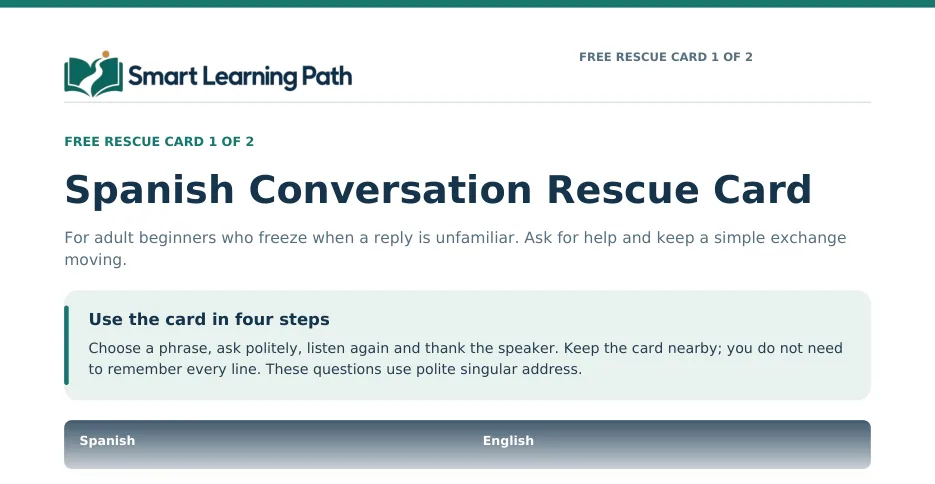
Day 5 of the free 7 Day Spanish Starter Plan is built on ¿Dónde está la estación? and ¿Dónde está el baño?, free to read on the page, with an emailed copy if you want one to print. The free 10 Minute Practice Planner has a seven-day log you can type into or print, and the Conversation Rescue Card collects eight rescue phrases, each linked to a short audio clip.

Cover the Spanish and recall it.
Say each answer out loud before you check it. Pulling the phrase out of memory is the part that helps it stick.
| English prompt | Your Spanish |
|---|---|
| Excuse me, is the metro far? | your phrase |
| Am I going the right way for the centre? | your phrase |
| Two blocks and left? | your phrase |
| How many blocks? | your phrase |
Check your answers: Disculpe, ¿el metro está lejos? · ¿Voy bien para el centro? · ¿Dos cuadras y a la izquierda? · ¿Cuántas cuadras?
- I can ask a direction question that ends in sí or no.
- I can tell derecha (right) from derecho (straight on).
- I can repeat one instruction back and point.
This is practice, not a proficiency test, and nobody is marking you.
One next step.
Do not collect five resources tonight. Open Day 5 of the free plan, read the two questions aloud, and answer them as if someone had just asked you. Then, next time you are out, ask one person ¿Está lejos? — even if you already know the answer. The question is small enough that a wrong guess costs nothing.
For the longer street question, see how to ask for the first turn.
Common questions.
What is a good way to ask for directions in Spanish?
Open with Disculpe or Perdón, then ask something answerable with sí or no: ¿Está lejos? or ¿Voy bien para el centro? Short questions get short answers, and a short answer is one you can repeat back.
What are the direction words in Spanish for left, right and straight?
a la derecha is right; a la izquierda is left. Straight on is (todo) derecho or (todo) recto. Siga derecho means carry on straight — derecha, with an a, means right.
How do I ask how many blocks it is?
¿Cuántas cuadras? A block is una cuadra in Mexico and una manzana in Spain. If you miss the number, repeat it back as a question — ¿Dos?
Practice, not a promise. These tasks help you rehearse everyday Spanish at your own pace. Individual progress varies; nothing here promises a level, a qualification or a fixed learning speed. How we write and check our Spanish
Sources and editorial notes
- Real Academia Española and Asociación de Academias de la Lengua Española, Diccionario panhispánico de dudas, entry on usted (usted as the formal treatment in Spain and America, implying courtesy and a degree of distance), retrieved October 18, 2026.
- Smart Learning Path, 7 Day Spanish Starter Plan (Day 5) and Conversation Rescue Card, our own free materials.
All dialogues here are illustrative practice examples written for this page, not recordings of real conversations. Regional words differ across the Spanish-speaking world, so treat the Mexico and Spain notes as a starting point and follow what you hear locally. Spanish checked with AI review. See our Editorial Policy. Spotted a mistake? Suggest a correction.
Related reading.
Back to the blogUnderstand Directions in Spanish at Real Speed
Catch left, right and the street name before you turn.
How to Ask Someone to Repeat or Slow Down in Spanish
Polite phrases for a fast or unclear reply.
Try one useful task.
Open the free seven-day plan and practise about ten minutes a day, at your own pace.
No account or payment needed.