
Practice habits
Spanish practice when you are tired: one loop, ten minutes.
After a long day, points and streaks do not help you speak. This is a sit-down loop you can run in ten minutes: one phrase, five times aloud, one spoken prompt, one exchange.
The evening your Spanish motivation goes missing.
It is half past eight. The last call is over, the plan needs one more revision, and the only thing you want to do with your mouth is eat. Spanish was the plan for the evening. Instead you tap through the old app, collect something that looks like progress, and close it without having said one sentence out loud.
That is not laziness. Concentrating on a new language is a different job from concentrating on deadlines, and after a full day of the second, the first one loses. The app made it harder rather than easier: its loop was built to be high-energy — points, streaks, a celebration every three taps. It felt like effort. It did not leave you with anything you could say at a café counter in Mexico City.
The fear underneath is specific. You arrive, someone speaks, and nothing comes out — not because you never saw the words, but because your mouth has never produced them. So the useful question is not how to find more motivation. It is this: what is the smallest session that ends with you saying something useful out loud?
The answer on this page is a ten-minute loop you run yourself. One phrase, five repetitions, one spoken prompt, one short exchange. Then you stop.

The loop: one phrase, five reps, one prompt, one exchange.
Sit down, set a timer for ten minutes and follow four steps. The loop asks for one phrase, not a topic. You finish when you have a short exchange you could survive in real life, not when an app tells you the lesson is complete.
| Minutes | Step | What you do | Done when |
|---|---|---|---|
| 0:00 to 2:00 | Pick one phrase | Choose one phrase for a moment you will actually meet this week. Read it, check the meaning once, then leave the list alone. | One phrase is written at the top of your page. |
| 2:00 to 5:00 | Say it aloud five times | Slowly first, then at normal speed. Five times through, not five minutes of reading. | The phrase has left your mouth five times without the page. |
| 5:00 to 8:00 | Answer one spoken prompt | Say the likely question aloud yourself, or play it from an audio dialogue, then answer with your phrase. | You have answered the prompt twice, out loud, without reading. |
| 8:00 to 10:00 | One exchange, then stop | Run the exchange from start to finish: greeting, question, your phrase, the reply, thanks. | You have run it once without stopping, and noted the line that stumbled. |
Timings are a flexible guide, not a rule. A session that ends after step two still happened.
Step two is the one people skip. Reading a phrase five times feels like practice; saying it five times is practice. Speaking is a physical habit as well as a memory, so your mouth needs the phrase before your nerves need it. There is nothing to collect in this loop except the phrase itself.
Worked example: one phrase at a café counter.
Suppose the moment you dread most is ordering coffee. Pick one phrase: Un café, por favor. (A coffee, please.) The question you need to answer is ¿Qué desea?, a polite “What would you like?” used with usted. You do not have to say it yourself; you have to answer it.
| Spanish | English |
|---|---|
| Un café, por favor. | A coffee, please. |
| ¿Qué desea? | What would you like? (polite singular) |
| ¿Algo más? | Anything else? |
| No, gracias. | No, thank you. |
| Aquí tiene. | Here you are. |
| Gracias. | Thank you. |
You: Un café, por favor. · Staff: ¿Algo más? · You: No, gracias. · Staff: Aquí tiene. · You: Gracias.
You: A coffee, please. Staff: Anything else? You: No, thank you. Staff: Here you are. You: Thank you. An original practice dialogue, not a recorded conversation; a real café will word it differently.
In the loop you play both parts. You say ¿Qué desea? aloud, then answer it: two voices, one mouth, ten minutes. It feels odd for the first minute and then it stops feeling odd. The café scenario has this exchange with audio at slow and normal speed, so you can hear the question before you answer it.
If the reply arrives too fast in real life, ¿Puede repetir, por favor? (Can you repeat, please?) is worth a loop of its own. ¿Puede…? is the polite form for a stranger, a server or a landlord; friends and family get ¿Puedes…?. We have a longer walkthrough of the counter question and its usual replies in Qué desea meaning and how to reply.
Spanish practice after work: put the ten minutes where the day already pauses.
Motivation at nine at night is unreliable; a slot that already exists is not. Look for the moment after work when your mouth and hands are doing nothing: waiting for the kettle, sitting in the car before going in, the ten minutes before you open the laptop again.
Then keep two rules.
Sit down for it.
The loop is a sit-down loop: one phrase on paper or screen, said five times. “I will do it while I tidy up” is the sentence that ends most evening sessions.
Shrink before you skip.
If ten minutes is not there, do three: say the phrase five times and stop. Missing an evening needs no catch-up and no restart.
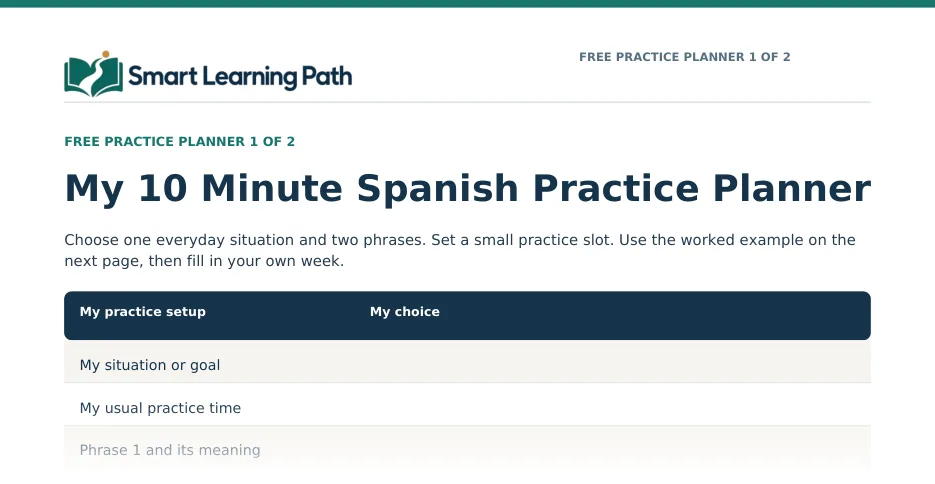
Keep the same phrase for two or three evenings. A phrase you can say without the page is worth more than five you can only recognise, and repetition is the part a game loop tends to skip, because a phrase you already know earns nothing. If you want a longer session later, the free Practice Planner has a printable seven-day log to write the loop into.

A short Spanish practice session that still counts.
What makes a session count is not its length. It is whether you produced Spanish aloud. Three lengths, the same loop:
| Length | What you fit in | What you leave with |
|---|---|---|
| 3 minutes | Steps one and two: one phrase, five times aloud. | The phrase has moved from the page to your mouth. |
| 10 minutes | The full loop, prompt and exchange included. | One usable exchange you could survive in real life. |
| 15 minutes | The loop, then listen to the same exchange at normal speed and answer again. | The question stops surprising you. |
Planning suggestions, not a measured programme. Progress varies, and this is practice, not a fluency test.
- Counts: one phrase said aloud five times, one question answered without reading, one exchange run to the end.
- Feels like practice but is a different task: reading a list of thirty phrases, watching a video with your hands still, protecting a streak.
“Is this just another app with points, then an upsell?”
Fair question, after an app that made you feel productive without making you speak. The honest answer has four parts.
The loop is not a product. Four steps on a page, run with a pen and a phone timer. There is no account to create and no microphone to switch on. Nothing here scores you, so nothing here can hand you a streak.
What it cannot do. A self-run loop gives you repetitions and a script you have rehearsed. It does not give you a person correcting your pronunciation mid-sentence, and it cannot tell you whether your Spanish is good. For that you need another human — a friend, a family member, a tutor — and this page will not pretend otherwise.
What we sell, plainly. This page, the everyday scenarios, the phrase deck and the seven-day plan are free to read in the browser. We also sell our own Spanish phrase packs ($9 each, $19 for all three) and a $49 self-paced course of 28 short lessons, both optional one-time payments with a 30-day full refund. See pricing and learning options and our refund policy. The course has no live sessions and no teacher feedback.
What the email is for. The whole plan is written out on its page, phrase by phrase, with the café dialogue on Day 4: read it in the browser without signing up. An email is asked for only when you want the printable PDF or the editable Word copy. A download click opens a sign-up box for a first name and email, we send a short email, and once you reply VERIFY we email you the file. The gate sits on the file, not on the content.
Start tonight with one phrase.
Before you close this page, choose the phrase and choose the moment. If you are preparing for Mexico City, the two most useful first loops are probably the counter and the doorway. Write one phrase in a note, then run steps one and two now: say it aloud five times.
Tomorrow, run the full ten minutes, prompt and exchange included. The day after, keep the same phrase and let the question arrive a little faster. On day three, change the situation and keep the loop. That is the whole plan for a tired week.
Read the seven-day plan See the practice tools
The plan page is free to read in your browser. An email is only needed for the printable PDF or Word copy.
Practice, not a promise. These tasks help you rehearse everyday Spanish at your own pace. Individual progress varies; nothing here promises a level, a qualification or a fixed learning speed. How we write and check our Spanish
Common questions.
How do I practise Spanish when I am tired after work?
Keep the session smaller than your energy rather than larger than your ambition. One phrase said aloud five times, then one spoken prompt and one short exchange: about ten minutes. Sitting down for it matters, because the plan to do it while tidying up is usually the plan that ends the session.
Is one short Spanish practice session a day enough?
It is enough to move a phrase from the page into your mouth, which is the step most evening sessions skip. It is not enough to cover a language, and progress varies from person to person. A short session you actually run most evenings is worth more than a long one you keep postponing.
Do I need an account or a microphone for this?
No. The loop runs on paper and a phone timer, and every phrase can be said aloud without recording anything. The free seven-day plan is written out in full on its page and can be read in a browser; an email is only needed if you want the printable PDF or the editable Word copy.
How is this different from the app that gave me points and streaks?
The app's loop rewards tapping. This loop rewards saying a phrase aloud five times and answering a question without reading. Nothing here is scored, so there is no streak to protect and no reason to carry on after the useful part is finished. What it cannot give you is a person correcting you; for that you need a real conversation.
Sources and editorial notes
- Content basis: the Smart Learning Path 7 Day Spanish Starter Plan (version 2.2, with the café dialogue on Day 4) and the 10 Minute Practice Planner (version 2.0), both free resources on this site.
- Spanish checked automatically with AI and rule-based checks; no teacher review. The polite usted forms and the familiar tú forms follow the usage used in the free resources.
The loop is a planning suggestion, not a measured programme. Learning outcomes from it have not been measured, this is practice, not a fluency test, and examples are illustrative: a real café, landlord or neighbour may say something different. Spanish checked with AI review. See our Editorial Policy. Spotted a mistake? Suggest a correction.
Related reading.
Visit the blogA 10-Minute Spanish Practice Routine
Read, cover, say, check, and repeat.
How to Practise Speaking Spanish Alone
Role plays and recall prompts without a partner.
How to Ask Someone to Repeat or Slow Down in Spanish
Polite phrases for a fast or unclear reply.
New on this topic: Record Yourself Speaking Spanish: A 90-Second Loop
Ten minutes, one phrase, one exchange.
The seven-day starter plan is free to read in your browser, phrase by phrase, with a café dialogue on Day 4.
No account or payment needed.