
Everyday situations
¿Qué desea? What it means, and how to reply.
One short question from a server, three answers you can produce, and a two-second drill that gets the reply out before the translating starts.
Practice dialogue written by our editors, not a recording.
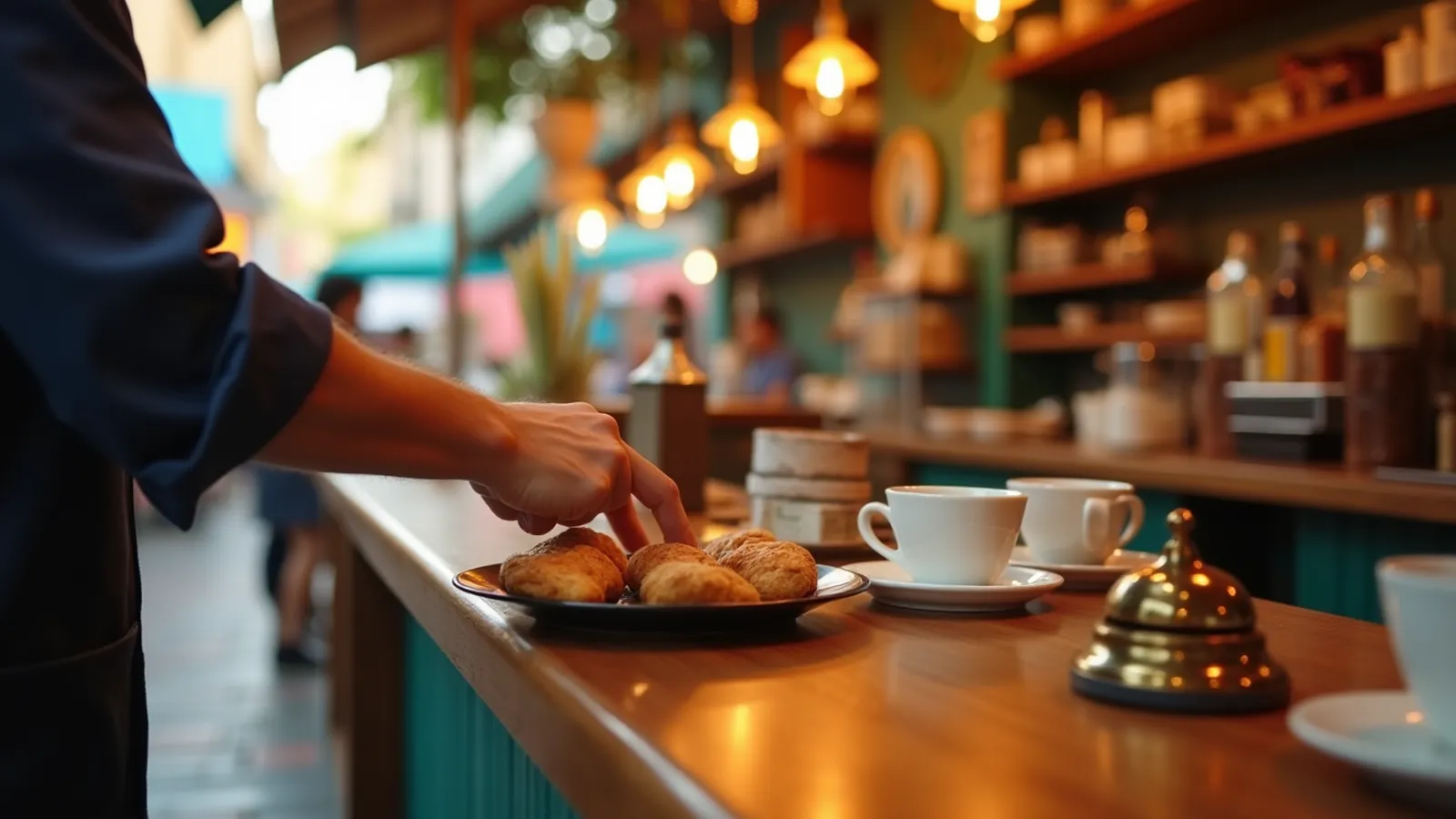
Your streak says 200 days. You know el café, la leche, por favor. Then you reach the counter in Mexico City, the server looks up and says ¿Qué desea? at normal speed, and the Spanish you have been collecting all year is gone.
That blank moment is not a memory problem. Recognising a phrase and producing one are different skills, and the counter tests the second — out loud, with about two seconds to answer. This page is one small repair: what the question means, three replies you can say without translating, and a drill that joins the question to the answer.
What this page is, and who pays for it. One question, three replies and a drill — free to read, no account and no microphone. No affiliate links or sponsorship here. We do plan to sell Spanish practice materials; none are on sale, and nothing on this page depends on you buying anything.
Your task: answer ¿Qué desea? with Un café, por favor, out loud, five times in a row. About ten minutes.
Practise with a seven-day plan.
The free 7 Day Spanish Starter Plan gives you a pronunciation day, seven days of phrases with a dialogue, a listening task and recall prompts, three goal tracks, an answer key and a tracker, 10 to 15 minutes a day. Use it on the web or download the 18-page PDF.
The complete plan is free and open on the web. Enter your email for the printable copy.
Two words, one question.
¿Qué desea? splits into qué (what) and desea (you want, you wish). Together it is the polite question a server asks when it is your turn: what would you like?
| Spanish | English |
|---|---|
| ¿Qué desea? | What would you like? (polite, one person) |
| ¿Qué deseas? | What would you like? (familiar, one person) |
| ¿Qué desean? | What would you like? (two or more people) |
| ¿Qué le gustaría? | What would you like? (softer, also polite) |
Desea comes from desear, to want or to wish, and it takes the third-person form because of usted. The Diccionario panhispánico de dudas notes that usted is grammatically a third-person pronoun, which is why it goes with desea and never with the familiar deseas. Qué keeps its accent because it is a question word; without it, que is a relative pronoun or conjunction — el café que pedí, the coffee that I ordered — and Spanish marks the start of the question with ¿. The question is not impatient, and your answer can be just as short.

Three replies that fit the question.
Under pressure, a full sentence is a trap. Use a short turn that answers the question and stops cleanly.
Each one does a different job. Un café, por favor is the everyday answer: the item, then por favor. Solo un café, gracias adds solo (only) and closes the exchange politely; the word is normally written without an accent now, as the Diccionario panhispánico de dudas explains. ¿Tiene té? turns a question back to them, which helps when coffee is not what you want — a yes is answered with Un té, por favor.
| Spanish | English |
|---|---|
| Un té, por favor. | A tea, please. |
| Un café con leche, por favor. | A coffee with milk, please. |
| Sin leche, por favor. | Without milk, please. |
Keep the shape item + por favor or item + gracias. Nobody at the counter is waiting for a longer sentence.
Illustrative replies; what is available, and what they ask next, changes from café to café.
Hear it, say it: the two-second drill.
The target is not perfect pronunciation. It is answering before the translation starts.
Say the reply on its own, five times.
Un café, por favor. Out loud, at speaking volume, until it stops feeling like a line you are reading.
Join the question to the answer.
Say them as one pair, five times: ¿Qué desea? — Un café, por favor. You are teaching your mouth that the second half follows the first.
Rotate the three replies.
Question, then a different answer each time — the coffee, the solo un café, the tea. That stops the reply becoming a recording you can only play in one order.
Let the question arrive at speed.
Ask someone to say ¿Qué desea? at normal speed while you are not looking, then answer. If nobody is around, say it quickly yourself, then close the page and repeat the three replies from memory.
A: ¿Qué desea? · B: Un café, por favor. · A: ¿Algo más? · B: No, gracias. · A: Aquí tiene.
An original practice dialogue written for this page, not a recording.
Why it arrives as one long sound.
Part of the panic is not vocabulary. At normal speed, Spanish words link together: the end of one word runs into the next and unstressed syllables get squeezed. That linking is ordinary connected speech, and it is why ¿Qué desea? can land as one short lump instead of two clear words.
You do not need every sound, only the shape: the qué at the start, the -ea at the end, and a person waiting. If it will not resolve, keep one rescue question ready: ¿Puede repetir, por favor? It keeps the conversation with you instead of handing it back in English.
What else you may hear at the counter.
One question is rarely the whole exchange. These are likely follow-ups, each with a reply that works.
| You may hear | English | A reply that works |
|---|---|---|
| ¿Qué va a tomar? | What are you having? | Solo un café, gracias. |
| ¿Algo más? | Anything else? | No, gracias. |
| ¿Para aquí o para llevar? | To have here or to take away? | Para llevar, por favor. |
| ¿Con leche? | With milk? | Sin leche, por favor. |
| ¿Efectivo o tarjeta? | Cash or card? | Con tarjeta, por favor. |
Illustrative replies. The exact questions, drink names and payment habits differ by venue, so follow their lead.
Survival phrases in Spanish.
These keep a conversation alive when a sentence arrives too fast, and they use the polite usted form, so they work with staff you do not know.
| Spanish | English |
|---|---|
| No entiendo. | I don’t understand. |
| ¿Puede repetir, por favor? | Could you repeat that, please? |
| ¿Puede hablar más despacio, por favor? | Could you speak more slowly, please? |
| ¿Qué significa esta palabra? | What does this word mean? |
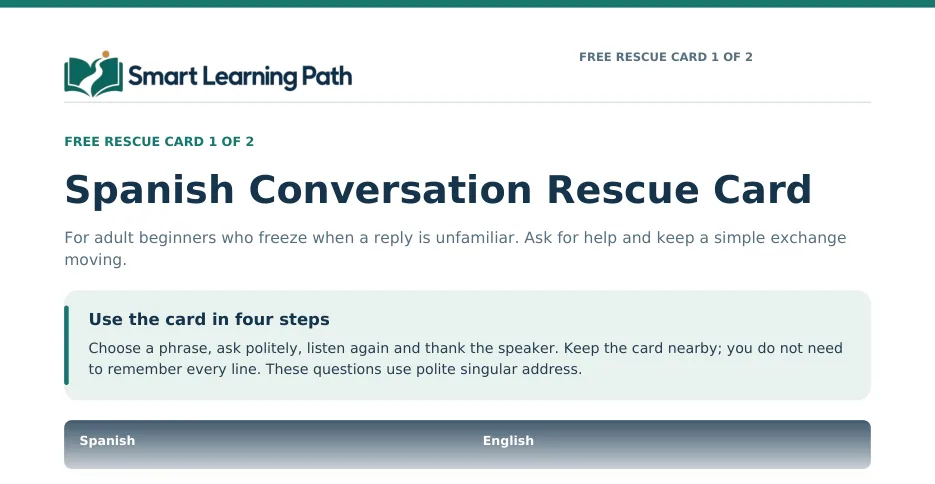
Using them is not a failure; it is how the exchange keeps going. Most are on the free Conversation Rescue Card, a free two-page printable card of clarification phrases.
Spanish phrases for travel: three, not thirty.
A counter needs three phrases: a greeting, your order, and one way to ask for a repeat. The rest of a hundred-phrase list can wait.
Match the greeting to the hour — Buenos días in the morning, Buenas tardes after midday — and the other two come more easily, because you have already spoken once. For more first-trip lines, see the first-trip phrases.
Why this is not another streak.
Fair objection, and it deserves a plain answer. An app is good at what it measures: recognising a word, tapping the right tile, keeping the streak alive. None of that is speaking at a counter. Producing a short answer out loud, in two seconds, improves by being practised that way.
What is here is small and unglamorous: the phrases, the dialogue, the drill, and a free seven-day plan that covers the same café ground on Day 4. No points, no streak, no microphone, and reading needs no account. The free files ask for a first name and email, then arrive by email once you confirm the sign-up.
On the upsell worry: we do plan to sell practice materials later, but the prices are planned rather than live, nothing has a checkout, and the free plan stays free. The pricing page separates what is planned from what exists, and the refund policy is public. This page will not make you a confident speaker by Friday; it can give you one exchange you produce without translating.
Cover the Spanish and answer four prompts.
Say each answer out loud before you look anything up, then check them all at the end.
| English prompt | Your Spanish |
|---|---|
| A coffee, please. | your phrase |
| Just a coffee, thank you. | your phrase |
| Do you have tea? | your phrase |
| Could you speak more slowly, please? | your phrase |
Check your answers: Un café, por favor. · Solo un café, gracias. · ¿Tiene té? · ¿Puede hablar más despacio, por favor?
- I can split ¿Qué desea? into its two words and say what each does.
- I can answer with Un café, por favor within a couple of seconds.
- I can ask for a repeat instead of switching to English.
This is practice, not a fluency test, and nobody is marking you.
One next step.
Do one thing, not five. Open the café scenario and take the customer’s side: it gives you the server’s lines and you answer out loud before reading the next one. Same question, less pressure.
Also useful, one link each: Day 4 of the free 7 Day Spanish Starter Plan for the café lines, the Conversation Rescue Card for the clarification phrases, and the ordering dialogue for the drinks half of the visit.
Common questions.
What does qué desea mean?
It means what would you like? — the polite question a server asks when it is your turn. Desea comes from desear, to want or to wish, and it is used with usted.
Is qué desea formal or informal?
Polite, because it uses usted. The familiar version is ¿Qué deseas?; with two or more people it is ¿Qué desean?
Why does qué have an accent?
Because it is a question word here. Without the accent, que is a relative pronoun or conjunction, as in el café que pedí. Spanish also opens the question with ¿.
What if I do not understand the question?
Say No entiendo, then ¿Puede repetir, por favor? or ¿Puede hablar más despacio, por favor? Both keep the exchange going.
Practice, not a promise. These tasks help you rehearse everyday Spanish at your own pace. Individual progress varies; nothing here promises a level, a qualification or a fixed learning speed. How we write and check our Spanish
Sources and editorial notes
- Real Academia Española and Asociación de Academias de la Lengua Española, Diccionario panhispánico de dudas: tilde diacrítica en qué / que (and solo), retrieved October 18, 2026.
- Real Academia Española and Asociación de Academias de la Lengua Española, Diccionario panhispánico de dudas: usted (third-person agreement, ustedes), retrieved October 18, 2026.
- Real Academia Española and Asociación de Academias de la Lengua Española, Diccionario panhispánico de dudas: signos de interrogación y exclamación (opening ¿), retrieved October 18, 2026.
- Smart Learning Path, 7 Day Spanish Starter Plan (Day 4, Dialogue 2 at a café) and Spanish Conversation Rescue Card (clarification phrases across its two pages), our own free workbook materials.
All dialogues and replies here are illustrative practice examples written for this page, not recordings of real conversations. Drink names, prices and counter questions differ by venue and country. Spanish checked by our editors; there has been no independent teacher review yet. See our Editorial Policy. Spotted a mistake? Suggest a correction.
Related reading.
Back to the blogOrder Coffee in Spanish with a Simple Dialogue
A short café exchange you can adapt.
How to Ask Someone to Repeat or Slow Down in Spanish
Polite phrases for a fast or unclear reply.
Spanish Phrases for Your First Trip
Greet, order, ask where something is and clarify.
Try one useful task.
Open the free seven-day plan and practise about ten minutes a day, at your own pace.
No account or payment needed.