
Practice habits
Record yourself speaking Spanish: the 90-second loop.
The app gave you a streak. This gives you a sentence in your mouth: three phrases said aloud, one listen-back, and one word to fix.
The streak is not the skill.
You have opened the app on the train for weeks. The counter is orange, the crowns stack up. Then someone at a café in Mexico City says ¿Algo más? and your mouth does something you did not plan: nothing.
That gap is not a vocabulary gap. Tapping a word on a screen is a different task from saying it to a person. The mouth has never formed the sounds, so the sounds stay foreign.
The fix is a daily prompt that makes you speak out loud, even alone. This is the ninety-second version: three phrases you already know, said into your phone, heard back once, with one word to fix. No account, no streak, no points.
The 90-second loop, step by step.
Open the recorder that came with your phone — Voice Memos on an iPhone, Recorder on Android. You do not need to name the file or keep it. The recording is a mirror, not a library.
Then run four steps. The timings are a suggestion: say the phrases slowly and the loop stretches to two minutes, which is also fine.
| Time | Step | What you do | Done when |
|---|---|---|---|
| 0:00 to 0:30 | Record | Say three phrases aloud from memory. No notes, no reading. | Three phrases are on the recording. |
| 0:30 to 0:50 | Listen once | Play it back end to end without stopping or re-recording. | You have heard the whole thing once. |
| 0:50 to 1:20 | Pick one word | Choose the word that sounded furthest from the model and say it three times, slowly. | One word is named and rehearsed. |
| 1:20 to 1:30 | Tick the strip | Mark today on the seven-day strip and write the word beside it. | A tick and a word are on paper. |
A flexible guide, not a test. Repeat a step, or stop after step two, whenever the day is short.
Why only one word? A list of ten corrections is a list you will not act on. One word a day is seven small changes a week, heard in your own voice.
Three phrases you already know.
Do not write new sentences for the loop. Use phrases you have already met, so the ninety seconds go on speaking rather than deciding. Here is a set for a first meeting:
| Spanish | English |
|---|---|
| Hola, buenos días. | Hello, good morning. |
| Me llamo ___. Mucho gusto. | My name is ___. Nice to meet you. |
| ¿Puede repetir, por favor? | Can you repeat, please? |
Illustrative examples. Say your own name in the gap.
¿Puede repetir? is the polite singular form — the one to use with a stranger, a landlord or someone at an official desk. With friends and family you would say ¿Puedes repetir? The same split shows up in questions: ¿Cómo te llamas? is familiar, ¿Cómo se llama? is polite.
These are the opening phrases of the free 7 Day Spanish Starter Plan, written out in full in your browser: Hola, Me llamo Ana, ¿Cómo te llamas?, Mucho gusto, then Perdón and No entiendo.
Listen back once. Pick one word.
You may find your recorded voice odd at first. That reaction is not information about your Spanish; it is information about hearing yourself from the outside for the first time.
So listen with one narrow question: which single word sounded furthest from the version you have heard? Not “was it good”. One word.
A few that come up often for beginners:
- gracias — in much of Latin America the c before i sounds like a plain s; keep the two syllables even rather than “GRASS-ee-us”.
- llamo — in Mexico City the ll usually sounds like an English y, so it begins like “yah-mo”, not “lah-mo”.
- ahora — the single r between two vowels is a light tap, close to the tt in the American English “butter”, and the stress falls on the middle syllable: a-HO-ra.
Say that word three times slowly, then stop. Tomorrow's recording tells you whether it moved. If a sound keeps returning after a week, the gracias pronunciation walkthrough takes one word apart syllable by syllable.
Keep a seven-day strip.
An app streak rewards opening the app. A strip on the fridge rewards the thing you want: opening your mouth. Seven boxes, one per day. Use a notebook, or the free 10 Minute Practice Planner, which has a week of logs in the same shape.
| Day | Three phrases said aloud | The one word I fixed |
|---|---|---|
| 1 | tick | one word |
| 2 | tick | one word |
| 3 | tick | one word |
| 4 | tick | one word |
| 5 | tick | one word |
| 6 | tick | one word |
| 7 | tick | one word |
A tick and a word are enough. Nothing here is scored and nothing is sent anywhere.
Missed a day? Start again at the next box rather than the first. Two sessions a week still beats a perfect week that ends in week two.
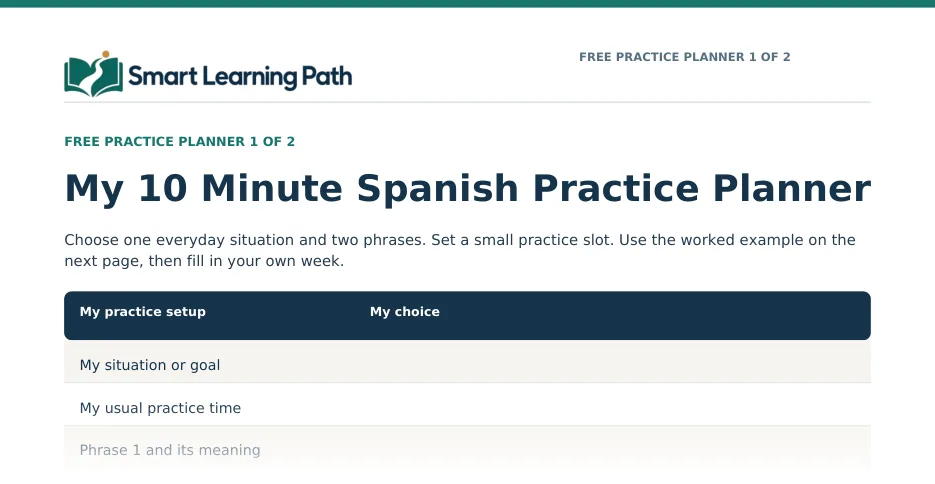
Spanish speaking practice exercises for the 90 seconds.
When the loop feels too easy, keep its shape and change one thing. Five variations, each under two minutes:
1. Swap the situation.
Same three phrases, different place: the café counter, the landlord at the door, the pharmacy. The everyday scenarios page gives you a prompt for each, with dialogues at slow and normal speed.
2. Change the person.
Say the polite version once, the familiar once: ¿Puede repetir? then ¿Puedes repetir? Hearing yourself switch is the start of choosing correctly.
3. Play both parts.
Ask aloud, then answer aloud: ¿Cómo te llamas? … Me llamo ___. Mucho gusto. Two turns, one recording.
4. Answer a fast reply.
Say your phrase, imagine the reply twice as fast, then use Perdón, ¿puede repetir, por favor? The aim is one more turn, not every word.
5. Run a speed round.
Say all three in fifteen seconds without reading, then listen once. A tumbled word is tomorrow's word to fix.
How to practise speaking Spanish alone.
Speaking alone can feel silly at first. It also becomes the easiest slot in the week, because it needs no partner, no booking and no courage.
Two rules keep it honest. Say the words out loud rather than in your head — a phrase only thought has not been practised. And listen back at least once, because your ear catches what your imagination skips. Everything else is optional, including whether you keep the file.
The guide to practising speaking alone adds more variations, and the 120-phrase deck gives you cards to draw three phrases from on days when choosing feels like work.
Is this just another app that gives points?
A fair question, because you have spent hours on the last one. Two honest answers.
There is nothing to install and nothing to keep up. This page is text: no streak to protect, no counter, no reminder at nine in the evening. If you stop for a fortnight, nothing breaks and nothing is lost.
The free part is complete, and the paid part is optional. The seven-day plan is readable in your browser, phrase by phrase. Three phrase packs ($9 each, $19 for all three) and a $49 self-paced course exist if you want more; both are one-time payments with a full refund within 30 days, set out on the pricing page and in the refund policy. If the free loop gets you speaking, you do not need either.
What the loop cannot do is promise an outcome. Ninety seconds a day is practice, not a fluency test, and individual progress varies. The editorial policy explains how the Spanish here is checked.
Your next task.
Before you close this tab, open your phone's recorder and say three phrases from memory. Listen once. Write one word down. That is day one of the strip. Tomorrow, same three phrases, same ninety seconds. If you want a wider plan to hang the loop on, the ten-minute 2 / 3 / 3 / 2 routine uses the same blocks with more room.
Practice, not a promise. These tasks help you rehearse everyday Spanish at your own pace. Individual progress varies; nothing here promises a level, a qualification or a fixed learning speed. How we write and check our Spanish
Common questions.
How do I practise speaking Spanish alone?
Say three phrases you already know out loud, without reading. Listen back once, name the one word that sounded furthest from the model, and write it down. A partner helps later; the first step happens alone.
How long should Spanish speaking practice take each day?
Ninety seconds covers three phrases, one listen-back and one word. The timings on this page are a planning suggestion, not a measured method; a slower two-minute run does the same job.
What are good Spanish speaking practice exercises for a beginner?
Swap the situation, switch between ¿Puede repetir? and ¿Puedes repetir?, play both parts of a dialogue, answer an imaginary fast reply with a repair phrase, then finish with a speed round. Keep to phrases you have already met.
Do I need an account or a microphone to use this site?
No. The pages are free to read with no account, and nothing on this site asks for a microphone; you record, if at all, on your phone's own recorder. The free PDFs are optional and arrive by email after a short verification reply.
Sources and editorial notes
- Content basis: the Smart Learning Path 7 Day Spanish Starter Plan (Day 1 greetings, Day 2 phrases for when you do not understand) and the 10 Minute Practice Planner.
- Usage notes on usted and tú, and on the sounds of gracias, llamo and ahora, checked automatically with AI and rule-based checks; no teacher review.
Ninety seconds is a flexible planning suggestion, not a measured method, and results from this loop have not been measured. Examples are illustrative and a real exchange may go differently. Spanish checked with AI review. See our Editorial Policy. Spotted a mistake? Suggest a correction.
Related reading.
Visit the blogHow to Practise Speaking Spanish Alone
Role plays and recall prompts without a partner.
A 10-Minute Spanish Practice Routine
Read, cover, say, check, and repeat.
Ten Everyday Scenarios
Dialogues with audio and scripted role plays for real situations.
New on this topic: Gracias Pronunciation: Syllables and Vowels · How to Remember Spanish When You Are Nervous · Spanish Shadowing Practice for Beginners
Ninety seconds. Three phrases. One word to fix.
The seven-day starter plan is free to read in your browser, phrase by phrase, with a café dialogue on Day 4.
No account or payment needed.