
Getting started
Gracias pronunciation: syllables and vowels.
You can read gracias without hesitating. What you cannot check is whether the version leaving your mouth is understandable. Two beats and two open vowels give you a way to check, today.
You can read it. You cannot hear it.
You know gracias means thank you. You have read it on signs and receipts. What you cannot do is find out whether the version leaving your mouth is understandable. That uncertainty is what keeps you quiet at the counter in Mexico City, and quiet is what you are trying to avoid.
This is a feedback problem before it is a confidence problem. English vowels shrink in the middle of a word; Spanish vowels stay short and open. Read gracias with English vowels and you get something like “GRAH-syus”. Keep the vowel open and you get “GRAH-syahs”, which is closer to what you will hear. The check is five small steps: clap the beats, keep the vowels open, copy a model at slower and normal speed, record yourself, and confirm the final vowel is still clear.
The whole page in one line: two beats, GRA-cias, final a as open as the a in father.
Practise with a seven-day plan.
The free 7 Day Spanish Starter Plan gives you a pronunciation day, seven days of phrases with a dialogue, a listening task and recall prompts, three goal tracks, an answer key and a tracker, 10 to 15 minutes a day. Use it on the web or download the 18-page PDF.
The complete plan is free and open on the web. Enter your email for the printable copy.
Clap two beats and keep the vowels open.
Spanish is spoken in regular beats, and you can feel them with your hands. Clap once on each beat. Gracias has two: gra | cias. The first is stronger. Say the pair five times slowly, clapping: GRA-cias, GRA-cias.
| Spanish | Beats | Stress |
|---|---|---|
| gracias | gra · cias | GRA-cias |
| tarjeta | tar · je · ta | tar-JE-ta |
| muchas gracias | mu · chas gra · cias | MU-chas GRA-cias |
Neither gracias nor tarjeta carries a written accent. That is a useful clue: the stress sits on the second-to-last beat. Spanish uses a written accent to mark exceptions, as with question words such as ¿Cómo?, ¿Qué? and ¿Dónde?.
Now the vowels. Gracias is built on an open a, repeated in both beats. Tarjeta alternates a, e, a. If the vowels shrink, the word shrinks with them.
| Vowel | Sounds close to | Watch out for |
|---|---|---|
| a | the a in father | the flat a in cat, or a swallowed “uh” |
| e | the e in bed, kept short | the “ay” glide in say |
Say them alone, out loud, five times: a, e, a — ah, eh, ah. Keep your mouth open on the a. Then put them back into tarjeta.
English turns unstressed vowels into “uh”. Spanish does not. That extra “uh” at the end of gracias is the most common reason a clear word sounds unclear.
Regional note: in Mexico City the c before i or e sounds like an s, so gracias is close to GRAH-syahs. In much of Spain it sounds like the th in think. Both are Spanish; use what you hear where you live.
The r in gra is a single, light tap of the tongue behind the top teeth, not the long rolled r.
Three beats: tar-JE-ta.
La tarjeta is the card in your pocket: bank card, business card, gym card. You will need it in your first week, so it earns thirty seconds here.
| Spanish | English |
|---|---|
| la tarjeta | the card |
| ¿Puedo pagar con tarjeta? | Can I pay by card? |
| tarjeta de crédito | credit card |
| tarjeta de débito | debit card |
Three beats: tar-JE-ta. The middle beat is strongest and holds the e. The j is not the English j. In Mexico it is a soft, breathy h, close to the h in hotel: tar-HEH-tah. In much of Spain it is rougher, closer to the ch in Scottish loch. Then the last beat, -ta, with an open a; do not let it become “-tuh”.
Say the pair back to back five times: gracias — tarjeta. Two beats, then three. Open a at the end of both. That contrast is the exercise.
Listen, copy, record, check.
Clapping fixes the shape. Audio fixes the sound. Day 4 of the free 7 Day Spanish Starter Plan is a short café dialogue, and gracias appears twice: Un café, por favor · ¿Algo más? · No, gracias · Aquí tiene · Gracias. It plays at slower speed and at normal speed.
Use the two versions in this order: slower once with the words in front of you; slower again, saying it along with the audio; normal speed, still with it; then normal speed, a beat behind. You are copying, not testing. Copying is the step most app drills skip.
Then record. A phone voice recorder is enough: three takes of each word. Play your take, then the model, then your take again. Listen for two things only: how many beats you hear, and whether the last vowel is still open. An extra “uh” at the end means the vowel collapsed. A missing beat means two syllables merged into one.
Clap the beats.
One minute. Gracias twice, tarjeta twice, muchas gracias twice.
Say the vowels alone.
One minute. A, e, a out loud, mouth open. Then straight into tarjeta.
Copy the model.
Three minutes. Day 4 at slower speed, then normal speed, with the audio and after it.
Record and check.
Four minutes. Three takes of each word, then compare: same number of beats, final vowel open.
No account and no microphone are needed. The plan and its audio are on the site. Only the downloadable files ask for a first name and email; reply VERIFY to the short email and the file follows.
Two short sessions on different days do more than one long session. The US Institute of Education Sciences practice guide Organizing Instruction and Study to Improve Student Learning recommends spacing learning over time and using quizzing to re-expose learners to key content. This drill borrows those two ideas in a small way; it is a practice plan, not a promise about how quickly anyone learns.
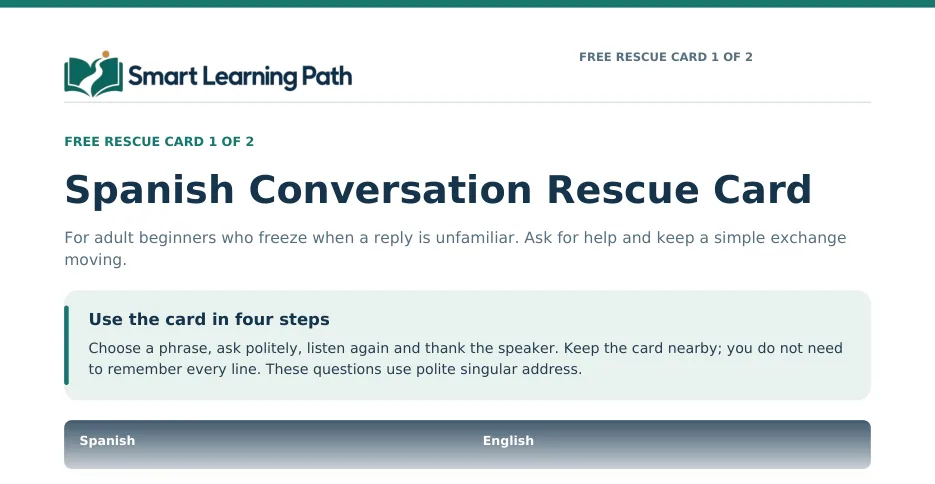
The free ten everyday scenarios add more short dialogues with audio for everyday situations. If an answer comes back too fast, say ¿Puede repetir, por favor? (Can you repeat, please?) — puede is the usted form. The Conversation Rescue Card keeps eight key phrases on two printable pages.
Muchas gracias: keep the ending clean.
Once GRA-cias is steady, put the word in front. The fixed phrase is muchas gracias; mucho gracias is not used, because gracias is feminine plural and the word before it agrees.
Two beats plus two beats: MU-chas GRA-cias. The ch is the same sound as English ch in chair. The final a of gracias stays open even though it is no longer at the end of the sentence.
You will hear gracias clipped and hurried in fast speech. Do not copy that yet. Clear beats are a safer choice.
Is this just another app that teases you?
A fair question, especially after an app that handed out streaks and left you unable to order a coffee. Here is exactly what this page is.
- No points, no streaks, no account. Nothing here scores you or rewards you for opening the site.
- The free plan is a web page. All seven days, with a dialogue a day at slower and normal speed, are readable without signing in.
- Downloads are separate. A PDF or Word file asks for a first name and email; reply VERIFY to the short email and the file follows. Every email has an unsubscribe link.
- What we sell is optional. Three phrase packs at $9 each or $19 for all three, and a $49 self-paced course, all one-time payments with a 30-day refund. See pricing and the refund policy.
- The Spanish is checked automatically, with AI and rule-based checks. No teacher reviews it yet; our Editorial Policy says plainly what that means.
What that means for your prep time: the drill above is the whole page. If it helps, the free plan is the next ten minutes. If it does not, you have spent ten minutes and typed nothing into a sign-up box.
Common questions.
How do you pronounce “gracias” in Spanish?
Two beats: GRA-cias. The first beat is stronger, the a in both beats stays open, and the final s is a soft s. In Mexico City the c before i sounds like an s, so it comes out close to GRAH-syahs.
What is the phonetic pronunciation of gracias?
One practical respelling is GRAH-syahs. Respellings are rough because they borrow English sounds that only come close. Copy a model at slower and normal speed and record yourself next to it.
How do you pronounce “muchas gracias”?
MU-chas GRA-cias. Gracias is feminine plural, so the word in front is muchas, not mucho. Keep the final a open.
How do you pronounce “tarjeta”?
tar-JE-ta, three beats. The middle beat is strongest and holds a short e. In Mexico the j is a soft, breathy h, so it sounds close to tar-HEH-tah.
Practice, not a promise. These tasks help you rehearse everyday Spanish at your own pace. Individual progress varies; nothing here promises a level, a qualification or a fixed learning speed. How we write and check our Spanish
Sources and editorial notes
- Smart Learning Path, 7 Day Spanish Starter Plan (Day 4 café dialogue, with audio at slower and normal speed) and Conversation Rescue Card (our own free materials).
- Real Academia Española and ASALE, Diccionario panhispánico de dudas, “tilde” (written accent on interrogative words such as cómo), retrieved October 18, 2026.
- Real Academia Española and ASALE, Diccionario panhispánico de dudas, “signos de interrogación y exclamación” (Spanish questions open with ¿), retrieved October 18, 2026.
- Institute of Education Sciences, What Works Clearinghouse, Organizing Instruction and Study to Improve Student Learning (practice guide: space learning over time, use quizzing to re-expose learners to key content), retrieved October 18, 2026.
Examples are illustrative, and pronunciation varies by country and by region; use the version you hear where you live. Spanish checked with AI review. See our Editorial Policy. Spotted a mistake? Suggest a correction.
Related reading.
Back to the blogHow to Check Spanish Pronunciation Alone
Compare your vowels and rhythm with clear audio.
Order Coffee in Spanish with a Simple Dialogue
A short café exchange you can adapt.
Free Practice Tools
The Conversation Rescue Card and the 10 Minute Practice Planner.
New on this topic: Last-Minute Spanish Before Moving: A 7-Day Plan · Why Spanish Sounds Fast: A Beginner Listening Plan · Beginner Spanish Phrases: What to Learn First
Practise the two beats out loud.
Day 4 of the 7 Day Spanish Starter Plan is a café dialogue with Gracias and No, gracias in it, at slower and normal speed. Ten minutes.
No account or payment needed.