
Practice habits
Spanish shadowing practice for beginners.
Shadowing means speaking with the audio instead of waiting for it to finish. Here is a five-minute loop you can run alone, with three beginner phrases to start.
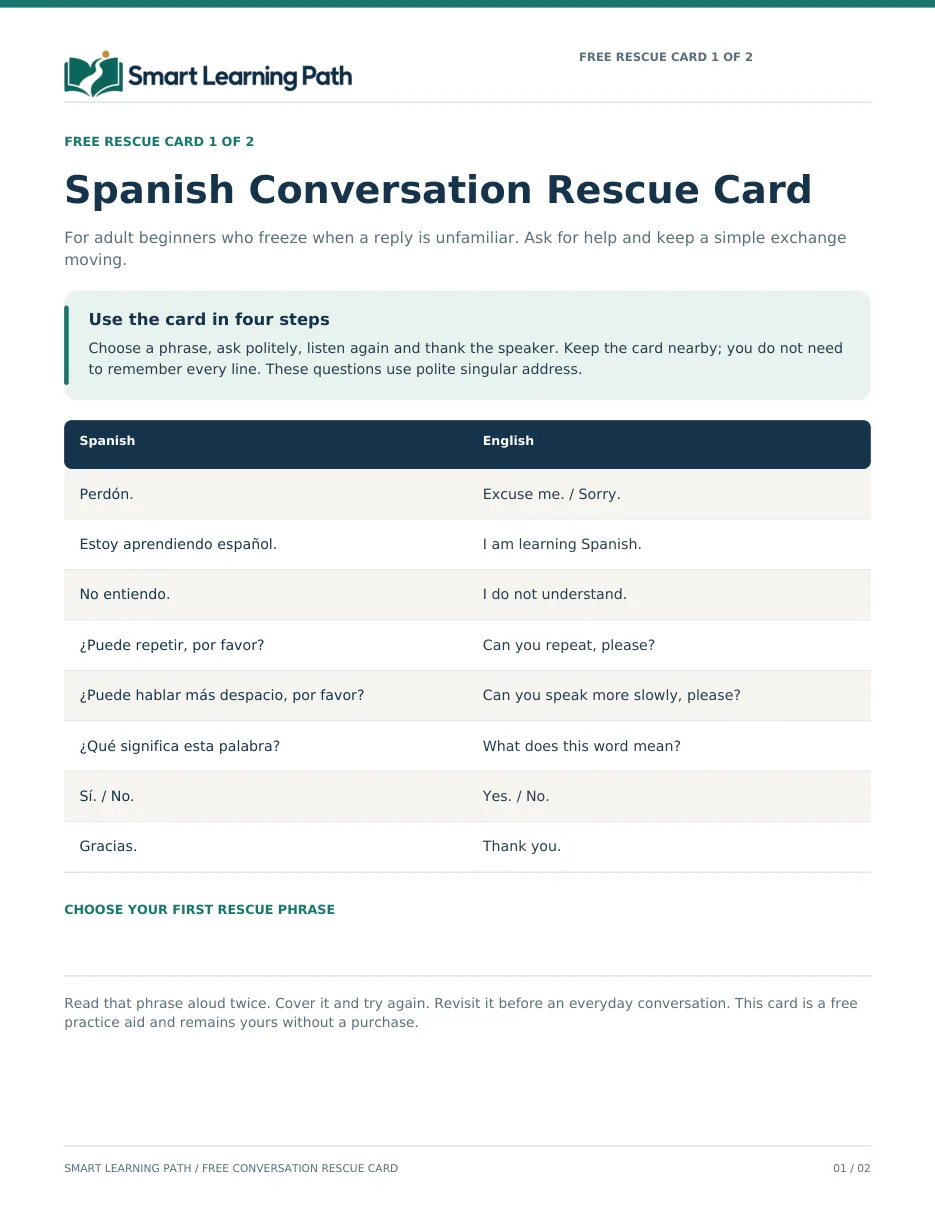
Practise with a seven-day plan.
The free 7 Day Spanish Starter Plan gives you a pronunciation day, seven days of phrases with a dialogue, a listening task and recall prompts, three goal tracks, an answer key and a tracker, 10 to 15 minutes a day. Use it on the web or download the 18-page PDF.
The complete plan is free and open on the web. Enter your email for the printable copy.
Recognising Spanish is not the same as speaking it.
The fear is specific: you arrive in Mexico City, you open your mouth at a café counter, and nothing comes out. Behind it sits a quieter worry about how you have been practising. A streak counts taps, not spoken sentences. It cannot tell whether you said anything aloud, and this loop is only about saying it aloud.
Tapping the right tile proves you can recognise a word on a screen. It does not train your mouth, your breath or the rhythm a real reply needs. Shadowing is the small, direct habit for that gap: you play a short line of Spanish and speak along with it, rather than waiting for it to finish and then repeating.
Speak with the audio
Both at once, quietly if you need to.
Keep it short
Two or three phrases, five minutes, out loud.
Nothing records you
No account and no microphone needed.
This is a practice method, not a test of your level. Progress varies from person to person.

Beginner Spanish listening practice in a five-minute loop.
One short clip, four steps, five minutes. The clip can be a line from Day 1 or Day 4 of the free 7 Day Spanish Starter Plan, or any short, clear recording of the same phrase that you can replay.
| Time | Step | What you do |
|---|---|---|
| 1 minute | Listen once | Play the whole line and do not speak. Notice the tune of it. |
| 2 minutes | Repeat in chunks | Pause after each short chunk and copy it aloud, matching the rhythm. |
| 1 minute | Speak with the audio | Play it again and speak at the same time as the recording. This is the shadowing step. |
| 1 minute | Say it from memory | Stop the audio and say the whole line once. Note the one chunk that wobbled. |
Five minutes is a suggestion, not a rule. A two-minute version with a single phrase still counts.
The free plan files are a printable PDF and an editable Word file, so they carry the phrases as text and you supply the sound. If a line sounds too fast, replay it; many players have a playback speed control, so try a slower setting for the chunk step and normal speed for the shadow step. If yours does not, run the chunk step twice instead.
Repeat in chunks, not word by word.
A chunk is a short group of words you can say in one breath. Spanish is spoken in these groups, so learning them whole saves you from stitching single words together while someone waits to take your order.
Take Un café, por favor. (A coffee, please.) That is two chunks, not four separate words:
Say each chunk three times: once slowly, once at normal speed, then once with the audio. Only then join them. If you drop a word, go back to the chunk rather than starting the whole sentence again. This is how daily Spanish practice starts to sound like speech rather than reading.
Rhythm tip: the stress in café falls on the last syllable, and favor carries its stress at the end too. Copy that shape in your voice; do not flatten it.
Three phrases to shadow today.
Each one is short enough for a five-minute loop and useful in your first week: an introduction, a café request and a polite request to slow down.
| Spanish | English | Shadow it in two chunks |
|---|---|---|
| Hola, me llamo Ana. Mucho gusto. | Hello, my name is Ana. Nice to meet you. | Hola, me llamo Ana. · Mucho gusto. |
| Un café, por favor. | A coffee, please. | Un café, · por favor. |
| Perdón, ¿puede hablar más despacio, por favor? | Sorry, can you speak more slowly, please? | Perdón, ¿puede hablar · más despacio, por favor? |
Say your own name in place of Ana. Examples are illustrative; a real exchange may be different.
The introduction comes from Day 1 of the free 7 Day Spanish Starter Plan and the café line from Day 4. The third phrase is the one that protects you when a reply arrives too fast. ¿Puede…? is polite singular address (usted), a safe choice with someone you do not know.
Shadow a short café exchange.
Once single phrases feel comfortable, shadow both sides of a short exchange. Say the customer's line, then the server's, then swap and start again.
A: Un café, por favor. · B: ¿Algo más? · A: No, gracias. · B: Aquí tiene.
A: A coffee, please. B: Anything else? A: No, thank you. B: Here you are. An original practice dialogue, not a recorded conversation.
Do the exchange three ways: read it aloud, say it with the audio, then say it with the audio switched off while you picture the counter in front of you. That last step is conversation practice on your own, and it is the closest thing to a rehearsal you can do before you arrive.
Make it a daily Spanish practice habit.
Daily practice works better as a small, fixed slot than as a long session you keep postponing. Attach the loop to something you already do: the kettle, the walk to the station, the first five minutes after lunch.
Same time, same phrase
Repeat one phrase for three days before adding another. Coming back to it later is what helps it stay.
No time today?
Do the one-minute shadow step only. Something said aloud beats nothing said aloud.
The ten-minute practice routine adds recall and a written note to this loop, and the free 10 Minute Practice Planner has a blank week you can fill in.
Will this be another app that gives points but no speaking?
Fair question, and the honest answer has two parts.
What is free. This page and the whole seven-day plan are free to read, with no account and no microphone involved. The download asks for a first name and email because that is how the file is sent, so you can read the plan on the plan page first and decide afterwards. There are no points here, no score and no streak to keep. The only measure is whether you said the phrase aloud.
What is planned. We do intend to sell a toolkit, a four-week conversation course and a monthly practice membership. None of them is on sale yet, no date is fixed and no coach is named. The planned contents and prices sit openly on the pricing page, so you can see the whole picture now rather than after a handful of emails.
What we will not do is promise that five minutes a day makes you a confident speaker by a set date. Individual progress varies, and a page cannot measure yours. What we can do is show you how the content is checked: see the Editorial Policy.
Check what needs another try.
After the loop, tick the help you needed for the hardest chunk. This is a note for your next session, not a score.
- I said it while reading the phrase
- I said it with the audio only
- I said it from memory, without the audio
Your task: run the loop once today with one phrase, then say that phrase from memory at the end. Write the difficult chunk in your notes and come back to it tomorrow. The spaced practice guide explains why a later revisit beats repeating everything today.
Questions about shadowing.
What is Spanish shadowing practice?
Shadowing means playing a short line of Spanish audio and speaking along with it at the same time, copying the rhythm and the sounds rather than analysing them. You then say the line once more from memory.
Do I need a microphone or an account to try it?
No. The loop is described in full on this page, nothing records your voice, and the whole seven-day plan can be read on the site before you decide whether to download it.
Is shadowing the same as listening practice?
No. Listening practice trains your ear. Shadowing adds your voice, because you speak at the same time as the audio rather than after it. The practice routine gives a wider weekly shape for both.
How long does progress take?
There is no set time, and individual progress varies. The loop is designed to make speaking aloud part of a short session, not to promise a result by a date.
Practice, not a promise. These tasks help you rehearse everyday Spanish at your own pace. Individual progress varies; nothing here promises a level, a qualification or a fixed learning speed. How we write and check our Spanish
Sources and editorial notes
- Content basis: the Smart Learning Path 7 Day Spanish Starter Plan (Days 1 and 4) and the Conversation Rescue Card.
- Institute of Education Sciences, What Works Clearinghouse, Organizing Instruction and Study to Improve Student Learning (practice guide, released September 2007), retrieved October 18, 2026. Its recommendations include spacing learning over time and using quizzing to prompt retrieval. The guide is about classroom study in general and was not written about shadowing.
- Real Academia Española, Diccionario panhispánico de dudas: signos de interrogación y exclamación, retrieved October 18, 2026. Spanish questions open with ¿ as well as closing with ?.
- Real Academia Española, Diccionario panhispánico de dudas: tilde, retrieved October 18, 2026. Background on written accents in Spanish.
The timings are a flexible planning aid and no learning outcome for this loop has been measured. Examples are illustrative. Spanish checked by our editors; no independent teacher review yet. See our Editorial Policy. Spotted a mistake? Suggest a correction.
Related reading.
Visit the blogHow to Practise Speaking Spanish Alone
Role plays and recall prompts without a partner.
Remember Spanish Phrases with Spaced Practice
Revisit phrases on later days to keep them.
A 10-Minute Spanish Practice Routine
Read, cover, say, check, and repeat.
Five minutes. Out loud.
Follow the free seven-day plan and say every phrase aloud once before you move on.
No account or payment needed.