
Conversation basics
Spanish filler words that buy you three seconds.
When a normal-speed reply blurs past, two small words hold your place — and one polite question brings the sentence back in a simpler version.
Someone behind the counter says a sentence at normal speed and it arrives as one long sound. «¿Con leche o solo?» You catch leche, maybe solo, and before you have a reply the next customer steps forward. So you nod, pay and hope — or say «sorry?» in English and the whole exchange changes language.
What you need in that half-second is not more grammar. It is a small sound that says «I am still here», followed by a question that brings the sentence back simpler: «A ver… ¿Puede repetir, por favor?» (Let me see… can you repeat, please?).
This page teaches that move: the common Spanish filler words, where each one fits, and one café exchange where half the sentence disappears and the reply still lands. Nothing here needs an account, a microphone or an install.
Your task: learn one filler and one question — «A ver…» and «¿Puede repetir, por favor?» — and use them together once this week.
Three seconds is enough to stay in the conversation.
When a reply goes past you, there are three reflexes: freeze, switch to English, or make a small, ordinary sound that holds your place while your brain catches up. The third is what people do in every language. In English it is «well…» or «let me see…». Spanish has its own set, usually called filler words in Spanish, or Spanish conversation fillers.
Be clear about what a filler does. It does not make a fast sentence understandable. It buys the second you need to say ¿Puede repetir, por favor? instead of falling silent. Filler plus request is the whole technique, and it is learnable in one sitting.
It also answers the worry about switching to English. A short, natural pause signals that you are still speaking Spanish, not that you need rescuing.
The three-second move, in two phrases.
Learn these as a pair, because they work together.
Say them as one breath: «A ver… ¿Puede repetir, por favor?» The first part is not a word you are reciting; it is a pause with a purpose.
One spelling point: a Spanish question opens with ¿, and no full stop follows the closing mark. The accent in cómo or qué belongs to the word; it is not decoration.
Common Spanish filler words and phrases.
These are ordinary in everyday conversation. Choose two or three rather than trying to hold all of them, keep them short, and say each one once rather than five times.
| Spanish | English | Where it fits | Note |
|---|---|---|---|
| A ver… | Let me see… | Checking a price, a screen or a receipt. | Fine anywhere. |
| Pues… | Well… | Starting an answer you have not finished forming. | Neutral. |
| Bueno… | Well… / OK… | Softening a reply or changing direction. | Neutral. |
| Este… | Um… / Er… | A hesitation sound while you think. | Common in Mexico; keep it short. |
| O sea… | I mean… / That is… | Explaining again what you just said. | Colloquial; skip it if unsure. |
| Mire… | Look… | Getting attention before a question. | Polite singular (usted). |
| Déjeme ver… | Let me see… | Buying time while you check something. | Polite singular. |
| Un momento, por favor. | One moment, please. | A full sentence that works as a filler. | Safe everywhere. |
| Espere un momento. | Wait a moment. | Someone is about to rush off. | Polite singular. |
| ¿Cómo se dice…? | How do you say…? | You have the English word but not the Spanish one. | A question, so it keeps ¿. |
An illustrative list for practice, not a ranking or a frequency count.
Two are enough to start: A ver and un momento, por favor. Add the rest when the first two feel automatic.
A café counter where half the sentence disappears.
Here is the move in the order it happens. The server’s first line is the kind that blurs: a normal-speed question with two options inside it. The learner lines are yours.
| Speaker | Spanish | English |
|---|---|---|
| You | Un café, por favor. | A coffee, please. |
| Server | ¿Con leche o solo? | With milk or black? |
| You | A ver… perdón, no entiendo. ¿Puede repetir, por favor? | Let me see… sorry, I do not understand. Can you repeat, please? |
| Server | ¿Con leche o sin leche? | With milk or without milk? |
| You | Ah, sin leche. Gracias. | Ah, without milk. Thank you. |
| Server | ¿Algo más? | Anything else? |
| You | No, gracias. ¿Cuánto es? | No, thank you. How much is it? |
An original practice dialogue for rehearsal, not a recorded conversation.
Notice what did the work. The filler bought a moment; the request got a second version; the second version was shorter and clearer. ¿Con leche o sin leche? is easier to catch than the first line, and the answer needed one word. You never left Spanish, and nothing dramatic happened. The same shape works at a pharmacy, a building reception or a phone shop: fill, ask, then answer the shorter version.
Espere or espera? Match the person in front of you.
Some fillers change with the person in front of you. Staff, strangers and anyone older than you get the polite singular, the usted form; friends, close family and children get the familiar tú form.
| Polite (usted) | Familiar (tú) | English |
|---|---|---|
| Espere un momento. | Espera un momento. | Wait a moment. |
| Mire… | Mira… | Look… |
| Déjeme ver… | Déjame ver… | Let me see… |
| ¿Puede repetir? | ¿Puedes repetir? | Can you repeat? |
A ver, pues and bueno do not change, so they are the safest ones to rehearse first. If you are unsure with a stranger, choose the polite form. Nobody is offended by ¿Puede…?
Rehearse the move out loud.
Say the filler as a pause.
«A ver…» three times, slowly, the way you would say «let me see». It should sound like thinking, not reciting.
Join it to the question.
Same breath: «A ver… ¿Puede repetir, por favor?» Then try «Un momento, por favor. ¿Puede repetir?»
Read the café dialogue as both people.
Then cover the learner lines and answer the server’s questions without looking.
Choose one real moment this week.
A coffee counter, a building reception, a shop. Decide now which one it is.
Now check recall. Cover the right-hand column and say the Spanish aloud before you look.
| Say this in Spanish | Your answer |
|---|---|
| Let me see… (buying time) | your phrase |
| Can you repeat, please? (polite) | your phrase |
| One moment, please. | your phrase |
| Wait a moment. (polite) | your phrase |
Check your answers: A ver… · ¿Puede repetir, por favor? · Un momento, por favor. · Espere un momento.
Repeat the table today, again in two days, then once next week. The IES What Works Clearinghouse practice guide Organizing Instruction and Study to Improve Student Learning recommends spacing reviews over time and using quizzing that involves active retrieval, rather than re-reading alone. For a five-date schedule and a recall log, see our guide to remembering Spanish phrases with spaced practice.
- I can hold my place with a filler.
- I can ask for a repeat politely.
- I can answer the shorter second version.
- I can use one of these for real this week.
This is practice, not a test of your level.
Is this just another app that teases, then upsells?
A fair question after evenings that felt productive but never involved speaking. Points and streaks count taps, not speech. This page does not: there is no account, no streak, no microphone and nothing to install. It gives you a handful of phrases, one dialogue and a recall routine you can do with a closed laptop — which is the part an app rarely puts in front of you.
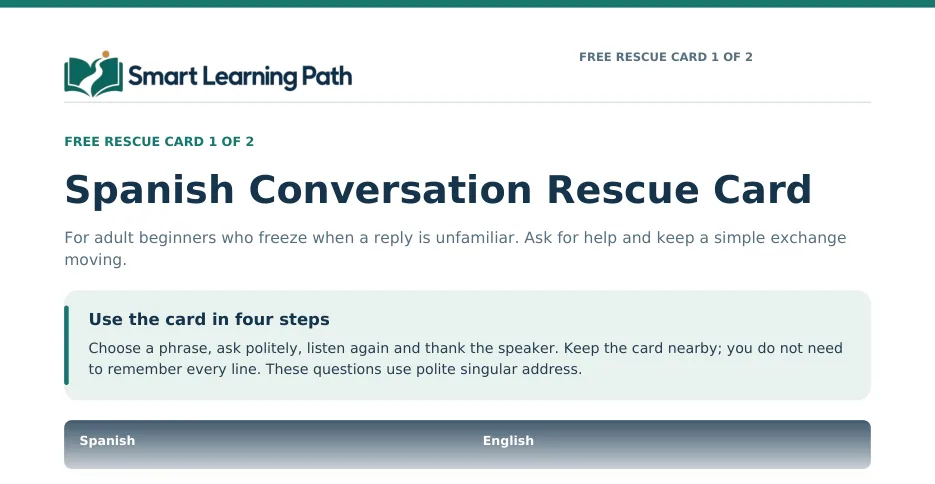
The free files work the same way. The 7 Day Spanish Starter Plan puts these clarification phrases on Day 2 — Perdón, ¿Puede repetir, por favor? and ¿Puede hablar más despacio, por favor? — and adds ¿Dónde está la estación? on Day 5. The two-page Conversation Rescue Card keeps eight rescue phrases, a worked café example, a checklist and a cut-out pocket card, and each phrase on screen links to its recording. A download asks for a first name and email; reply VERIFY to the short first email and we send you the file. Nothing on this page is behind that form, and the free material is complete on its own.
About money, plainly. Our pricing page sets out our own phrase packs ($9 each, $19 for all three) and a $49 self-paced course, alongside the Spanish Starter Toolkit, the four-week conversation course and the practice membership — all three of those planned and not open for booking. None of it changes what you can do with this page, the free plan or the free card.
For more rehearsal of the request itself, asking someone to repeat or slow down in Spanish takes the same phrases into longer exchanges. Listening at natural speed is a separate skill with its own plan in Spanish listening practice at normal speed; a filler buys you a second, but the ear is what fills it.
Common questions.
What are common filler words in Spanish?
Start with A ver…, un momento, por favor and pues…. Add espere un momento for polite settings. Este… is a hesitation sound you will hear in Mexico; keep it short.
Do Spanish conversation fillers help me understand a fast reply?
Not directly. They buy a second or two and keep you in the conversation. Understanding comes from asking for a repeat or slower speech, then listening at natural speed again.
Is it espere or espera?
Both are correct. Espere un momento is the polite singular (usted); espera un momento is the familiar singular (tú). Use the polite form with staff and strangers.
Can I practise this without an account or a microphone?
Yes. Read the phrases aloud, cover the answers in the recall table, then say them from memory. Nothing here needs an install or an account.
Practice, not a promise. These tasks help you rehearse everyday Spanish at your own pace. Individual progress varies; nothing here promises a level, a qualification or a fixed learning speed. How we write and check our Spanish
Sources and editorial notes
- Smart Learning Path, Spanish Conversation Rescue Card and 7 Day Spanish Starter Plan, Day 2 (our own free materials).
- Institute of Education Sciences, What Works Clearinghouse, Organizing Instruction and Study to Improve Student Learning (2007 practice guide): recommendations to space learning over time and to use quizzing that involves active retrieval, retrieved October 18, 2026.
- Real Academia Española and ASALE, Diccionario panhispánico de dudas, «signos de interrogación y exclamación» (opening ¿, and no full stop after the closing mark), retrieved October 18, 2026.
- Real Academia Española and ASALE, Diccionario panhispánico de dudas, «tilde» (interrogative words written with an accent), retrieved October 18, 2026.
The dialogue is an original practice example, not a recorded conversation, and the phrase list is illustrative rather than a frequency count. Spanish checked with AI review; no independent teacher review yet. See our Editorial Policy. Spotted a mistake? Suggest a correction.
Related reading.
Back to the blogHow to Ask Someone to Repeat or Slow Down in Spanish
Polite phrases for a fast or unclear reply.
Why Spanish Sounds Fast: A Beginner Listening Plan
Close the gap between textbook audio and real street speech.
Spanish Listening Practice at Normal Speed
Use one dialogue at two speeds until normal feels fine.
Try one useful task.
Open the free seven-day plan and practise about ten minutes a day, at your own pace.
No account or payment needed.