
Practice habits
Spanish listening practice at normal speed.
Slow audio feels manageable; the person behind the counter does not slow down. Work one short dialogue at two speeds until the fast version stops being noise.
Why the slow version feels easy and the real one does not.
Slow audio gives you room. Each word arrives with a pause around it, and Un café, por favor is easy to follow. Then the person behind the counter answers at their own speed, the words run together, and last night’s practice is gone. That gap — between the recording you can follow and the reply you will actually get — is the thing worth working on.
A longer phrase list does not close it. One short dialogue, worked at two speeds in three passes, does more, and it fits into about ten minutes.
Practise with a seven-day plan.
The free 7 Day Spanish Starter Plan gives you a pronunciation day, seven days of phrases with a dialogue, a listening task and recall prompts, three goal tracks, an answer key and a tracker, 10 to 15 minutes a day. Use it on the web or download the 18-page PDF.
The complete plan is free and open on the web. Enter your email for the printable copy.
Start with one café dialogue.
Use the café exchange from Day 4 of the free 7 Day Spanish Starter Plan. Five short lines, one situation you will meet in your first week. You are not trying to understand everything; you are trying to hear these lines without translating each word in your head.
| Speaker | Spanish | English |
|---|---|---|
| You | Un café, por favor. | A coffee, please. |
| Server | ¿Algo más? | Anything else? |
| You | No, gracias. | No, thank you. |
| Server | Aquí tiene. | Here you are. |
| You | Gracias. | Thank you. |
Add two clarification phrases.
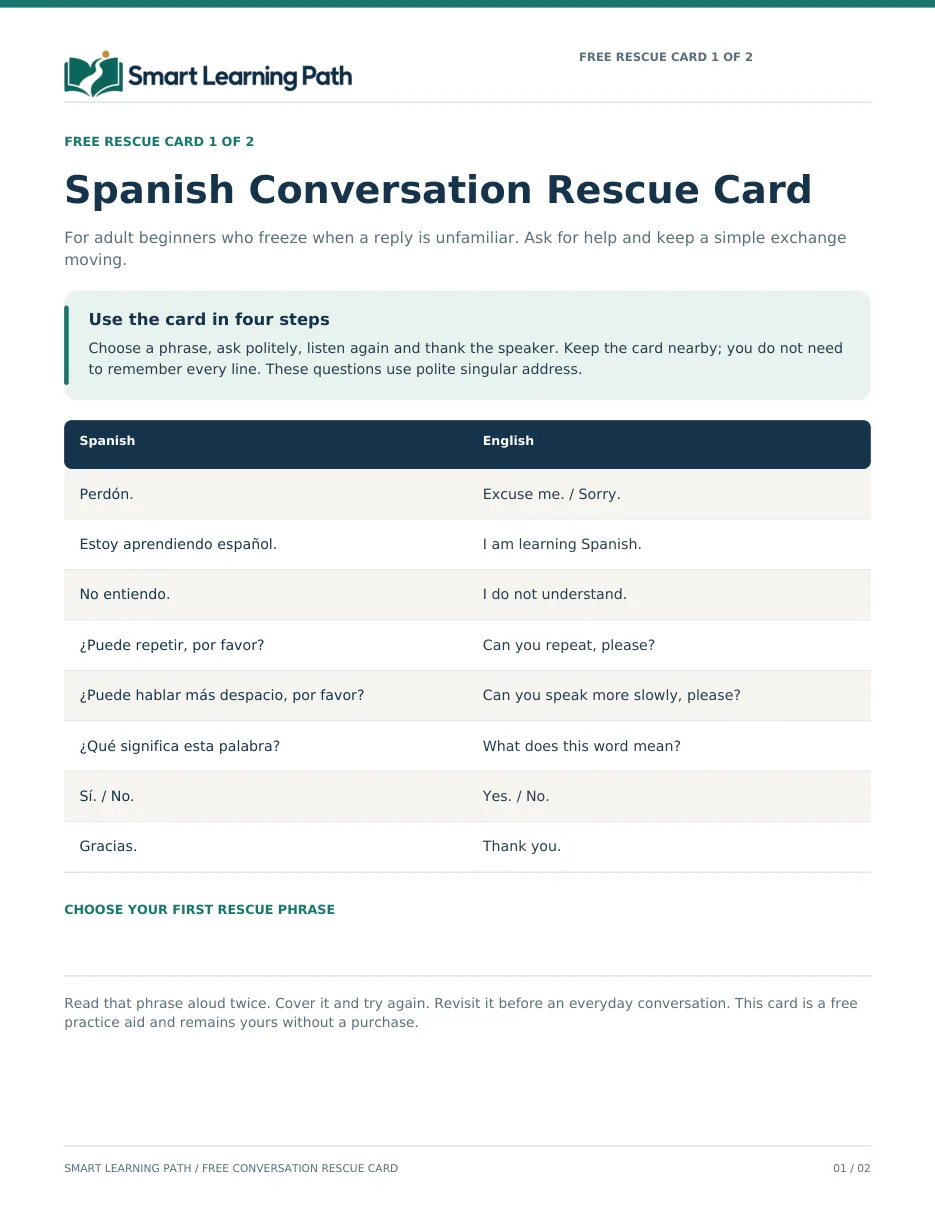
A fast reply is where a short exchange goes wrong, so keep two lines ready from the Conversation Rescue Card.
| Spanish | English |
|---|---|
| ¿Puede repetir, por favor? | Can you repeat, please? |
| ¿Puede hablar más despacio, por favor? | Can you speak more slowly, please? |
Both use polite singular address (usted), a safe choice with someone you do not know. Between friends or family, use ¿Puedes repetir, por favor?
Use three passes: listen, read, listen again.
Each pass has one job, and you keep the same five lines throughout. Ten minutes is a planning suggestion; five is still a session.
Pass one: slow, no text.
Play the slow version once with the Spanish hidden. Do not pause after every word; let the whole exchange run. Afterwards, write down which lines you caught. That note shows you where to look, nothing more.
Pass two: normal speed, with the text.
Read along while the normal-speed version plays. Your eyes carry the parts your ears miss, and you start to see where words join together. Reading along is not cheating; it teaches the shape of a sentence before you hear it unaided.
Pass three: normal speed, no text.
Same recording, text away. Listen for the five lines you now know, then note the one line you lost. That line starts your next session.
Then answer out loud.
Play the server’s part and reply as yourself: Un café, por favor … No, gracias. Listening and speaking use the same phrases from different directions.
You need two recordings of the same lines, and you can make both yourself. Read the five lines aloud slowly and record them on your phone, then record them again at your usual pace. The café scenario lists the phrases and a short role play you can read aloud for the recording.
Run pass one before you read anything else.
Day 4 has the café lines; the two clarification phrases come from Day 2 and the Conversation Rescue Card.
Open Day 4Slow Spanish listening practice is a step, not a home.
Slow audio earns its place at the start of a new dialogue: it separates the words and lets you check the meaning. The trouble comes when every session stays slow. You get comfortable at a speed nobody uses, and the gap reopens the moment you step outside.
What slow audio is good for.
First contact with new lines, checking that you hear the words you think you hear, and repairing a line that keeps escaping you.
When to move to normal speed.
Once you can follow a line at slow speed with the text hidden, play that same line at normal speed in the same session. Not next week — straight away, while the phrase is still in your ears.
- Slow with text: check the meaning.
- Slow without text: check you can hear it.
- Normal with text: check where the words join.
- Normal without text: check what you kept.
Note where normal speed stops feeling too fast.
There is no fixed day when that happens, and a page promising normal speed in a set number of weeks is guessing. What you can track is the point in a dialogue where the fast version stops being noise and starts being words. Fill this in after a session.
| Dialogue I practised | e.g. ordering a coffee |
|---|---|
| Slow, text hidden: what I caught | a short note |
| Normal, with text: what I needed the text for | one or two words |
| Normal, text hidden: the line I lost | your line |
| My next session | day and time |
Your task: run the three passes on the café dialogue today, then write down the one line you lost. Start tomorrow with that line slowly, then at normal speed.
Repeat the method with one shop dialogue.
A small shop makes a good second dialogue: short turns, predictable questions, and plenty of chances to ask for repetition. Work it through the same three passes.
| Speaker | Spanish | English |
|---|---|---|
| You | Perdón, ¿tiene pan? | Excuse me, do you have bread? |
| Shopkeeper | Sí, aquí tiene. | Yes, here you are. |
| You | ¿Cuánto cuesta? | How much is it? |
| Shopkeeper | Son dos euros. | That is two euros. |
| You | Gracias. | Thank you. |
If the reply arrives too fast, you already have the tool: ¿Puede repetir, por favor? Asking is normal, and it keeps the exchange in Spanish rather than switching to English. There are more options in our guide to asking someone to repeat or slow down.
An illustrative dialogue, not a recorded conversation. The amount and the currency depend on the country, so swap in the local one; a real exchange may also be shorter than this.
Beginner, A2 and intermediate listening practice.
Beginner Spanish listening practice.
One short, familiar dialogue, two speeds, text nearby. Five to ten lines is plenty, and the three passes above are enough structure.
Spanish listening practice at A2.
Level labels vary between courses and exams, so treat them as rough guides. In practice, A2 means short everyday exchanges about familiar things: ordering, paying, asking where something is, saying who you are. Ten-line dialogues at normal speed, using phrases you already know, sit closer to that than news clips or films.
Spanish listening practice at intermediate level.
Change the material, not just the speed: the same dialogue at normal speed with no text, then a new situation you have not rehearsed. When you can follow a normal-speed exchange on a familiar topic and still ask ¿Puede repetir, por favor? when you lose a line, you are working above the beginner stage.
Is this just another app that felt productive?
Fair question. Nothing here keeps a streak, gives points or listens to you. What it gives you is a dialogue in two languages, three passes with a job each, and phrases you can use the same week. Every step above is written out on this page, and the free plan sits on its own page too; you can have it emailed to you if you want the worksheet.
On the commercial side, since you asked: paid options are planned, not on sale. A Starter Toolkit at a planned $39 one-time, a four-week conversation course at a planned $249, and a Practice Membership at a planned $39 a month. Booking is not open, no dates are set and there is no checkout. Taking the emailed plan adds four follow-up emails, one of which mentions paid phrase packs, and every email has an unsubscribe link. Details sit on the pricing page, with the refund policy alongside it.
Questions about listening practice.
How long before normal speed stops feeling too fast?
Nobody can give you a date, and a page that does is selling something. Use the log instead: note the pass at which you caught a line without the text, then move to a new dialogue. Listening progress is uneven, and a line that is clear today can vanish tomorrow.
Do I need an app, an account or a microphone?
No. You need the dialogue text and two recordings of the same lines, slow then normal, which you can make on a phone or get from someone reading them to you. The method above runs on paper and your own voice.
Is slow Spanish listening practice useful, or a waste of time?
Useful as a first pass on a new dialogue, because it separates the words and lets you check meaning. Less useful as a permanent home. Keep it as a step and always follow it with the same lines at normal speed.
Can I use this for A2 or intermediate practice?
Yes, by changing the material rather than the method. Use short everyday dialogues at normal speed with no text, then move to situations you have not rehearsed. Judge yourself by whether you can follow a familiar topic and ask for a repeat when you lose a line.
Practice, not a promise. These tasks help you rehearse everyday Spanish at your own pace. Individual progress varies; nothing here promises a level, a qualification or a fixed learning speed. How we write and check our Spanish
Sources and editorial notes
- Content basis: the Smart Learning Path 7 Day Spanish Starter Plan (Day 2 clarification phrases, Day 4 café dialogue) and the Conversation Rescue Card, both free resources from this site.
- Institute of Education Sciences, What Works Clearinghouse, Organizing Instruction and Study to Improve Student Learning (practice guide, 2007), retrieved October 18, 2026. It recommends spacing learning over time and using quizzing so learners revisit key content and spot what still needs study. It was not written about this listening routine.
- Real Academia Española, Diccionario panhispánico de dudas: signos de interrogación y exclamación, retrieved October 18, 2026. Spanish questions open with ¿ as well as closing with ?.
The timings and the three passes are a practical structure, not a measured method. Listening outcomes for this routine have not been measured or tested. All dialogues are illustrative examples. Spanish checked by our editors; no independent teacher review yet. See our Editorial Policy. Spotted a mistake? Suggest a correction.
Related reading.
Visit the blogOrder Coffee in Spanish with a Simple Dialogue
A short café exchange you can adapt.
How to Ask Someone to Repeat or Slow Down in Spanish
Polite phrases for a fast or unclear reply.
A 10-Minute Spanish Practice Routine
Read, cover, say, check, and repeat.
One dialogue. Two speeds. Three passes.
Take the café lines from Day 4 of the free seven-day plan and work them once slowly, then twice at normal speed.
No account or payment needed.