
Everyday situations
How to split the bill in Spanish, politely.
You can order the coffee. The bill is where people stall — is la cuenta right, and is it rude to ask about your card? Here are the short answers and a script you can say aloud today.
Practice dialogue written with AI assistance, not a recording.
Asking for the bill should be the easy part of the evening. You have ordered, you have said gracias, and then the table goes quiet, because you are not sure how to finish. Is la cuenta the right word? Is it rude to ask about your card? And what happens if the reply comes back too fast?
Both questions have short answers. La cuenta is the bill, and La cuenta, por favor is the normal request in a café or restaurant. Asking about your card is ordinary, not rude: ¿Puedo pagar con tarjeta? gets a plain yes or no. Settle those two and the exchange is about six lines long.
The bigger worry is underneath: getting there, opening your mouth, and finding nothing — or being answered in English before you have finished. So this page gives you both sides of the conversation, and the phrases that keep you in Spanish when a sentence arrives too fast.
What this page is, and who pays for it. One script, the replies you may hear, and a recall task — free to read, with no account and no microphone. There are no affiliate links, sponsorship or paid placements on this page. We also describe our own phrase packs ($9 each, $19 for all three) and a $49 self-paced course on the pricing page; nothing on this page depends on you buying anything. If an app once gave you points and streaks but never a spoken sentence, hold this page to the same test: it should make you say something out loud. Read the lines, then say them with the page closed.
Your task: ask for the bill, ask for two separate bills, and ask whether your card is accepted — out loud, in about ten minutes.
Start with four words.
Read the first line aloud twice, then read the table to see how little changes when you want a full sentence.
| Spanish | English |
|---|---|
| La cuenta, por favor. | The bill, please. |
| ¿Me trae la cuenta, por favor? | Could you bring me the bill, please? |
| Quiero pagar, por favor. | I would like to pay, please. |
| Aquí tiene. | Here you are. |
| Gracias. / De nada. | Thank you. / You’re welcome. |
La cuenta is the bill: the paper, or the total on a screen. The related verb contar means to count, which is an easy memory hook — somebody has counted up what you ordered. In a shop you would not ask for la cuenta; you pay at the till, la caja. This is a café and restaurant page.
¿Me trae…? uses usted, the polite singular, the safe choice with staff you do not know; ¿Me traes la cuenta? is for a friend. Pagar la cuenta simply means to pay the bill, so Quiero pagar, por favor tells them you are ready. In Spain you may hear ¿Me cobra, por favor? at the end of a meal; La cuenta, por favor is understood everywhere.

Ask for two bills, politely.
Say it when you ask for the bill, not after it arrives. Four lines cover it.
| Spanish | English |
|---|---|
| ¿Puede traer dos cuentas, por favor? | Could you bring two bills, please? |
| ¿Podemos pagar por separado? | Can we pay separately? |
| Dos cuentas, por favor. | Two bills, please. |
| Por separado, por favor. | Separately, please. |
Notice the shape of the first line: ¿Puede…? is the polite form for usted. The Real Academia Española’s Diccionario panhispánico de dudas describes usted as the form used for formal treatment in the educated norm of both Spain and the Americas, carrying a degree of distance, courtesy and formality. Grammatically it behaves like a third person, which is why the verb is puede and not puedes. With staff you do not know, that is the safe choice.
¿Podemos pagar por separado? includes you and your group, so it is a request rather than an instruction. Some places take payment at one till and work the split out themselves, so treat two bills as a polite request and follow their lead. The shortest version, Dos cuentas, por favor, does the job too.
Ask about the card second.
Keep the order: bill first, card second. You are never holding two new phrases at once, and the first answer tells you what to ask next.
| Spanish | English |
|---|---|
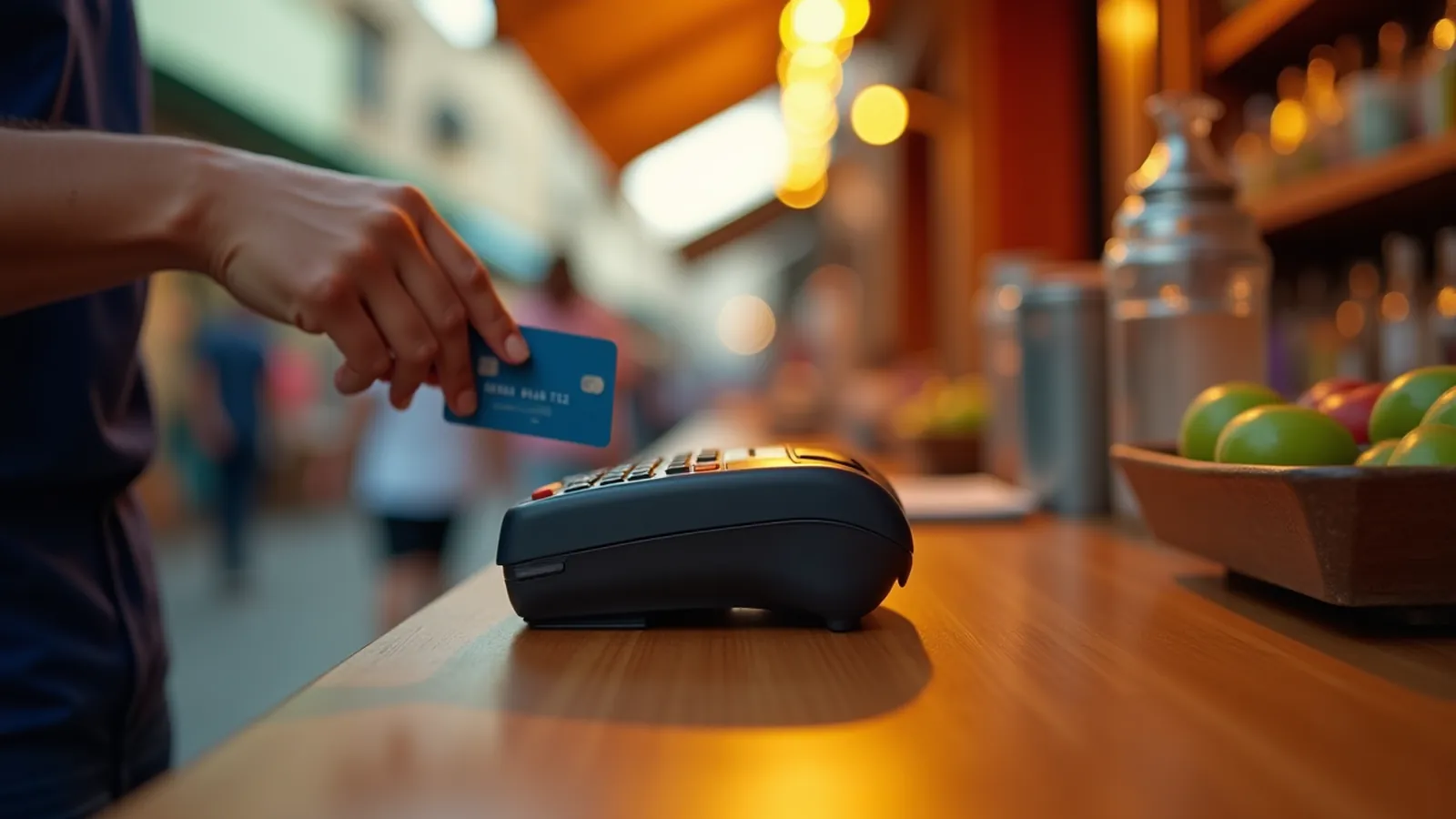
| ¿Puedo pagar con tarjeta? | Can I pay by card? |
| ¿Aceptan tarjeta? | Do you take cards? |
| ¿Efectivo o tarjeta? | Cash or card? |
| Con tarjeta, por favor. | By card, please. |
| Solo efectivo. | Cash only. |
| ¿Hay un cajero cerca? | Is there a cash machine nearby? |
¿Aceptan tarjeta? speaks to the business rather than to one person — plural you, ustedes. The same RAE entry notes that across the Americas ustedes is the only plural form used for several people, formal or informal, which is why it is the natural question to a café. ¿Puedo pagar con tarjeta? says the same thing from your side of the table and is understood anywhere.
Asking is normal, not awkward: card habits differ between a sit-down restaurant and a market stall, so the question is how you find out. If the answer is Solo efectivo, De acuerdo keeps things friendly and ¿Hay un cajero cerca? keeps you moving. For the counter version, the four-step script in pay by card in Spanish covers a shop till.
Run the whole exchange once.
Read it twice: once as the customer, once as the mesero. Alone? Cover the reply column, say your line aloud, then uncover and answer.
| Original practice dialogue | English |
|---|---|
| Customer: La cuenta, por favor. | The bill, please. |
| Mesero: Claro. ¿Todo junto o por separado? | Of course. Together or separately? |
| Customer: Por separado, por favor. ¿Puede traer dos cuentas? | Separately, please. Could you bring two bills? |
| Mesero: Sí, claro. | Yes, of course. |
| Customer: ¿Puedo pagar con tarjeta? | Can I pay by card? |
| Mesero: Sí. Aquí tiene la terminal. | Yes. Here is the card reader. |
| Customer: Gracias. Hasta luego. | Thank you. See you later. |
An illustrative practice dialogue written for this page, not a recording or a transcript of a real café. Your mesero will use their own words.
The ordering half is in the café ordering dialogue, which covers drinks and ¿Algo más?. Two useful words: el mesero and la mesera are the waiter and waitress in Mexico; in Spain you would hear camarero and camarera.
If the reply is unclear, ask again.
This is the part that decides whether the evening ends in Spanish or in English. You do not need every word; you need one way back in.
| Spanish | English |
|---|---|
| Perdón. / Disculpe. | Sorry. / Excuse me. (Disculpe is the polite usted form.) |
| No entiendo. | I don’t understand. |
| ¿Puede repetir, por favor? | Could you repeat that, please? |
| ¿Puede hablar más despacio, por favor? | Could you speak more slowly, please? |
| ¿Puede escribirlo, por favor? | Could you write it down, please? |
All the ¿Puede…? lines use usted, so they work with a stranger and never sound blunt. Pick one, learn it as a single sound, and it stays available when the table is loud. If they answer you in English, it is usually quicker for them, not a verdict on your Spanish: stay in Spanish with ¿Puede decirlo en español, por favor?, or simply carry on.
Cover the Spanish and recall it.
Saying a line from memory, then checking it, moves a phrase from “I have seen it” to “I can say it”. Rereading feels easier, so say the line from memory before you look. Cover the tables, answer these four out loud, then check.
| English prompt | Your Spanish |
|---|---|
| The bill, please. | your phrase |
| Could you bring two bills, please? | your phrase |
| Can we pay separately? | your phrase |
| Can I pay by card? | your phrase |
Check your answers: La cuenta, por favor. · ¿Puede traer dos cuentas, por favor? · ¿Podemos pagar por separado? · ¿Puedo pagar con tarjeta?
- I can ask for the bill with one short line and keep it polite.
- I can ask for two bills before the bill arrives.
- I can ask about my card without switching to English.
- I have one phrase ready for a reply I did not catch.
This is practice, not a proficiency test, and nobody is marking you.
One next step.
Do not collect five resources tonight. Do this once: open the café scenario, read the bill exchange aloud as the customer, then answer the mesero’s lines out loud before you look at the next one.
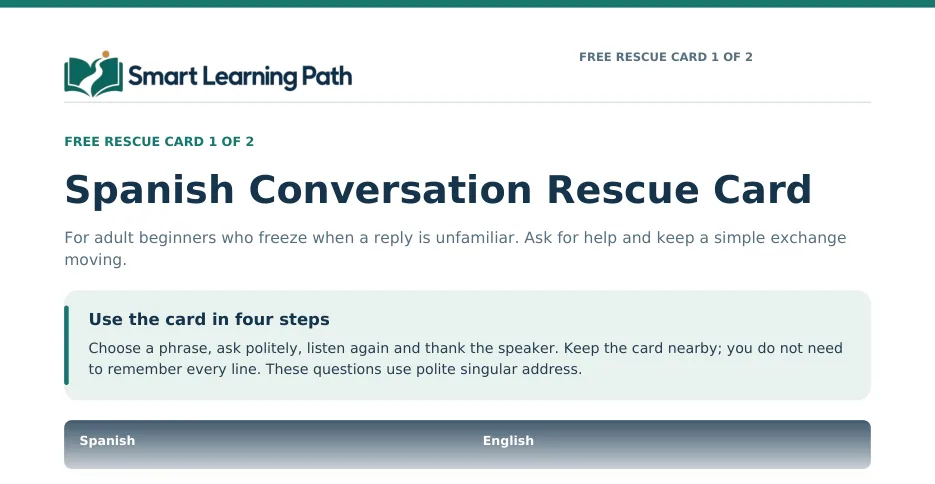
Also useful, one link each: Day 4 of the free 7 Day Spanish Starter Plan for the café lines, and the Conversation Rescue Card, where each rescue phrase links to its own audio.
Common questions.
Can we split the bill in Spanish?
Yes. The short request is ¿Podemos pagar por separado?, and Dos cuentas, por favor explains what you need. Some places take payment at one till, so treat it as a polite request and follow their lead.
How do I ask to split the bill in Spanish?
Ask ¿Puede traer dos cuentas, por favor? — could you bring two bills, please. The usted form puede keeps it polite with staff you do not know.
How do you say pay the bill in Spanish?
Pagar la cuenta means to pay the bill. At the table you say La cuenta, por favor, or Quiero pagar, por favor. In Spain you may also hear ¿Me cobra, por favor?
What if I do not understand the reply?
Say No entiendo, then ¿Puede repetir, por favor? or ¿Puede hablar más despacio, por favor? Asking again is how a conversation keeps going, not a failure.
Practice, not a promise. These tasks help you rehearse everyday Spanish at your own pace. Individual progress varies; nothing here promises a level, a qualification or a fixed learning speed. How we write and check our Spanish
Sources and editorial notes
- Real Academia Española and Asociación de Academias de la Lengua Española, Diccionario panhispánico de dudas: usted (formal treatment; third-person agreement; ustedes as the plural form used across the Americas), retrieved October 18, 2026.
- Smart Learning Path, 7 Day Spanish Starter Plan (Day 4, Dialogue 2 at a café) and Spanish Conversation Rescue Card, our own free materials.
All dialogues here are illustrative practice examples written for this page, not recordings of real conversations. Card rules and payment habits differ by venue and country, so ask locally. Spanish checked with AI review. See our Editorial Policy. Spotted a mistake? Suggest a correction.
Related reading.
Back to the blogPay by Card in Spanish: A 4-Step Counter Script
Hear the total, ask about card, understand the answer.
Order Coffee in Spanish with a Simple Dialogue
A short café exchange you can adapt.
Understand Prices in Spanish at Speed
Catch 'son cincuenta pesos' and pay without guessing.
Try one useful task.
Open the free seven-day plan and practise about ten minutes a day, at your own pace.
No account or payment needed.