
Practice habits
Spanish for expats: practise the scenes you will meet.
Six weeks before the move, the evenings disappear into app games that score points but leave you without one sentence for a landlord or a taxi driver. Here is a smaller routine aimed at the exact scenes waiting for you.
Six weeks out, the evenings have gone.
The plan was a little Spanish each evening before the move. What actually happens is this: you open an app, tap through a few matching games, collect the points, watch the streak number rise, and close it feeling productive. Then you picture a landlord’s door in Mexico City and find you have no sentence for it.
The fear underneath is specific. You will arrive, open your mouth, and nothing will come out. You will be the one who cannot order a coffee, and the person behind the counter will switch to English before you finish. That fear is not silly, and more tapping will not shift it. It shifts in small pieces, when you say sentences aloud about the scenes you are actually moving into.
Below is a routine for that and nothing grander: ten to fifteen minutes a day, one scene at a time, five boxes ticked across the week.

Practise with a seven-day plan.
The free 7 Day Spanish Starter Plan gives you a pronunciation day, seven days of phrases with a dialogue, a listening task and recall prompts, three goal tracks, an answer key and a tracker, 10 to 15 minutes a day. Use it on the web or download the 18-page PDF.
The complete plan is free and open on the web. Enter your email for the printable copy.
Points are not the same as speaking.
Recognising the right word on a screen and producing a sentence out loud to a stranger are two different tasks. An app can train the first while you never once practise the second. That is how a streak can feel like effort and a conversation about a deposit can still feel impossible.
The study advice worth keeping is narrow. The IES What Works Clearinghouse practice guide Organizing Instruction and Study to Improve Student Learning recommends spacing learning over time — returning to the same material after a delay — and using quizzing with active retrieval, pulling the answer out of memory instead of looking at it. Both fit a small daily routine. Neither was written for adult language learners, so treat them as sensible principles, not as evidence about this method.
In practice: three phrases per scene, said from memory, met again later in the week.
Run one scene a day.
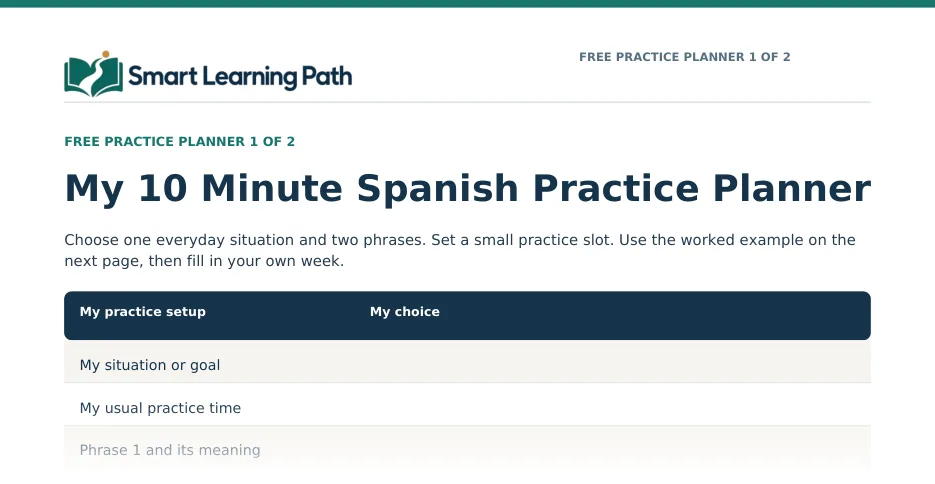
Five steps, ten to fifteen minutes, one scene. The steps are printed on the free 10 Minute Practice Planner if you like a sheet, but you can start in a notebook tonight.
Pick one relocation scene.
Not a topic such as “house vocabulary”, but a moment: asking about a flat, taking a taxi from the airport, greeting a neighbour.
Write three phrases for it.
Two that do the work and one that repairs the conversation when the reply comes back too fast.
Say each phrase aloud twice.
Once reading it, once with the page covered. Slow and clear beats fast and mumbled.
Run one role play.
Say your line, then the likely reply, then your next line. Both parts, out loud, no reading.
Tick one box.
A log of what you said, not a streak of what you opened.
Scene one: renting a flat in Spanish.
Renting is where a small phrase gap gets expensive. You will usually deal with a landlord or an agent, in person or by phone, and the questions arrive quickly. Take three of these first.
| Spanish | English |
|---|---|
| Busco un departamento de dos recámaras. | I am looking for a two-bedroom flat. |
| ¿Puedo ver el departamento? | Can I see the flat? |
| ¿Cuánto es la renta? | How much is the rent? |
| ¿Qué incluye la renta? | What does the rent include? |
| ¿Cuánto es el depósito? | How much is the deposit? |
| ¿Está amueblado? | Is it furnished? |
Examples are illustrative. A real conversation may be shorter, longer or different.
Word choice matters. In Mexico the everyday words are departamento, recámara and renta. In Spain you will hear piso, habitación and alquiler. Neither set is wrong; pick the one that matches where you are going. The walkthrough on renting a flat in Mexico City takes these phrases further.
Tú: Buenos días. Busco un departamento de dos recámaras. · Agente: Claro. ¿Para cuándo lo necesita? · Tú: Para el mes que viene. ¿Puedo verlo esta semana? · Agente: Sí, ¿le parece el jueves? · Tú: Perfecto. ¿Cuánto es la renta?
You: Good morning, I am looking for a two-bedroom flat. Agent: Of course. When do you need it? You: For next month. Can I see it this week? Agent: Yes, does Thursday suit you? You: Perfect. How much is the rent? An original practice dialogue, not a recorded conversation.
Survival phrases, and the travel ones overlap.
These appear in almost every day of your first month, and they cover most of what you need as Spanish phrases for travel too. Learn them as sounds, then say them from memory.
| Spanish | English |
|---|---|
| Buenos días. | Good morning. |
| Por favor. / Gracias. | Please. / Thank you. |
| ¿Dónde está el baño? | Where is the bathroom? |
| Un café, por favor. | A coffee, please. |
| La cuenta, por favor. | The bill, please. |
| ¿Me puede llevar a esta dirección, por favor? | Can you take me to this address, please? |
| No entiendo. | I do not understand. |
| ¿Puede repetir, por favor? | Can you repeat, please? |
Examples are illustrative, not a script for every shop or café.
¿Puede…? is the polite singular form, used with usted — the safe default with a stranger at a counter or an official desk. With friends you would say ¿Puedes…?. In Mexico you will also hear ¿Mande? where other countries say ¿Cómo?; it means “pardon?” and is a normal, polite request to repeat something. Airport, hotel and restaurant lines sit in the guide to Spanish phrases for your first trip.

Tick five boxes, not a streak.
A streak rewards opening the app. A log records something you did with your voice. Draw five boxes for the working week and fill one after each session.
- Monday: the new scene, and my three phrases
- Tuesday: the same phrases, from memory, out loud
- Wednesday: a different scene
- Thursday: role play, both parts
- Friday: last week’s scene, recalled out loud
If a box stays empty, leave it empty. The log is a record, not a score, and a missed box is information: usually the slot was too long or the scene was too big.
Is this another free site that will upsell me?
Fair question, and it deserves a plain answer rather than a countdown timer.
Free to read in the browser: the seven-day starter plan is written out phrase by phrase on its own page — hello, asking someone to repeat, a café dialogue, directions, a recall day and three role plays. No account and no microphone needed to work through it.
Free files, email asked: the same plan, the Conversation Rescue Card and the Practice Planner also exist as PDFs with editable Word twins. A download click opens a sign-up box for a first name and email; reply VERIFY to the short email and the file follows. The routine above works without any of them.
Paid, and not open: a starter toolkit (planned at $39 one-time), a four-week conversation course (planned at $249) and a practice membership (planned at $39 a month) are described on the pricing page. There is no checkout, no dates and no coach name, and nothing starts on its own.
Choose tonight’s scene.
Before you close the tab, pick the scene that unsettles you most — the landlord, the taxi, the pharmacy — and write three phrases for it. Say each one aloud twice, then play both parts of the exchange once. That is ten minutes, and it is the whole method.
| My scene this week | e.g. asking about a flat |
|---|---|
| Phrase 1 and meaning | your phrase |
| Phrase 2 and meaning | your phrase |
| My repair phrase | your phrase |
Your task: fill in three phrases for one scene today and say each of them aloud twice before you stop.
Read the seven-day plan See the relocation path
The plan page is free to read in your browser. An email is only needed if you want the printable PDF or Word copy.
Questions you may be asking.
What Spanish should I learn first before moving to Mexico City?
The scenes you will meet in your first fortnight: greeting a landlord, asking about a flat, taking a taxi, ordering food and asking someone to repeat. Three phrases per scene, said aloud, is a better early use of ten minutes than a long word list.
How do I talk about renting in Spanish?
Begin with Busco un departamento (I am looking for a flat), ¿Cuánto es la renta? (how much is the rent?) and ¿Puedo verlo? (can I see it?). In Mexico you will hear departamento, recámara and renta; in Spain, piso, habitación and alquiler.
What are the most useful Spanish survival phrases?
Buenos días (good morning), por favor (please), ¿Dónde está el baño? (where is the bathroom?), la cuenta, por favor (the bill, please) and no entiendo (I do not understand). Add ¿Puede repetir, por favor? and you have one more turn in most conversations.
Do I need an app or a microphone to practise?
No. Three phrases, a pen and your voice. The free plan and tools here are text and PDF files and nothing listens to you; whether a session works depends on saying the phrases out loud rather than reading them.
Practice, not a promise. These tasks help you rehearse everyday Spanish at your own pace. Individual progress varies; nothing here promises a level, a qualification or a fixed learning speed. How we write and check our Spanish
Sources and editorial notes
- Content basis: the Smart Learning Path 7 Day Spanish Starter Plan and 10 Minute Practice Planner.
- Institute of Education Sciences, What Works Clearinghouse, Organizing Instruction and Study to Improve Student Learning (practice guide, 2007), retrieved October 18, 2026. It lists recommendations on spacing learning over time and on using quizzing with active retrieval. It was written for school subjects and says nothing about this routine.
- Regional word notes on departamento, renta and ¿Mande? checked by our editors; no independent teacher review yet.
The timings are a flexible planning aid. Examples are illustrative and this is practice, not a fluency test; progress varies from person to person. Spanish checked by our editors. See our Editorial Policy. Spotted a mistake? Suggest a correction.
Related reading.
Visit the blogSpanish for Moving Abroad: First Everyday Questions
Short questions for a new setting.
Spanish Phrases for Your First Trip
Greet, order, ask where something is and clarify.
Spanish for Relocation
Everyday questions for a new place.
Ten minutes a day, one scene at a time.
The seven-day starter plan is free to read in your browser, phrase by phrase, with a café dialogue on Day 4.
No account or payment needed.