
Getting started
Spanish vocabulary for renting a flat in Mexico City.
Your prep time is short. These twenty words cover the five conversations a flat hunt actually needs, from the deposit to the wifi password.
You do not need more phrases. You need these five scenes.
Hours go on sentences like “the pen is on the table”, and then a landlord asks about the deposit and nothing comes out. The list is usually the problem: beginner lists are organised by grammar, while a real conversation is organised by task.
Renting a flat in Mexico City is one task. It runs in five small scenes: the rent, the deposit, the keys, the bills, the wifi. Twenty words cover them. Read each phrase aloud, check the English, cover it, then say it again.
This week’s practice: ask the rent, check the deposit, get the keys, ask who pays the bills, ask for the wifi password.
Practise with a seven-day plan.
The free 7 Day Spanish Starter Plan gives you a pronunciation day, seven days of phrases with a dialogue, a listening task and recall prompts, three goal tracks, an answer key and a tracker, 10 to 15 minutes a day. Use it on the web or download the 18-page PDF.
The complete plan is free and open on the web. Enter your email for the printable copy.
Scene 1: ask about the rent.
In Mexico City the rent is la renta.
| Spanish | English |
|---|---|
| la renta | the rent |
| el departamento | the flat |
| el dueño / la dueña | the landlord |
| el contrato | the contract |
Busco un departamento en renta. (I am looking for a flat to rent.) ¿Cuánto es la renta? (How much is the rent?) Tengo que pagar la renta el día primero. (I have to pay the rent on the first of the month.) That last one is how you say “pay rent” in Spanish: pagar la renta.
You will also hear el depa, short for departamento. Use the full word in a first message.
Scene 2: check the deposit.
This is the question people forget, and it is the one that costs money.
| Spanish | English |
|---|---|
| el depósito | the deposit |
| un mes de renta | one month’s rent |
| el recibo | the receipt |
| incluido / incluida | included |
¿Cuánto es el depósito? (How much is the deposit?) ¿El depósito es un mes de renta? (Is the deposit one month’s rent?) ¿Me da un recibo, por favor? (Will you give me a receipt, please?)
Watch the ending on incluido: ¿Está incluida la luz? (Is electricity included?) but ¿Están incluidos los servicios? (Are utilities included?)
Scene 3: get the keys.
| Spanish | English |
|---|---|
| la llave | the key |
| el inquilino / la inquilina | the tenant |
| la copia | the copy |
| la cerradura | the lock |
¿Me da las llaves, por favor? (Will you give me the keys, please?) Quiero una copia de la llave. (I want a copy of the key.) La cerradura no funciona. (The lock is not working.) Soy el nuevo inquilino. (I am the new tenant.) If you are a woman, say Soy la nueva inquilina.
The ll in llaves sounds like the y in “yes” in most places, including Mexico City.
Scene 4: ask who pays the bills.
| Spanish | English |
|---|---|
| los servicios | the utilities |
| la luz | electricity |
| el agua | water |
| el gas | gas |
¿Están incluidos los servicios? (Are utilities included?) ¿Quién paga la luz? (Who pays the electricity?) Los servicios no están incluidos. (Utilities are not included.)
Scene 5: sort out the wifi.
One question does a lot of work: ¿Cuál es la contraseña del wifi? (What is the wifi password?)
| Spanish | English |
|---|---|
| el wifi | the wifi |
| la contraseña | the password |
| el internet | the internet |
| el técnico / la técnica | the technician |
¿Hay internet en el departamento? (Is there internet in the flat?) El internet no funciona. (The internet is not working.) ¿Puede mandar un técnico? (Can you send a technician?)

One note on alquiler and renta.
You will meet el alquiler in articles and paperwork. In Mexico City, la renta is what people say. Other countries use other words for the same idea, and arriendo is one you may hear too. Learn the pair, then use the one you hear around you.
| English | Mexico | Spain |
|---|---|---|
| the rent | la renta | el alquiler |
| the deposit | el depósito | la fianza |
| the landlord | el dueño, la dueña | el casero, la casera |
A rough map, not a rule. Word choices vary by country and even by city; use the version you hear where you live. For Mexico City, keep la renta.
Put the five scenes into one dialogue.
A: Hola, buenas tardes. Busco un departamento en renta. · B: Sí, hay uno disponible. · A: ¿Cuánto es la renta? · B: Un mes de renta, y el depósito es otro mes. · A: ¿Están incluidos los servicios? · B: La luz y el agua no están incluidos. · A: ¿Y la contraseña del wifi? · B: Se la doy el día del contrato.
A: Hello, good afternoon. I am looking for a flat to rent. B: Yes, there is one available. A: How much is the rent? B: One month’s rent, and the deposit is another month. A: Are utilities included? B: Electricity and water are not included. A: And the wifi password? B: I will give it to you on the day of the contract. An original practice dialogue, not a recorded conversation.
Both speakers use the polite usted forms here (se la doy, not te la doy), which is the safer choice with a landlord you have just met. Read both parts aloud twice, then read only part A and let the English stand in for B. Finally change one detail: ask about the gas instead of the water.
Add Spanish small talk at the door.
The first minute with a landlord is usually small talk, and that is where nerves show. Use usted, the polite form, with someone you have just met. It takes the same verb forms as él and ella: ¿Cómo está?, not ¿Cómo estás?
| Spanish | English |
|---|---|
| Buenas tardes. ¿Cómo está? | Good afternoon. How are you? |
| Me mudé por trabajo. | I moved for work. |
| ¿Puede repetir, por favor? | Can you repeat, please? |
| ¿Puede hablar más despacio, por favor? | Can you speak more slowly, please? |
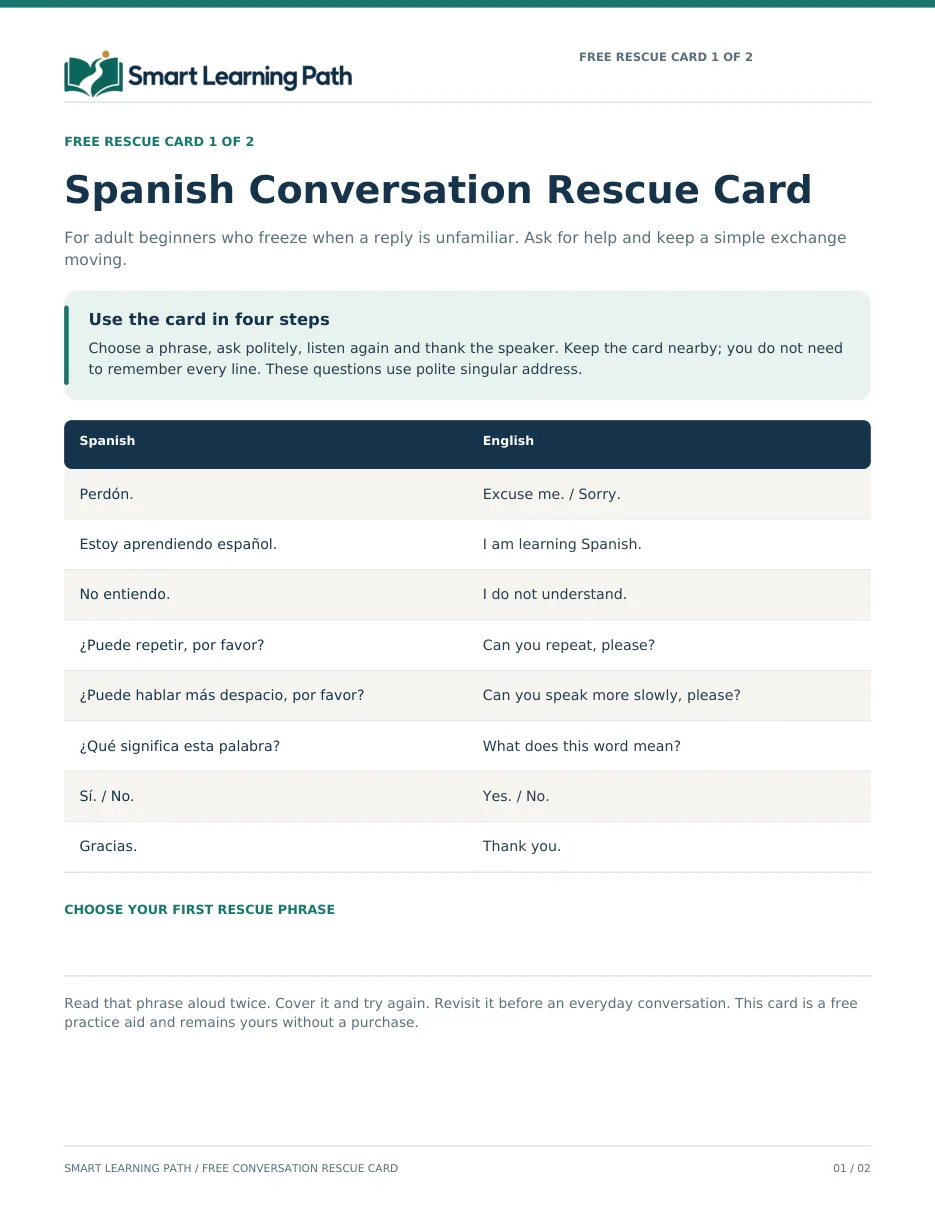
The last two keep a conversation alive when an answer arrives too fast. The free Conversation Rescue Card keeps them on two printable pages, and Day 2 of the free 7 Day Spanish Starter Plan is built around them. For more opening lines, see our greetings guide.
Make it daily Spanish conversation practice.
Speaking practice works better in short, repeated turns than in one long session. One scene a day gets all twenty words said aloud several times in a week.
Read and say.
Take one scene and read the Spanish aloud twice.
Cover and recall.
Hide the English and say each word from the Spanish.
Role play.
Read part A of the viewing dialogue and answer yourself as B.
Note what to repeat.
Write down the phrase that would not come. That is tomorrow’s first minute.
The 10-minute routine walks through the same steps with a worked example, and our relocation pages put vocabulary next to the situation it belongs to. A US Department of Education practice guide recommends spacing learning over time and using quizzes to re-expose learners to key content. Our loop borrows those ideas in a small way; it is a planning example, not a promise about learning speed.
Is this just another app that teases you?
Fair question. Here is exactly what this page is and is not.
- No points or streaks. Nothing here rewards you for opening the site.
- The free plan is on a web page. All seven days, including both dialogues, are readable without an account.
- Downloads are separate. A PDF or Word file opens a short form (first name and email), then an email follows; every email has an unsubscribe link.
- Paid options are planned, not open. The pricing page lists planned prices for a toolkit, a four-week course and a membership. There is no checkout, and nothing starts automatically.
- Spanish checked by our editors. No independent teacher review yet. Our Editorial Policy explains how pages are checked.
What that means in practice: ten minutes here goes on words you will use in Mexico City, not on a score.
Common questions.
How do I say “pay rent” in Spanish?
Use pagar with la renta in Mexico: Tengo que pagar la renta. (I have to pay the rent.) In Spain you would usually say pagar el alquiler.
Is it renta or alquiler in Mexico City?
La renta is the everyday word in Mexico. Other countries use other words for the same idea, for example arriendo or alquiler. Both are correct Spanish; use the one you hear locally.
Do I need an account to read this page?
No. The twenty words and the dialogue are on this page, and the seven-day plan is readable on the site without signing in. Only the downloadable files ask for a first name and email.
How much Spanish do I need before a viewing?
These twenty words and a few clarification phrases are enough to start. If an answer comes too fast, say ¿Puede repetir, por favor?
Practice, not a promise. These tasks help you rehearse everyday Spanish at your own pace. Individual progress varies; nothing here promises a level, a qualification or a fixed learning speed. How we write and check our Spanish
Sources and editorial notes
- Smart Learning Path, 7 Day Spanish Starter Plan (Day 2 clarification phrases, Day 5 asking where things are) and Conversation Rescue Card (our own free materials).
- Real Academia Española and ASALE, Diccionario panhispánico de dudas, “usted” (formal address with third-person verb forms), retrieved October 18, 2026.
- Institute of Education Sciences, What Works Clearinghouse, Organizing Instruction and Study to Improve Student Learning (practice guide: space learning over time, use quizzes to re-expose learners to key content), retrieved October 18, 2026.
Examples are illustrative, and word choices vary by country; use the version you hear where you live. Spanish checked by our editors. See our Editorial Policy. Spotted a mistake? Suggest a correction.
Related reading.
Back to the blogSpanish for Relocation
Everyday questions for a new place.
Spanish for Moving Abroad: First Everyday Questions
Short questions for a new setting.
How to Ask Someone to Repeat or Slow Down in Spanish
Polite phrases for a fast or unclear reply.
Practise the flat-hunting words free.
The 7 Day Spanish Starter Plan is on the web, with two dialogues and a printable tracker. Ten minutes a day.
No account or payment needed.