
Everyday situations
Kilo in Spanish: ask the price per kilo, then the total.
A market stall is short, and two of its lines are numbers. Here is how to ask what a kilo costs, ask for half or a quarter, and hear quince against cincuenta before you pay.
Practice dialogue written for this page, not a recording.
Fifteen. Fifty. The two prices differ by one small sound, and by the time you have worked out which one you heard, the vendor has already said the total, looked past you and asked ¿Algo más? You nod. You hand over a note. A minute later, outside the stall, you work out that you paid three times what the card said — and you still cannot tell whether you were overcharged or simply misheard.
That is the fear in plain words: you will arrive, open your mouth, and nothing will come out. Not because you cannot learn words, but because a market stall gives you a few seconds to answer, and the numbers arrive fastest of all. Fifteen and fifty. Eighteen and eighty. They are the whole risk, and they are also the easiest part of Spanish to drill, because there are only four of them.
This page is one small, fixed scene: how to ask the price per kilo, how to ask for half or a quarter, how to hear quince against cincuenta, and how to ask for the total before you pay rather than afterwards.
What this page is. A vendor script, a number drill and a role play you can read here in the browser — no account, no microphone, no app to install. There are no affiliate links on this page. The site does sell optional paid extras, our own phrase packs and a self-paced course, and the pricing page says plainly what each one costs. The test for this page is simple: by the end you should have said four Spanish sentences out loud.
Your task: run the stall script out loud, then tell the difference between four prices — 15, 50, 18 and 80 pesos — without checking the page.
Practise with a seven-day plan.
The free 7 Day Spanish Starter Plan gives you a pronunciation day, seven days of phrases with a dialogue, a listening task and recall prompts, three goal tracks, an answer key and a tracker, 10 to 15 minutes a day. Use it on the web or download the 18-page PDF.
The complete plan is free and open on the web. Enter your email for the printable copy.
Kilo in Spanish is kilo. The quantities are the work.
Kilo is the word you already know, short for kilogramo, and it is what a market stall sells fruit and vegetables by. The Spanish-to-English half of this is easy. What takes practice is the quantity in front of the word and the number that comes after it.
| Spanish | English |
|---|---|
| el kilo | the kilo |
| un kilo de manzanas | one kilo of apples |
| medio kilo, por favor | half a kilo, please |
| un cuarto de kilo | a quarter of a kilo |
| tres cuartos de kilo | three quarters of a kilo |
| un kilo y medio | a kilo and a half |
| por pieza | by the piece |
Two small things worth knowing. Medio goes before the noun and agrees with it — medio kilo, but media docena for half a dozen. And not every stall sells by weight: some fruit is priced por pieza, by the piece, so the number on the card may not be a price per kilo at all. Asking settles it in one line.
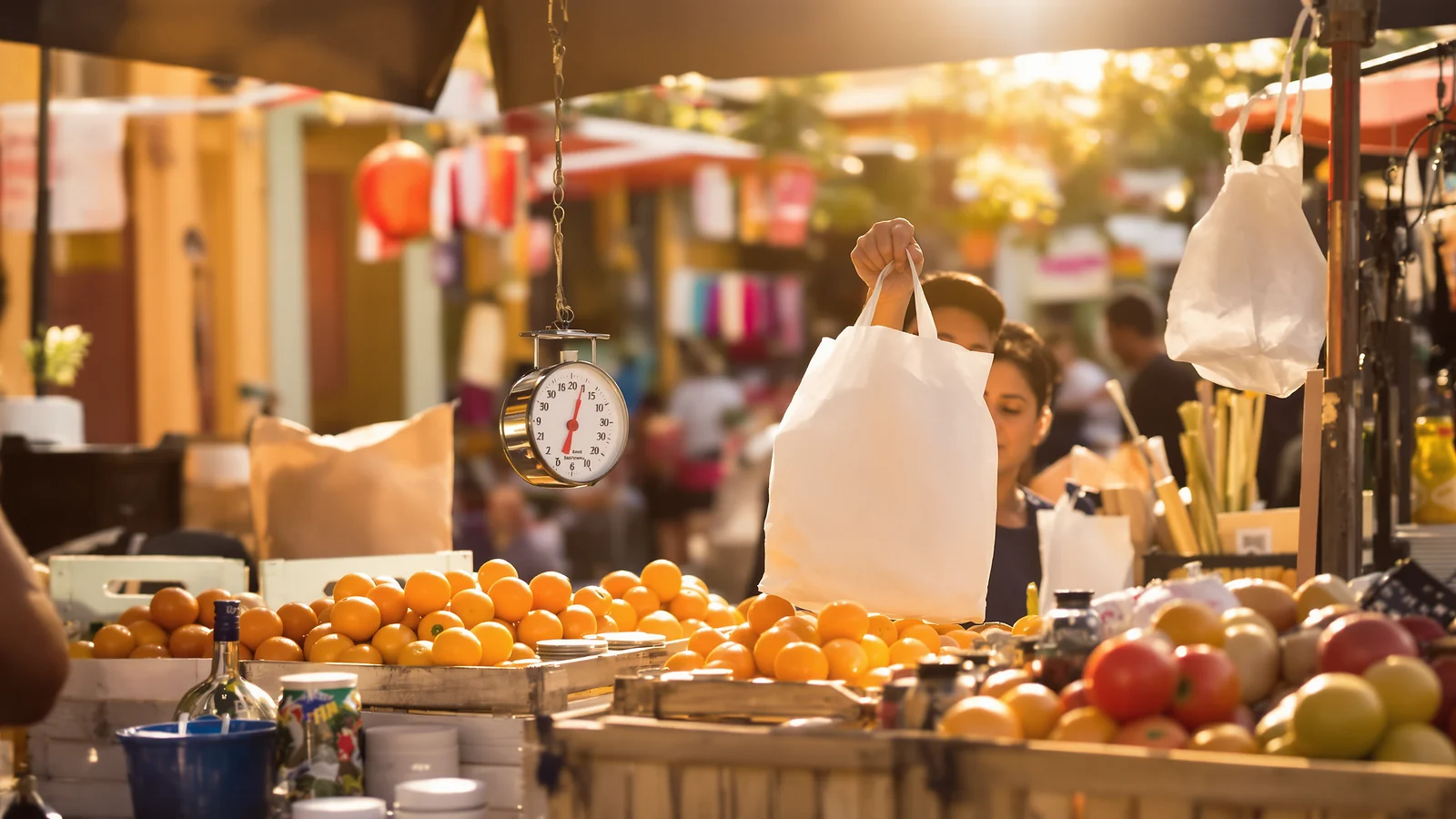
Ask the price, then ask the total.
Two questions carry the whole exchange. ¿Cuánto cuesta el kilo? means how much is a kilo. ¿Cuánto es en total? means how much is it altogether. Ask the first before you point at anything, and the second before you hand over money. Neither is rude; both are exactly what a local says at the same stall.
| Spanish | English |
|---|---|
| ¿Cuánto cuesta el kilo? | How much is a kilo? |
| ¿A cuánto está el kilo? | How much is the kilo going for? (a common market variant) |
| ¿Cuánto cuesta la pieza? | How much is it per piece? |
| Medio kilo, por favor. | Half a kilo, please. |
| Un cuarto de kilo, por favor. | A quarter of a kilo, please. |
| ¿Algo más? | Anything else? (the vendor asks this) |
| Nada más, gracias. | Nothing else, thanks. |
| ¿Está bien así? | Is that all right? (checking the amount weighed) |
| ¿Cuánto es en total? | How much is it altogether? |
Notice cuesta, not cuestan. The subject is el kilo, one thing, so the verb stays singular. If you point at two different items and ask about both, it becomes ¿Cuánto cuestan? — how much are they? Using the singular for one kilo is correct, and it is what you will hear.
A: ¿Cuánto cuesta el kilo de plátanos? · B: Cincuenta pesos. · A: Medio kilo, por favor. · B: ¿Algo más? · A: Nada más, gracias. ¿Cuánto es en total?
An illustrative practice dialogue written for this page, not a recording. The prices are made up for practice.
Read it once as the vendor, once as yourself. The vendor’s half is three lines long, which is the point: you are not carrying the conversation. You are slotting four short replies into a scene that runs the same way at almost every stall.
Quince or cincuenta? Dieciocho or ochenta?
If numbers are the part that defeats you, it is usually two pairs: 15 and 50 (quince, cincuenta) and 18 and 80 (dieciocho, ochenta). Getting one wrong is expensive, and it is also the easiest thing on this page to fix, because the two numbers in each pair have a different shape in the mouth as well as on the page.
| Spanish | English |
|---|---|
| quince | fifteen |
| cincuenta | fifty |
| dieciocho | eighteen |
| ochenta | eighty |
| quince pesos el kilo | fifteen pesos a kilo |
| cincuenta pesos el kilo | fifty pesos a kilo |
Quince is short and ends on a soft e sound. Cincuenta is longer, with the stress in the middle syllable, cuen. Dieciocho opens with die; ochenta starts on an o and carries chen. Say each pair aloud five times slowly, then five times fast. A difference you can hear in your own mouth is a difference you will catch across a counter.
Say the pairs aloud.
Quince, cincuenta. Dieciocho, ochenta. Five rounds slowly, then five at speed. Look away from the page for the last two rounds.
Record one number and name it back.
Say one of the four numbers into your phone’s voice recorder, pause, then play it back and write down which one you heard. Eight rounds, mixing the two pairs. Nothing leaves your phone; this is your own ear you are training.
Put the number back inside a price.
Say Quince pesos el kilo, then Cincuenta pesos el kilo, then ¿Cuánto es en total? after each. A number on its own is easy; a number inside a price is the skill you actually need.
The prices used on this page are illustrative examples for practice, not typical market prices.
Run the stall out loud, then check.
Cover the right-hand column and say your line for each English prompt before you look. Then check below — and if a line stalls, cover it again and repeat that one pair, not the whole table.
| English prompt | Your Spanish |
|---|---|
| How much is a kilo? | your line |
| Half a kilo, please. | your line |
| A quarter of a kilo, please. | your line |
| Nothing else, thanks. | your line |
| How much is it altogether? | your line |
Check your answers: ¿Cuánto cuesta el kilo? · Medio kilo, por favor. · Un cuarto de kilo, por favor. · Nada más, gracias. · ¿Cuánto es en total?
This is practice, not a fluency test. Nobody marks it, and getting a line wrong here costs nothing. Repeat the round on three separate days, starting from memory each time, rather than five times tonight.
- I can ask the price per kilo without switching to English.
- I can ask for half or a quarter of a kilo.
- I can ask for the total before I hand over money.
- I can tell quince from cincuenta.
The free 10 Minute Practice Planner has a seven-day log with from-memory and with-a-prompt ticks, if you want those three days written down somewhere.
Different from the app you already tried?
Fair question, and an honest answer has two halves. No web page can tell you how a stall will feel on the day. What this page can do is give you the lines and the number pairs here in the browser, with nothing to install, no microphone and no account to create. If you want to hear yourself, your phone’s recorder is enough.
On the second half of the worry: the free material is not a two-page teaser that stops at the good bit. The 7 Day Spanish Starter Plan is an 18-page PDF, and the whole plan also sits on the web page, so you can judge the plan in the browser first; the PDF itself comes by email (first name and email, then a short VERIFY reply). The Conversation Rescue Card is two pages of phrases that buy you time, and it arrives the same way. None of it needs the paid side.
The paid side exists and it is optional: three phrase packs (Travel, Family and Relocation, $9 each or $19 for all three) and the $49 self-paced course Spanish Conversation Foundations, with no live sessions, teacher or feedback. One-time payment through Stripe, full refund within 30 days — see pricing and the refund policy. None of it is needed for the stall script above, and none of it promises that you will speak on the day. Progress varies; the practice is what does the work.
What you will not find here is a streak, points or a leaderboard. Those are very good at making you feel productive. Saying quince and cincuenta out loud until they stop being a guess is less entertaining, and much closer to the thing you actually need at the counter.
One next step.
Tonight, ten minutes: run the stall dialogue out loud twice, then the four prices until quince, cincuenta, dieciocho and ochenta arrive without looking. Tomorrow, try the same four numbers silently, in your head, in a queue.
Try the numbers quiz at the till
Also useful, one link each: market phrases for buying fruit, for the lines either side of the price, and understanding prices at speed, for the numbers said quickly at a counter.
Common questions.
What does kilo mean in Spanish to English?
It means kilo, short for kilogramo (kilogram). It is the same word in both languages for the unit of weight, and at a market it is usually what the price is quoted per: un kilo de manzanas is one kilo of apples. To ask the price, say ¿Cuánto cuesta el kilo?
How do you say half a kilo in Spanish?
Medio kilo. At a stall you would say Medio kilo, por favor. Slightly more polite and just as common: ¿Me da medio kilo, por favor?
How do you say one kilo in Spanish?
Un kilo. Kilo is masculine, so it takes un: un kilo de plátanos. Two kilos is dos kilos, and a kilo and a half is un kilo y medio.
How do you say quarter kilo in Spanish?
Un cuarto de kilo. At a stall you will also hear just un cuarto, with kilo understood. Three quarters is tres cuartos de kilo.
Why do quince and cincuenta sound alike at a market?
They are different words, but at speed the difference is easy to miss. Quince (15) is short and ends on a soft e sound. Cincuenta (50) is longer, with the stress in the middle syllable, cuen. Practise the pair aloud slowly, then fast, until the difference stops being a guess.
Practice, not a promise. These tasks help you rehearse everyday Spanish at your own pace. Individual progress varies; nothing here promises a level, a qualification or a fixed learning speed. How we write and check our Spanish
Sources and editorial notes
- Smart Learning Path, 7 Day Spanish Starter Plan (an 18-page PDF, also readable on the web page; includes the days on shopping and catching a price), our own free material.
- Smart Learning Path, 10 Minute Practice Planner and Conversation Rescue Card (free two-page printables), our own free material.
- Smart Learning Path, Spanish Numbers Listening Quiz at the Till (companion number practice on this site).
All dialogues and prices on this page are illustrative practice material written for this page, not recordings of real conversations and not a record of market prices. Spanish checked with AI review. See our Editorial Policy. Spotted a mistake? Suggest a correction.
Related reading.
Back to the blogBuying Fruit in Spanish: Market Phrases and Numbers
Ask for a kilo, catch the total, hand over the note.
Understand Prices in Spanish at Speed
Catch 'son cincuenta pesos' and pay without guessing.
Spanish Numbers Listening Quiz at the Till
Drill 15 to 100 so the total lands the first time.
New on this topic: Quince vs Cincuenta in Spanish: 15 or 50?
Try one useful task.
Open the free seven-day plan and practise about ten minutes a day, at your own pace.
No account or payment needed.