
Everyday situations
Buy fruit in Spanish with one line at the counter.
Prices at a market come per kilo, then all at once as a total, and the numbers are where a beginner loses the thread. Here is the counter dialogue, the price words and a short drill on pairs like 15 and 50.
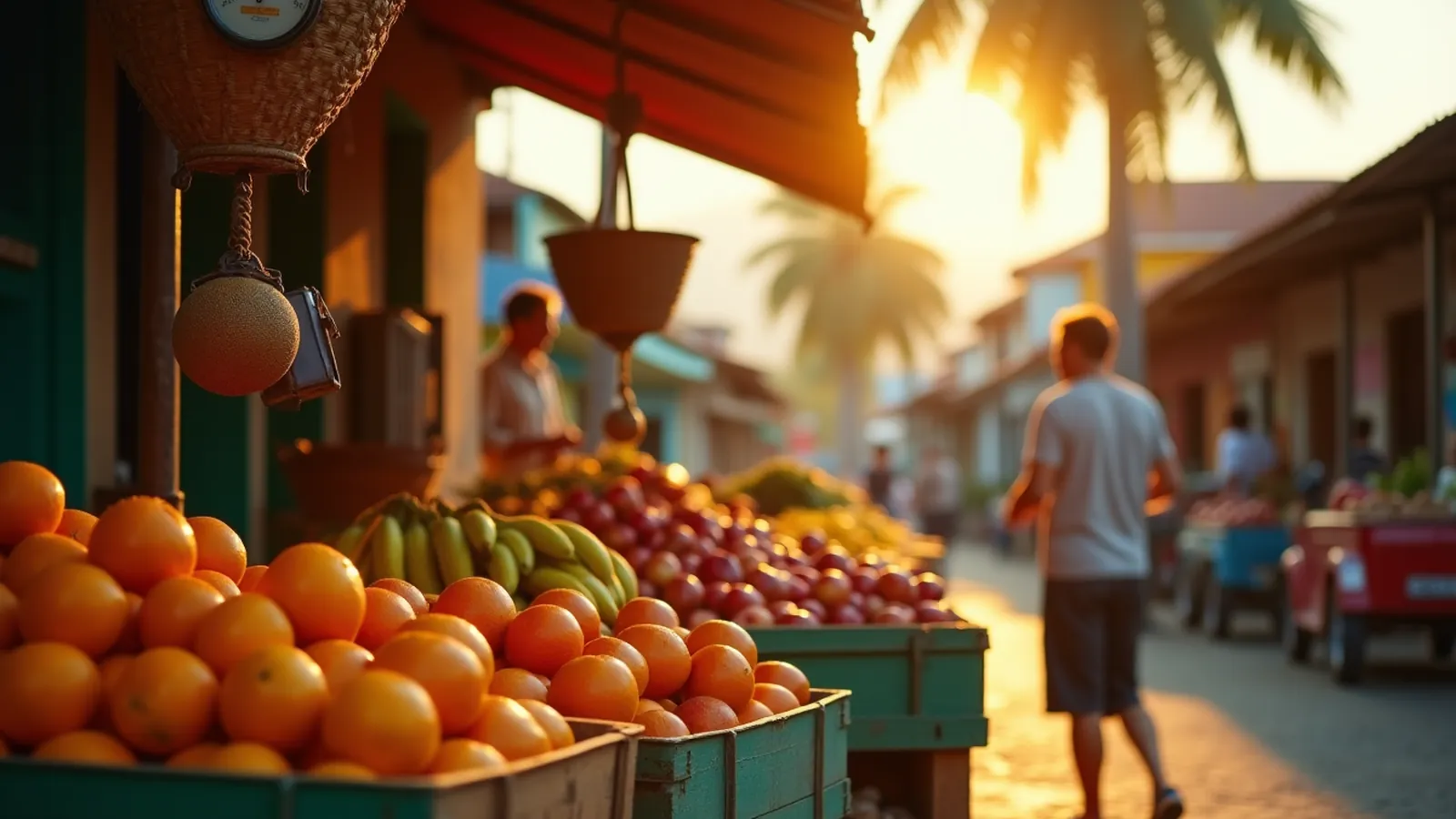
Your task: ask for a kilo, hear the price per kilo, check the total and pay the right amount. Say each line aloud.
You know the word for apples. Then the vendor gives a price per kilo, adds a second item and says the total in one quick breath, and the difference between 15 and 50 disappears. You hand over a note and hope. The fix is not more vocabulary: it is one short counter dialogue you can say without thinking, plus a drill on the numbers that actually get misheard.
Practise with a seven-day plan.
The free 7 Day Spanish Starter Plan gives you a pronunciation day, seven days of phrases with a dialogue, a listening task and recall prompts, three goal tracks, an answer key and a tracker, 10 to 15 minutes a day. Use it on the web or download the 18-page PDF.
The complete plan is free and open on the web. Enter your email for the printable copy.
Ask for a kilo in one line.
At a market counter you do not need a sentence with a verb. The pattern is the amount, then de, then the fruit, then por favor. Read the table, then say each line aloud.
| Spanish | English |
|---|---|
| Un kilo de manzanas, por favor. | A kilo of apples, please. |
| Medio kilo de fresas, por favor. | Half a kilo of strawberries, please. |
| Dos kilos de naranjas, por favor. | Two kilos of oranges, please. |
| ¿Cuánto cuesta el kilo? | How much does a kilo cost? |
| ¿Cuánto es? | How much is it altogether? |
| Nada más, gracias. | Nothing else, thank you. |
Use un, not uno, in front of a masculine noun: un kilo, un melón. The fruit does not change the pattern: un kilo de manzanas, dos kilos de manzanas.
Produce words vary between countries, and even between markets, so the stall may use a word your app never taught. That is not a problem: point and ask ¿Me da un kilo de esto, por favor? If you want the name, ask ¿Cómo se llama esto?
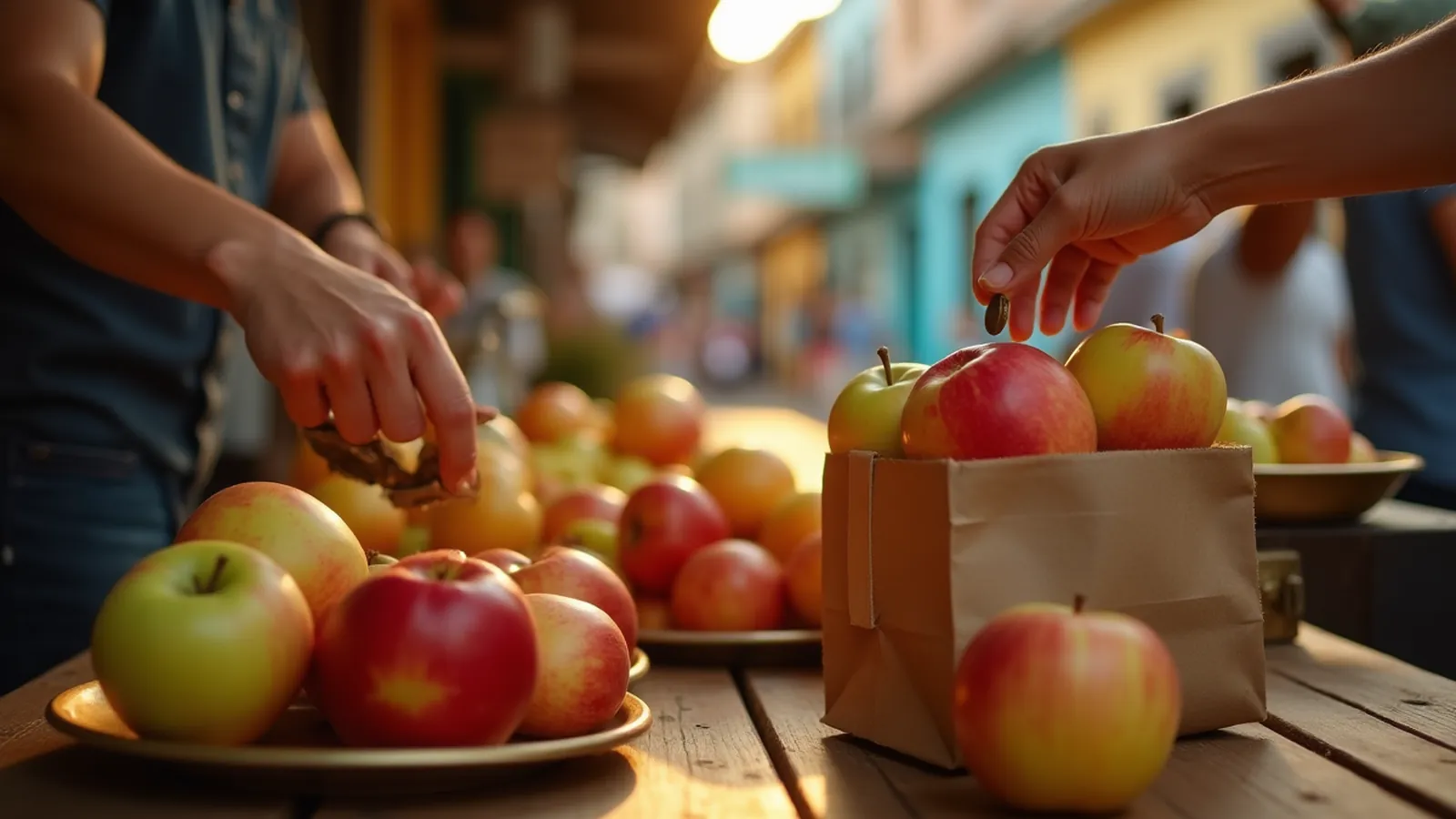
Walk through the counter dialogue.
Read it once as the learner and once as the vendor. Practising alone, cover the vendor lines and answer aloud before you look.
| Original practice dialogue | English |
|---|---|
| Learner: Buenas tardes. ¿A cuánto está el kilo de manzanas? | Good afternoon. How much is a kilo of apples? |
| Vendor: A cincuenta pesos. | Fifty pesos. |
| Learner: Un kilo, por favor. ¿Y el plátano? | A kilo, please. And the banana? |
| Vendor: Cuarenta el kilo. | Forty a kilo. |
| Learner: Medio kilo de plátano, por favor. | Half a kilo of banana, please. |
| Vendor: ¿Algo más? | Anything else? |
| Learner: Nada más, gracias. ¿Cuánto es? | Nothing else, thank you. How much is it? |
| Vendor: Son setenta pesos. | That is seventy pesos. |
| Learner: Aquí tiene. Gracias. | Here you are. Thank you. |
| Vendor: Gracias a usted. Hasta luego. | Thank you. See you later. |
An original practice dialogue, not a recorded conversation. The prices are illustrative, not real market prices, and the currency word changes by country.
The total is 70 pesos: 50 for a kilo of apples plus 20 for half a kilo of bananas at 40 a kilo. Doing that sum while the vendor is still talking is what catches a number you misheard.
The same ask, listen, answer loop sits on Day 4 of the free 7 Day Spanish Starter Plan, with a café counter instead of a market stall.
Catch the price and the total.
Vendors give prices in short phrases, not sentences. Recognise these three and you can stay calm with your hand on your wallet.
| You might hear | English | A reply that works |
|---|---|---|
| A cincuenta el kilo. | Fifty a kilo. | Un kilo, por favor. |
| Son setenta pesos. | That is seventy pesos. | Aquí tiene. |
| ¿Algo más? | Anything else? | Nada más, gracias. |
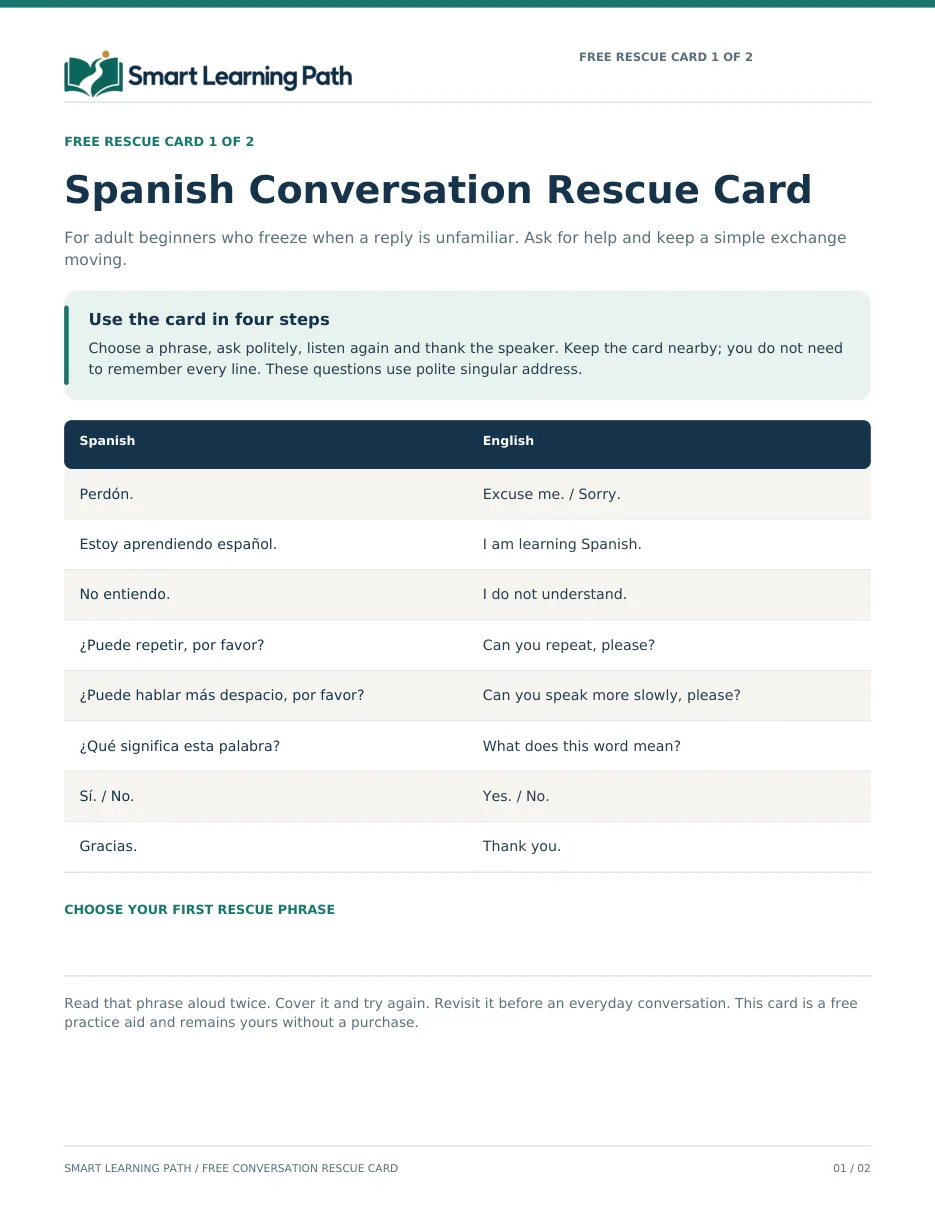
Ask for the total on purpose. ¿Cuánto es? puts the number in front of you before you hand over a note, so you can check it against your own sum. If the reply still runs past you, ¿Puede repetir, por favor? buys a second hearing; the free Conversation Rescue Card keeps those clarification phrases on one page.
Tell 15 from 50, then count to 100.
Most market confusion is not grammar; it is one number heard as another. A kilo at 15 and a kilo at 50 are very different purchases.
| Teens | Number | Tens | Number |
|---|---|---|---|
| trece | 13 | treinta | 30 |
| catorce | 14 | cuarenta | 40 |
| quince | 15 | cincuenta | 50 |
| dieciséis | 16 | sesenta | 60 |
| diecisiete | 17 | setenta | 70 |
| dieciocho | 18 | ochenta | 80 |
| diecinueve | 19 | noventa | 90 |
Two cues help. The teens up to 15 are short: once, doce, trece and quince have two syllables, while catorce has three (ca-tor-ce). The tens from 40 up end in -enta: cuarenta, cincuenta, sesenta, setenta, ochenta, noventa. Three syllables and an -enta ending means tens, not teens. If it still slips past, say it back: ¿Quince o cincuenta?
The numbers in Spanish 1-20.
The numbers in Spanish 1-20 are uno, dos, tres, cuatro, cinco, seis, siete, ocho, nueve, diez, once, doce, trece, catorce, quince, dieciséis, diecisiete, dieciocho, diecinueve, veinte. Note the written accent in dieciséis; diecisiete, dieciocho and diecinueve have none.
From 21 to 100 in three rules.
After veinte, the numbers in Spanish 1-100 settle into three rules. 21 to 29 are one word: veintiuno, veintidós, veintitrés, up to veintinueve. From 31 you join tens and units with y: treinta y uno, cuarenta y dos, noventa y nueve. And 100 is cien before a noun (cien pesos) but ciento inside a longer number (ciento cincuenta pesos).
Run a two-minute number drill.
Say each Spanish word aloud, then write the digit before you check. Ten items, no more.
| You hear | Write the digit |
|---|---|
| quince | your number |
| cincuenta | your number |
| dieciséis | your number |
| sesenta | your number |
| setenta | your number |
| diecisiete | your number |
| catorce | your number |
| cuarenta | your number |
| noventa | your number |
| diecinueve | your number |
Check your answers: quince 15 · cincuenta 50 · dieciséis 16 · sesenta 60 · setenta 70 · diecisiete 17 · catorce 14 · cuarenta 40 · noventa 90 · diecinueve 19.
Then leave it. Come back to the same list tomorrow, and again later in the week. The IES What Works Clearinghouse practice guide on organising instruction and study recommends spacing learning over time and using quizzing that requires active retrieval. Short, repeated recall fits a working week better than one long session you never repeat.
Turn it into daily practice in ten minutes.
Read the dialogue aloud.
Both parts, twice. Two minutes.
Cover the Spanish and recall.
Five lines, from the English only. Three minutes.
Role play at a counter.
Fruit on the table, your line out loud, then answer as the vendor with a price. Three minutes.
Note the two numbers you missed.
Write them in the planner so they come back tomorrow. Two minutes.
Read, recall, role play, note. The free 10 Minute Practice Planner has a weekly template for that shape, and Day 6 of the starter plan is a recall day if you want it laid out for you.
Nobody needs a microphone for this. Say the vendor’s line yourself, even if it feels silly in your kitchen; reading silently does not count.
- I can ask for a kilo with one short line.
- I can catch a per-kilo price and check the total.
- I can tell quince from cincuenta without guessing.
Why this is not another points app.
You have probably used an app that rewarded tapping and left you silent when a real person spoke. This page is a different shape of thing, so it is worth being plain about it.
It does not hear you, score you or record you, and it will not tell you that you spoke well, because we cannot know. What it gives you is the vocabulary of one situation, both sides of a dialogue, a drill aimed at the pair you are most likely to mishear, and a ten-minute way to repeat it all. The speaking part is yours: out loud, at the counter, in your kitchen.
The seven-day plan is published in full on the free plan page, so you can read it without downloading anything. If you want the PDF, the form asks for a first name and an email address; signing up is what sends the plan plus four follow-up emails on days 2, 4, 7 and 10, and every email has an unsubscribe link. The paid options (Starter Toolkit, Conversation Course, Practice Membership) are planned, not on sale: planned prices sit on the pricing page, there is no checkout and nothing starts automatically. How pages are checked is set out in the Editorial Policy.
Common questions.
How do I ask for a kilo of fruit in Spanish?
Say Un kilo de manzanas, por favor, or swap manzanas for the fruit you want. The pattern is un kilo de + the fruit + por favor, and it works at almost any market counter.
How can I tell quince from cincuenta?
Quince (15) has two syllables and is over quickly. Cincuenta (50) has three and ends in -enta, like cuarenta, sesenta and setenta. If it is still unclear, ask ¿Quince o cincuenta? or ¿Puede repetir, por favor?
What are the numbers in Spanish 1-20?
uno, dos, tres, cuatro, cinco, seis, siete, ocho, nueve, diez, once, doce, trece, catorce, quince, dieciséis, diecisiete, dieciocho, diecinueve, veinte.
How do the numbers in Spanish 1-100 work after 20?
21 to 29 are written as one word (veintiuno, veintidós), 31 and above join tens and units with y (treinta y uno, cuarenta y dos), and 100 is cien before a noun, as in cien pesos.
How do I ask for the total at a market?
Use ¿Cuánto es? The vendor may answer Son setenta pesos. Ask before you hand over a note, so you can check the number and the change.
Practice, not a promise. These tasks help you rehearse everyday Spanish at your own pace. Individual progress varies; nothing here promises a level, a qualification or a fixed learning speed. How we write and check our Spanish
Sources and editorial notes
- Smart Learning Path, 7 Day Spanish Starter Plan (Day 4 café dialogue, Day 6 recall) and the Spanish Conversation Rescue Card, our own free materials.
- Institute of Education Sciences, What Works Clearinghouse, Organizing Instruction and Study to Improve Student Learning (practice guide, released September 2007), for spacing learning over time and quizzing with active retrieval, retrieved October 18, 2026.
- Real Academia Española and ASALE, Diccionario panhispánico de dudas, “tilde”, on which syllables carry a written accent, retrieved October 18, 2026.
The dialogue is an original practice example, not a recorded conversation. Prices in it are illustrative, not real market prices. Produce names, currency and payment customs vary by country and by stall, so check locally. Spanish checked by our editors; no independent teacher review yet. See our Editorial Policy. Spotted a mistake? Suggest a correction.
Related reading.
Back to the blogOrder Coffee in Spanish with a Simple Dialogue
A short café exchange you can adapt.
How to Tell the Time in Spanish
Ask for the time and understand simple answers.
Spanish for Relocation
Everyday questions for a new place.
Try one useful task.
Open the free seven-day plan and practise about ten minutes a day, at your own pace.
No account or payment needed.