
Everyday situations
Do you have change in Spanish? The cash-counter script.
The total rushes past, so you hand over a big note and hope. Here is the fix: hear son plus the number, repeat it back, pay, and ask ¿Me da cambio? only when you need it.
Practice dialogue written for this page, not a recording.
The total arrives as one long sound: son doscientos cuarenta. By the time you have pulled doscientos apart from cuarenta, the hand is already out — so you push a big note across the counter and hope the change that comes back is right.
That is a listening-speed problem, not a grammar problem. The fix is boring: know the shape of the total before you hear it, repeat the number back, and keep one change phrase ready for the moments you actually need it. Below is the counter routine, the asking-for-change lines, and a ten-minute drill to say aloud tonight.
What this page is. A cash-counter script and a repeat-aloud drill — free to read, no account, no microphone, no affiliate links here. The site does sell optional extras; the pricing page says what each costs. The test is simple: this page should make you say a total out loud.
Your task: hear a total, repeat it back, pay and ask for change once in the polite form — about ten minutes, out loud.
Practise with a seven-day plan.
The free 7 Day Spanish Starter Plan gives you a pronunciation day, seven days of phrases with a dialogue, a listening task and recall prompts, three goal tracks, an answer key and a tracker, 10 to 15 minutes a day. Use it on the web or download the 18-page PDF.
The complete plan is free and open on the web. Enter your email for the printable copy.
Listen for son, then one number.
At a till or market stall the total often comes in the same shape: son plus an amount. Son cincuenta pesos. Son doscientos cuarenta. Son means they are, plural because pesos are plural, and it is your signal that a number is coming. You do not translate the sentence; you catch the number. To start the exchange yourself, use ¿Cuánto es? — how much is it?
| Spanish | English |
|---|---|
| ¿Cuánto es? | How much is it? |
| Son cincuenta pesos. | It is fifty pesos. |
| Son ciento veinte. | It is a hundred and twenty. |
| Son doscientos cuarenta. | It is two hundred and forty. |
| Son cuatrocientos ochenta. | It is four hundred and eighty. |
Amounts here are illustrative, not a price list. You may also hear just the number (Cincuenta) or Es cincuenta, so do not wait for a fixed formula. The hard part is that doscientos cuarenta runs together into one sound: normal speech, not slang. Practise the pairs aloud — doscientos cuarenta, cuatrocientos ochenta, ciento veinte — and the blur starts to break into pieces.
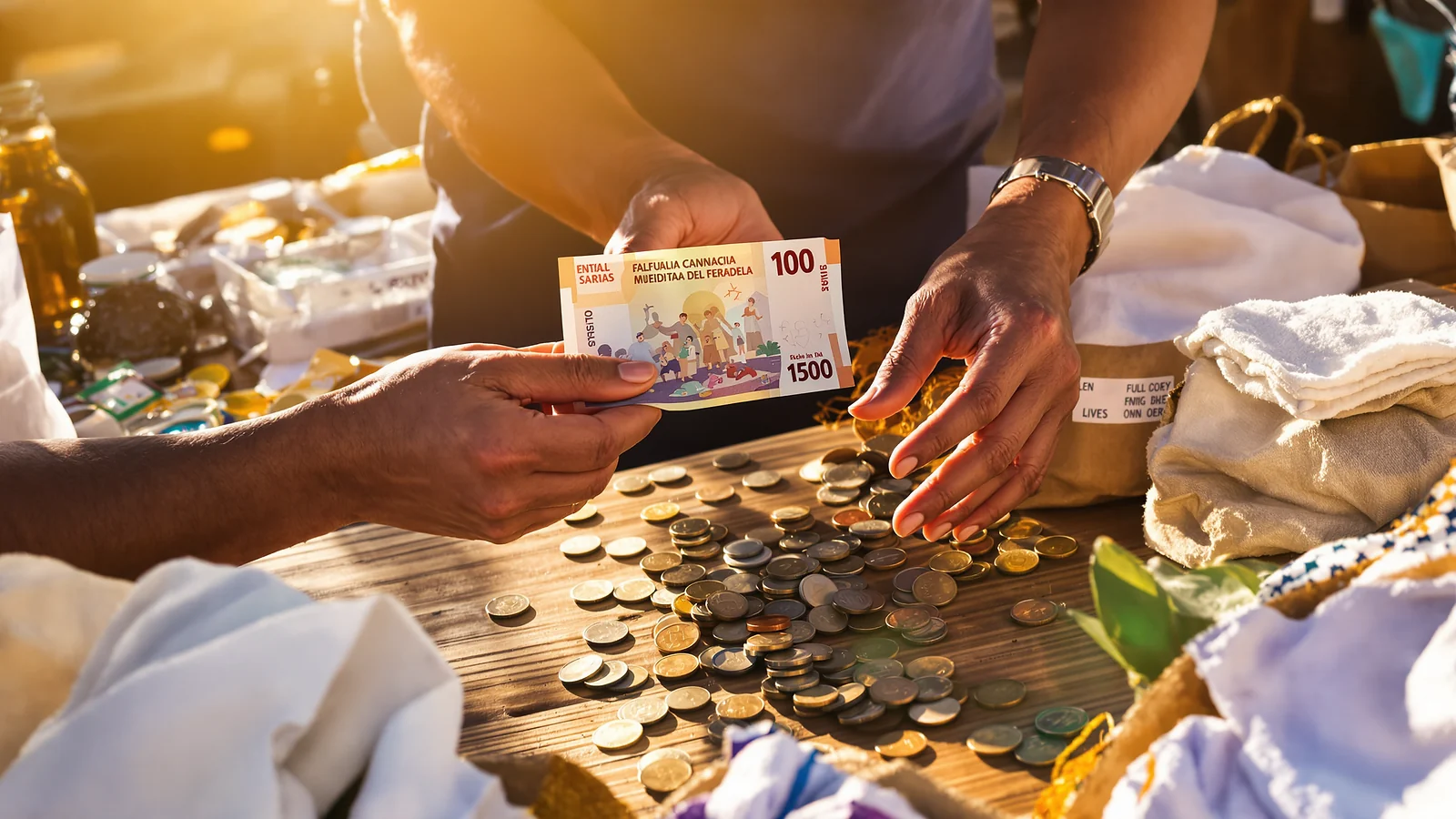
Repeat the number back before you pay.
The most useful move is to say the total back before the money leaves your hand: Doscientos cuarenta, ¿verdad? Aquí tiene. It confirms you heard, lets the cashier correct you before anything moves, and buys the second you need to pull out the right note. If the number did not land, use a repair line instead of a guess. All three below use puede, the usted form — polite singular, right with someone you have never met.
| Spanish | English |
|---|---|
| ¿Puede repetir, por favor? | Could you repeat that, please? |
| ¿Puede hablar más despacio, por favor? | Could you speak more slowly, please? |
| ¿Me lo puede escribir? | Could you write it down for me? |
| Perdón, no entiendo. | Sorry, I do not understand. |
With a friend you would say ¿Puedes repetir, por favor?, with puedes. At a till, keep puede.
Ask for change only when you need it.
Most of the time you say nothing. You hand over the note, the cashier gives change, and it is done in four seconds. The change phrases matter for specific moments: coins for the metro, a large note to break, or you are the one who is short.
| Spanish | English | When you need it |
|---|---|---|
| ¿Tiene cambio? | Do you have change? | Checking before you hand over a big note. |
| ¿Tienes cambio? | Do you have change? | The tú version: friends and family. |
| ¿Me da cambio? | Could you give me change? | The request itself. |
| ¿Me puede cambiar este billete? | Could you change this note for me? | You are holding a large note. |
| ¿Me lo da en monedas? | Could you give it to me in coins? | You need coins for the metro. |
| No tengo cambio. | I do not have change. | You are the one without smaller money. |
Cambio is understood everywhere Spanish is spoken. In Mexico you will also hear sencillo for loose change or small notes — ¿Tiene sencillo? — and in Spain suelto is more usual. Use cambio and you are safe on either side of the Atlantic. You may also hear No hay cambio — there is no change — from a small shop early in the morning; that usually means paying by card or finding a smaller note.
Can you make change in Spanish? The line is ¿Me puede cambiar esto? — can you change this for me? Esto means this, so say it while holding out the note.
Keep the change, without sounding blunt.
In English, keep the change is a throwaway. In Spanish the verb has to match the person. The safe version is Quédese con el cambio — usted, for a cashier or waiter you do not know. With a friend or neighbour: Quédate con el cambio. Add gracias and it never sounds off-hand: Gracias, quédese con el cambio. Leaving a few pesos is an optional courtesy, not a rule.
The whole counter script, start to finish.
Here it is as one exchange. It is an illustrative practice dialogue written for this page — not a recording — so the cashier you meet will use their own words.
| Original practice dialogue | English |
|---|---|
| Cajero: Buenos días. | Good morning. |
| Usted: Buenos días. ¿Cuánto es? | Good morning. How much is it? |
| Cajero: Son doscientos cuarenta. | It is two hundred and forty. |
| Usted: Doscientos cuarenta, ¿verdad? Aquí tiene quinientos. | Two hundred and forty, right? Here is five hundred. |
| Cajero: ¿No tiene cambio? | Do you not have anything smaller? |
| Usted: No, lo siento. Solo tengo este billete. | No, sorry. I only have this note. |
| Cajero: Está bien. Aquí tiene su cambio. | That is fine. Here is your change. |
| Usted: Gracias. ¿Me lo puede dar en monedas? Es para el metro. | Thanks. Could you give it to me in coins? It is for the metro. |
| Cajero: Claro, aquí tiene. | Of course, here you are. |
Aquí tiene su cambio — here is your change — is the line you will hear most at the end, and gracias is a complete reply.
Drill it out loud in ten minutes.
Reading the tables is not the drill. The drill is saying the numbers until their shape stops surprising you.
Say six totals aloud.
Read each one twice: slowly, then at the speed a cashier would say it. The second pass is the one that matters.
Answer the prompt, not the page.
Cover the Spanish column, read the English total, say the Spanish aloud, then check. Being wrong is part of it; the check is the point.
Add the two extra moves.
For each total add Aquí tiene, and for one of them say Quédese con el cambio instead.
Then repeat on three separate days, each round starting from memory. Three short rounds across a week do more than one long session on a Sunday. The IES What Works Clearinghouse practice guide Organizing Instruction and Study to Improve Student Learning recommends spacing learning over time and using quizzing with active retrieval — answering from memory rather than rereading.
Cover the tables and answer these four out loud. Check only after you have tried all four.
| English prompt | Your Spanish |
|---|---|
| It is two hundred and forty pesos. | your answer |
| Do you have change? | your answer |
| Could you change this note for me? | your answer |
| Keep the change. | your answer |
Check your answers: Son doscientos cuarenta pesos. · ¿Tiene cambio? · ¿Me puede cambiar este billete? · Quédese con el cambio.
- I can say the total back before I pay.
- I can ask ¿Cuánto es? without rehearsing it first.
- I can ask for change in the polite form.
Is this just another app that teases, then upsells?
Fair question, and the honest answer has two halves.
First: this is a web page, not an app. No account, no streak, no microphone reading you, and nothing here scores you. You find out whether you can catch a total by catching one — reading the cashier line aloud and answering it. That is practice, not a fluency test.
Second, about money: the free material is not a two-page teaser. The 7 Day Spanish Starter Plan is an 18-page PDF, and the whole plan is also on that web page, so you can read Day 4 (order and pay at a café) in the browser before deciding anything. The Conversation Rescue Card is two pages of phrases that buy you time, each linked to an MP3.
There is a paid side, and it is fairer to say so once: three phrase packs (Travel, Family, Relocation) at $9 each or $19 for all three, and a self-paced course, Spanish Conversation Foundations, at $49 — no live sessions, no teacher, no feedback. One-time payment through Stripe, full refund within 30 days. The pricing page lists all of it and the refund policy is one page. None of it is needed for anything on this page.
One next step.
Tonight, with the page closed: say ¿Cuánto es?, answer your own question with a total, then say Aquí tiene. Five times, five different numbers. Tomorrow add ¿Tiene cambio? and Quédese con el cambio. When numbers feel steadier, practise prices at speed — the same skill with bigger totals and quieter voices.
Practise prices in Spanish at speed
Also useful, one link each: Day 4 of the free 7 Day Spanish Starter Plan for ordering and paying at a café, and the Conversation Rescue Card for ¿Puede repetir? and the rest on one printable page.
Common questions.
How do you ask for change in Spanish?
The short request is ¿Me da cambio? — could you give me change? To check first, ask ¿Tiene cambio? (do you have change?). To break a note, ¿Me puede cambiar este billete? means could you change this note for me.
What does ¿Tiene cambio? mean?
It means do you have change? Tiene is the usted form, the polite singular, which is the right register with a shopkeeper you do not know. With a friend it is ¿Tienes cambio?
How do you say keep the change in Spanish?
Quédese con el cambio to a shopkeeper or waiter, because it uses usted. With a friend, Quédate con el cambio. Add gracias and it sounds warm rather than off-hand.
How do you say can you make change in Spanish?
¿Me puede cambiar esto? — can you change this for me? Say it while holding out the note; esto means this, so you do not need to name the money.
What does son mean in a price?
It means they are, and it is how a total is usually given: Son cincuenta pesos. The plural is there because pesos are plural. Listen for the number that follows rather than translating the whole sentence.
Practice, not a promise. These tasks help you rehearse everyday Spanish at your own pace. Individual progress varies; nothing here promises a level, a qualification or a fixed learning speed. How we write and check our Spanish
Sources and editorial notes
- Institute of Education Sciences, What Works Clearinghouse practice guide, Organizing Instruction and Study to Improve Student Learning (recommendations on spacing learning over time and using quizzing to promote retrieval), retrieved October 18, 2026.
- Smart Learning Path, 7 Day Spanish Starter Plan (Day 4, order and pay at a café) and Spanish Conversation Rescue Card (eight rescue phrases, each with an MP3), our own free materials.
All dialogues here are illustrative practice examples written for this page, not recordings of real conversations. Amounts are examples, not a price list. Spanish checked with AI review. See our Editorial Policy. Spotted a mistake? Suggest a correction.
Related reading.
Back to the blogUnderstand Prices in Spanish at Speed
Catch 'son cincuenta pesos' and pay without guessing.
Pay by Card in Spanish: A 4-Step Counter Script
Hear the total, ask about card, understand the answer.
Buying Fruit in Spanish: Market Phrases and Numbers
Ask for a kilo, catch the total, hand over the note.
Try one useful task.
Open the free seven-day plan and practise about ten minutes a day, at your own pace.
No account or payment needed.