
Conversation basics
Buenos días pronunciation, drilled at your own door.
You know the words already. What you are missing is a version of them you have said aloud, from memory, with a door in front of you.
You know the words. Buenos días was probably one of the first Spanish phrases you ever learned. Then the lift stops at the ground floor, the person at the entrance looks up, and your mouth produces a small, polite nothing.
That silence is not a vocabulary problem. What you are missing is a version of the phrase you have said aloud, from memory, with a door in front of you. Nerves rarely wipe out a greeting you can produce without hunting for it; they wipe out the ones you only recognise on a page.
So this page is a drill, not a list: a short pronunciation walk-through, a two-line door script, a cold recall at your own front door, and a doorman variant for a building entrance in Mexico City.
Your task: say both lines aloud once, right now, before you read any further. Slow is fine. Silent is the thing we are fixing.
Two lines carry the first ten seconds.
Almost every doorway exchange needs two lines from you. The first is the greeting on its own: «Buenos días.» It is already complete and already polite, and nothing has to follow it. That is worth saying plainly, because the freeze often comes from believing you owe a whole sentence.
The second line is optional and warms the exchange: «¿Cómo está?» (How are you?), the polite form used with usted. With a friend or a colleague who uses the familiar form with you, it becomes «¿Cómo estás?»
| Speaker | Spanish | English |
|---|---|---|
| You | Buenos días. | Good morning. |
| You | ¿Cómo está? | How are you? (polite) |
| Them | Bien, gracias. ¿Y usted? | Well, thank you. And you? (polite) |
| You | Muy bien, gracias. | Very well, thank you. |
An illustrative practice exchange, not a recorded conversation.
You do not need to produce the middle of that exchange. You need to recognise bien, gracias and have one reply ready. Rehearse your two lines; skim the other two.
Say it slowly before you say it fast.
The stress sits on two syllables: bue-nos dí-as. Four syllables in all, with a small pause where the space is. Add the two in ¿Cómo está?: CO-mo es-TÁ. Read the notes once, then say each phrase three times slowly, three times at normal speed, three times quickly.
- The accent on í does two jobs. It marks the stress and keeps the i and the a in separate syllables: dí-as. Say the a at the end; do not slide the vowels together.
- Five clean vowels. a as in father; e as in bed; i as in see but shorter; o round and short, with no glide; u as in boot. Spanish vowels do not wander.
- The b in buenos. Lips together, light, no puff of air.
- The d in días. Tongue tip against the back of your top front teeth, softer than the English d.
- The final s. Keep it light but audible. Do not drop it out of nerves.
To check your own pronunciation without a teacher, we keep a short method in how to check Spanish pronunciation alone. If fast speech frightens you most, why Spanish sounds so fast treats listening as a separate skill.
Run a cold recall at your own door.
Cold recall means no warm-up and nothing to read — the closest thing at home to the state you will be in when another person is waiting. You also train the doorway itself as a cue: see the door, say the lines.
Put the card on the door.
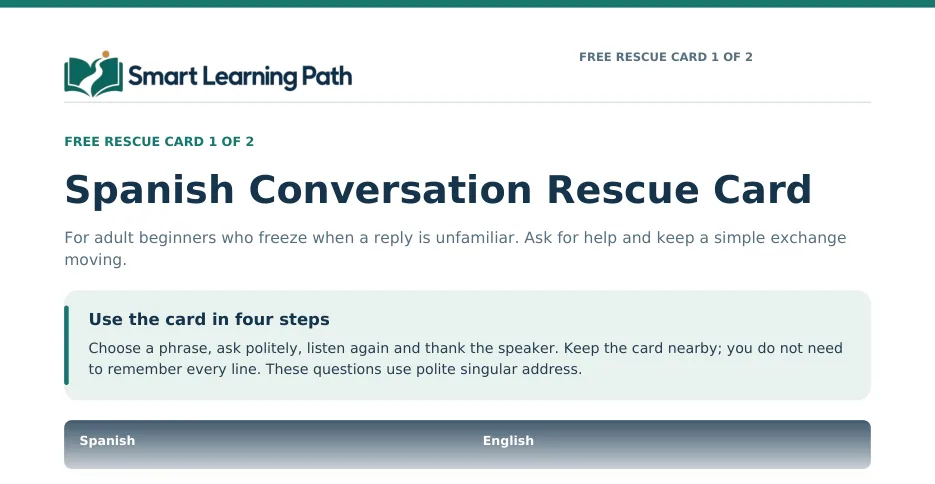
Tape the pocket card from the free Conversation Rescue Card inside your front door at eye level, or leave it out of reach in the hallway. The download asks for a first name and email; the file arrives after you reply VERIFY to the short email.
Close the door and say both lines.
Hand on the handle, notes out of sight. Buenos días. ¿Cómo está? Slowly counts. Silently does not.
Open the door and check.
Read the card. If a word came out wrong, close the door and repeat the whole thing. The correction belongs in the same place as the mistake.
Count clean crossings.
Three from memory — one leaving, one coming back, one extra — before you add anything new. Spread them over two days rather than one long sitting, and log them in the 10 Minute Practice Planner, which has from memory, with a prompt and not yet ticks.
Two rules keep the drill honest. Say the lines aloud, because reading them silently is a different skill. And treat a stumble as information: it tells you which word to slow down, not that you cannot do it.
Vary the doorway once the first one stops being interesting: the bathroom door, the office lobby, the lift. Day 1 of the free 7 Day Spanish Starter Plan is built on exactly these phrases, so the drill and the plan can run together.
Add the doorman variant.
In a Mexico City building, the person at the entrance is often the portero, or a security guard in the caseta by the gate. You will see them most mornings, and the exchange is short and repeated, which makes it the best-value rehearsal of your week.
You: Buenos días, ¿cómo está? · Portero: Bien, gracias, ¿y usted? · You: Muy bien, gracias. Que tenga buen día.
An original practice dialogue, not a recorded conversation.
- Greet first, before you are close enough to feel watched.
- Keep it to two lines. The same two lines every day is the point, not a longer script.
- Use usted until the other person uses tú with you. The polite form is never wrong here.
- Close as you pass the desk: Gracias, hasta luego or Que tenga buen día.
Expect one question you did not plan for. In Mexico you may hear ¿Cómo amaneció?, a morning greeting about how your morning has gone; Bien, gracias is a complete answer. For the register itself, our guide to usted vs tú explains who usually gets which form.
Practise greetings and goodbyes as pairs.
Spanish greetings practice often stops at hello, and then a second silence happens: leaving a desk, a shop, a lift. So learn them in pairs from the start. One hello, one goodbye, said together five times. Then swap the pair and go again.
| Spanish | English | When |
|---|---|---|
| Buenos días. | Good morning. | Morning. |
| Buenas tardes. | Good afternoon. | After midday until evening. |
| Buenas noches. | Good evening / good night. | Evening greeting, and a goodbye at night. |
| ¿Cómo está? | How are you? (polite) | Neighbours, doormen, staff. |
| ¿Cómo estás? | How are you? (familiar) | People who use tú with you. |
| Hasta luego. | See you later. | A goodbye that fits almost anywhere. |
| Que tenga buen día. | Have a good day. (polite) | Closing a short exchange warmly. |
| Adiós. | Goodbye. | Neutral, complete, always correct. |
General guidance for a beginner in Mexico; local habit varies from building to building.
For greetings and goodbyes practice in a longer form, ten everyday scenarios has short dialogues at normal and slower speed, so you copy a voice rather than guess at one.
Read it, cover it, say it, check it.
Cover the right-hand column and say the Spanish aloud before you look. Recognising a phrase on a page is not the same as producing it at a doorway, so repeat this tomorrow rather than twice today.
| Say this in Spanish | Your answer |
|---|---|
| Good morning. | your phrase |
| How are you? (polite) | your phrase |
| Very well, thank you. And you? (polite) | your phrase |
| Have a good day. (polite) | your phrase |
Check your answers: Buenos días. · ¿Cómo está? · Muy bien, gracias. ¿Y usted? · Que tenga buen día.
This is practice, not a test of your level.
Why this is not another points-and-streaks app.
The objection is fair, so keep it: you have already given evenings to an app that made you feel productive and left you quiet in front of a person. Points and streaks measure taps. They say nothing about whether a greeting arrives when a neighbour is waiting.
This page is a drill with a doorway and a count, not a game. No score, no streak, no account and no microphone. The free material is complete on its own: the 7 Day Spanish Starter Plan, the two-page Rescue Card, the two-page planner, the 120-card phrase deck and the ten scenarios with audio at normal and slower speed.
About the upsell worry, plainly: we do sell our own materials — three phrase packs at $9 each or $19 for all three, and a $49 self-paced course of 28 lessons in 8 modules, with no live sessions, teacher or coach feedback. Both are one-time payments with a 30-day refund under the refund policy, and every price is written on the pricing page. You can run this drill without buying anything, and decide later. Our Spanish is checked automatically, with AI and rule-based checks, and there is no teacher review; the editorial policy says what that covers.
Common questions.
How do you pronounce buenos días?
Say four syllables with the stress on bue and on dí: bue-nos dí-as. Keep the vowels short and clean, make the d soft behind your top teeth, and keep the final s light. The accent on í marks the stress and keeps the i and the a in separate syllables.
Is buenos días used all day?
No. Use it in the morning. After midday, buenas tardes is the usual greeting, and buenas noches in the evening or at night. The exact switch follows local habit, so copy what people around you say.
Should I use usted or tú with a neighbour or a doorman?
Start with the polite form, usted: ¿Cómo está? If the other person uses tú with you, you can switch to ¿Cómo estás? The polite form is never wrong with a stranger.
How do I practise Spanish greetings without a partner?
Run the door drill. Say both lines aloud from memory before you open your own front door, check them afterwards, and repeat until you have three clean crossings. Add a person only when the lines start to feel boring.
How is this different from the app I already tried?
This page is a drill with a doorway and a count, not a score. There is no streak, no account and no microphone, and the free files are complete on their own. Paid materials are optional and every price is published on the pricing page.
Practice, not a promise. These tasks help you rehearse everyday Spanish at your own pace. Individual progress varies; nothing here promises a level, a qualification or a fixed learning speed. How we write and check our Spanish
Sources and editorial notes
- Smart Learning Path, 7 Day Spanish Starter Plan, Day 1: Say hello (our own free material).
- Smart Learning Path, Spanish Conversation Rescue Card and 10 Minute Practice Planner (our own free materials).
- Smart Learning Path, Ten everyday scenarios (our own free audio dialogues at normal and slower speed).
The dialogues are original practice examples, not recorded conversations. Pronunciation notes describe careful, neutral speech, and regional habits vary. Spanish checked with AI review; no teacher review. See our Editorial Policy. Spotted a mistake? Suggest a correction.
Related reading.
Back to the blogSpanish Greetings for Your First Conversation
Key phrases and when to use them.
How to Remember Spanish When You Are Nervous
Drill four rescue phrases aloud until they come out fast.
When to Use Usted vs Tú in Spanish
Pick the polite form once, then practise the switch.
Try one useful task.
Open the free seven-day plan and practise about ten minutes a day, at your own pace.
No account or payment needed.