
Beginner Spanish · Family conversations
Start a small Spanish exchange with family.
Practise a greeting, a simple question and a request for repetition. Choose one manageable exchange and try it at your own pace.
The free tasks need no account, email or payment. Family examples are one context for the same planned beginner course.
Planned · not yet open
Choose a simple moment to practise.
Begin with a greeting
Say hello and ask how someone is.
Introduce yourself
Use your name in a short first exchange.
Ask for help with a reply
Request repetition or slower speech.
Adult beginner tasks only; not every family topic, regional expression or longer conversation.
Try a free greeting exchange.
Read both roles aloud. Pause after the question, then practise the reply.
| Spanish | English |
|---|---|
| A: Hola. ¿Cómo estás? | A: Hello. How are you? |
| B: Bien, gracias. ¿Y tú? | B: Well, thank you. And you? |
| A: Muy bien. Te presento a mi abuela, Carmen. | A: Very well. This is my grandmother, Carmen. |
| B: Encantada. | B: Pleased to meet you. (A man would say Encantado.) |
| Carmen: Mucho gusto. | Carmen: Nice to meet you. |
Make it a small task.
Read the dialogue twice. Cover one line and try again. Change abuela (grandmother) to madre (mother) or tía (aunt), and keep one useful phrase to revisit later.
This dialogue uses familiar singular address (tú). It is an illustration, not a recorded conversation.
Useful phrases for a family greeting.
| Spanish | English |
|---|---|
| Me llamo Sam. | My name is Sam. |
| ¿Cómo está usted? | How are you? (polite) |
| Muy bien. | Very well. |
| Está muy rico. | It is very tasty. (about food) |
| ¿Puedes repetir, por favor? | Can you repeat, please? (familiar) |
| ¿Puede repetir, por favor? | Can you repeat, please? (polite) |
Encantado or encantada? A simple rule.
Some Spanish words change their ending to match the person they describe. When you say “pleased to meet you” with encantado, the word describes you, the speaker.
- A man usually says Encantado.
- A woman usually says Encantada.
- Mucho gusto stays the same for everyone, so it is a safe choice.
The same idea works in Soy amigo de Ana and Soy amiga de Ana (I am a friend of Ana’s): the ending matches you.
Tú or usted? Many families use tú with everyone. Others use usted with grandparents or in-laws, and habits vary by family and country. Listen to what others say, or simply ask.
Practice ideas you can repeat.
Say both roles aloud.
Use your own name and a real relative. Swap roles so you hear the question and the reply.
Prepare one clarification phrase.
Choose ¿Puedes repetir, por favor? or the polite form, and rehearse it with Day 2 of the free plan.
Plan a short slot before a call or visit.
Use the 10 Minute Practice Planner to choose two phrases and revisit them on another day.
A small exchange is enough. You do not need to follow every word of a family conversation; asking for repetition is part of practising.
You can keep practising free.
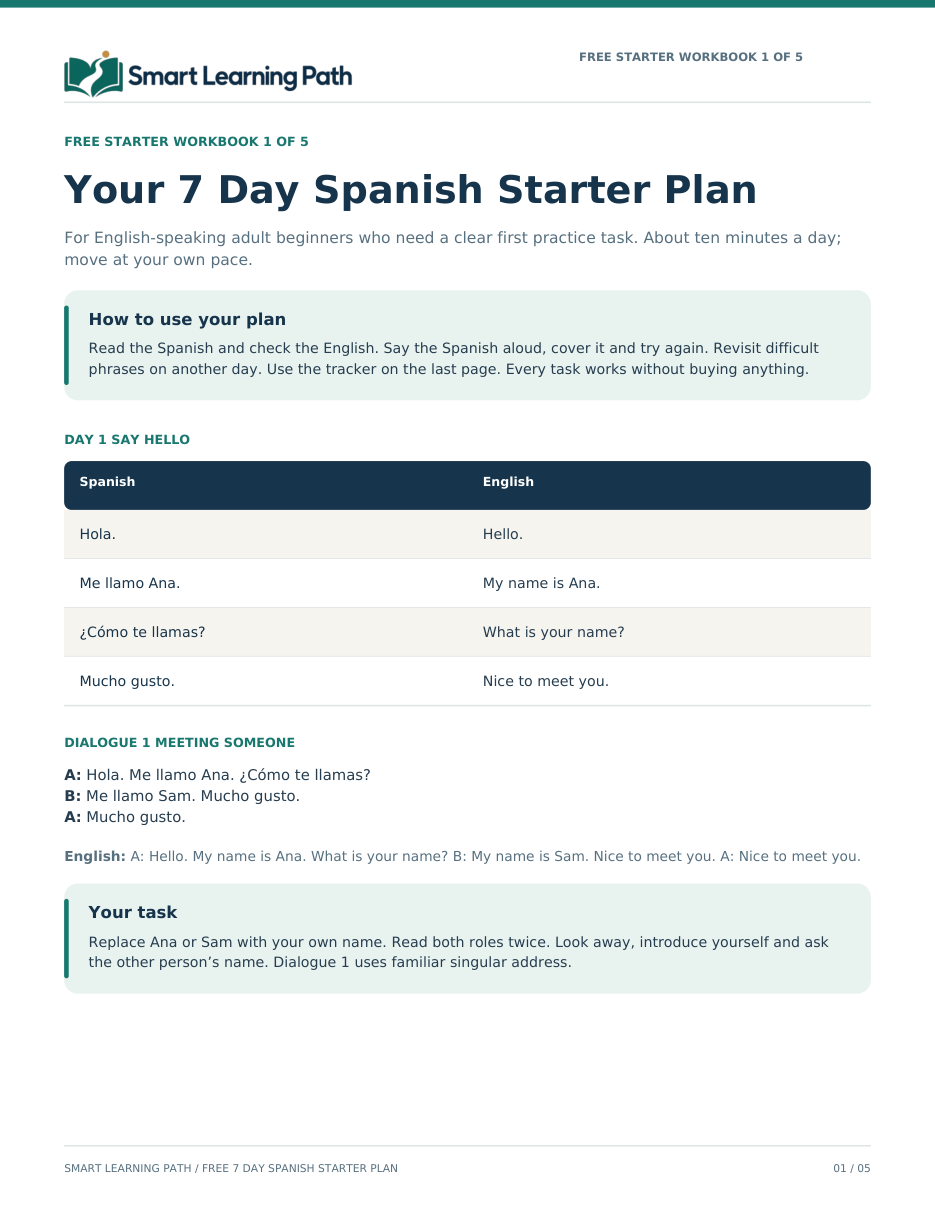
7 Day Spanish Starter Plan
Seven short tasks, two dialogues and a printable tracker.
Free workbookOpen the free plan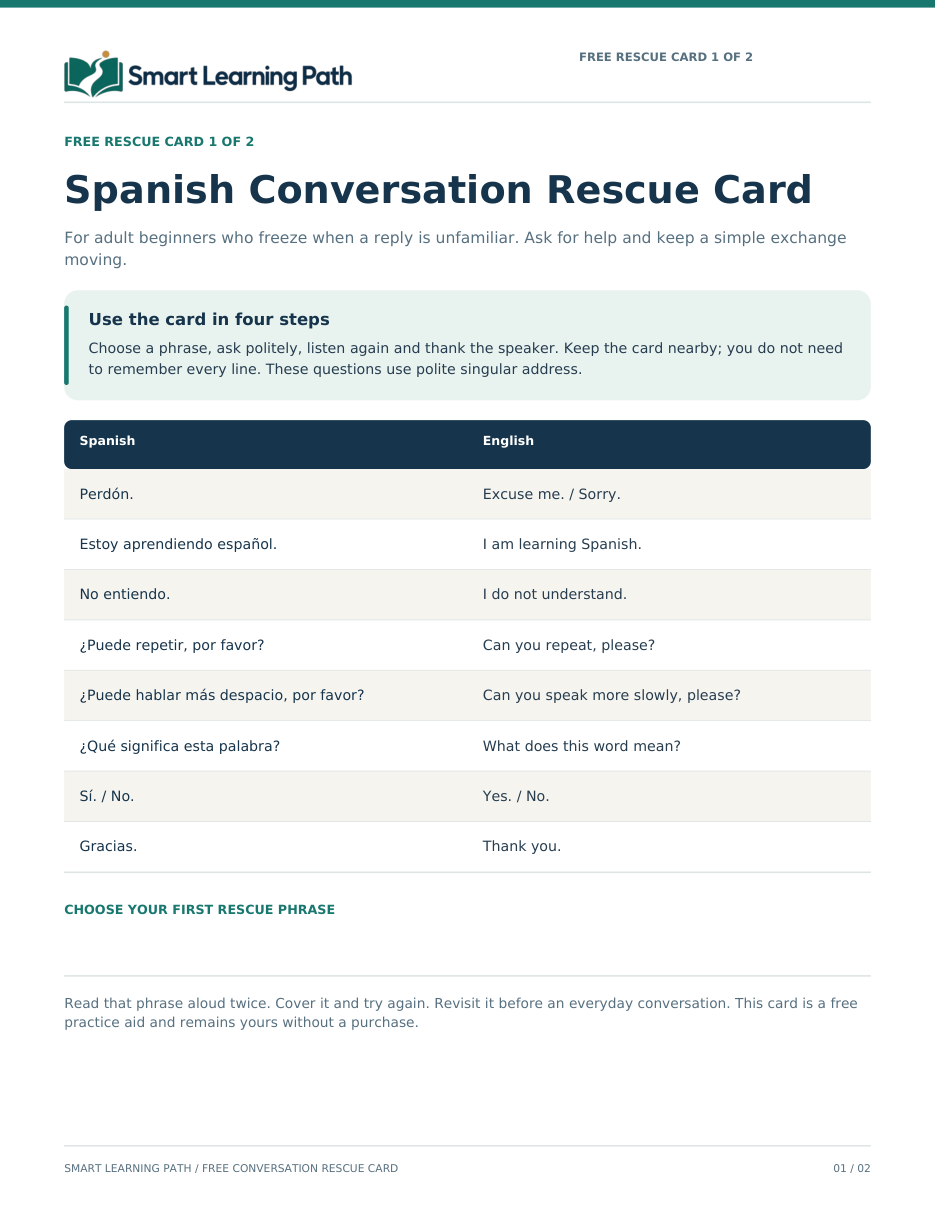
Conversation Rescue Card
Ask for repetition or slower speech when a reply is unclear.
No email requiredGet the rescue card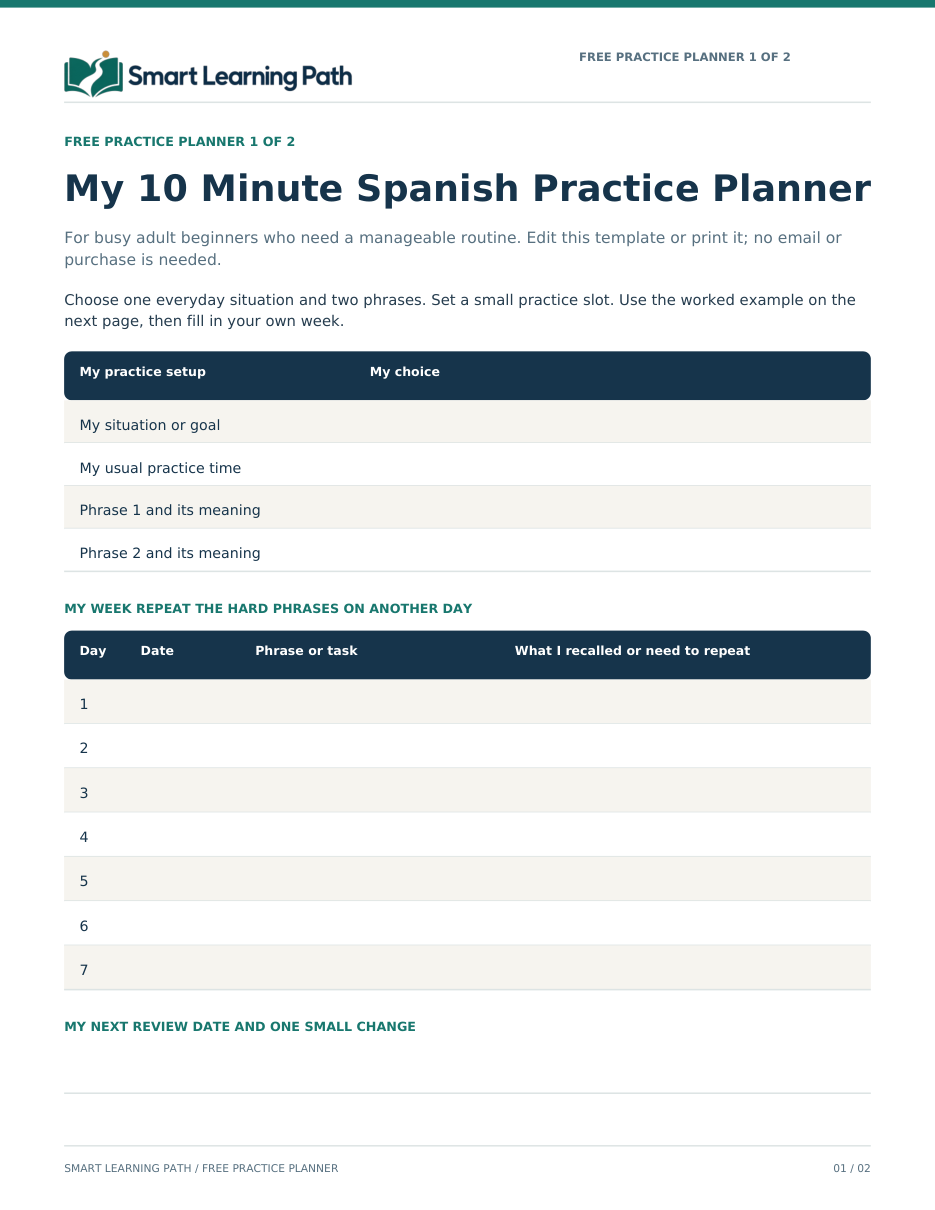
10 Minute Practice Planner
Choose two phrases and build a routine you can repeat.
No email requiredGet the plannerOptional support · planned
Consider live practice later, if it would help.
We plan a Four-Week Conversation Course for adult beginners, with structured role play and feedback. Family exchanges would be one context for its tasks. It is not open for booking yet.
- Eight one-hour live group sessions, two a week.
- Four feedback cycles, about 30 minutes per learner in total.
- About 15 minutes of daily practice plus two live hours a week.
- A minimum of 8 and a maximum of 12 learners per group; the planned toolkit included.
Four-Week Conversation Course
| Planned price | $249 one-time |
|---|---|
| Status | Not yet open for booking |
Dates and a coach have not been confirmed. Booking is not open. The planned membership would be a separate optional purchase that never starts automatically.
Choose the topic “A planned course, toolkit or membership”.
Common questions.
Is this a separate family course?
No. Family examples are one context for the same planned four-week beginner course. There is no separate family course.
Is this intended for children?
No. The free plan and the planned course are designed for English-speaking adult beginners.
Can I keep using the free tools without enrolling?
Yes. The full 7 Day Spanish Starter Plan, the Conversation Rescue Card and the 10 Minute Practice Planner are free and stay free.
Keep reading.
Visit the blogSpanish for Family Conversations
Greetings and manageable exchanges with family.
Spanish Greetings for Your First Conversation
Key phrases and when to use them.
How to Ask Someone to Repeat or Slow Down in Spanish
Polite phrases for a fast or unclear reply.
Practice, not a promise. These tasks help you rehearse everyday Spanish at your own pace. Individual progress varies; nothing here promises a level, a qualification or a fixed learning speed. How we write and check our Spanish
Sources and editorial notes
- Greetings and clarification phrases build on our free 7 Day Spanish Starter Plan and Conversation Rescue Card. The family dialogue is an original illustration.
- Planned course details come from the Smart Learning Path business plan and proposals (October 2026). They are proposals, not a confirmed offer.
Examples are illustrative. Spanish checked by our editors. See our Editorial Policy and Pricing and Learning Options.
Keep the next exchange manageable.
Repeat the greeting, add one new phrase and plan your next ten minutes.
No account or payment needed.