
Practice habits
Six minutes after the app: say the sentence out loud.
Your app gives you a streak and the next tap. Here is a six-minute add-on you run straight after a session: one sentence, out loud, recorded on your own phone.
The streak never reached your mouth.
You have said it to yourself, probably in the car or on the walk back from the office: I'll arrive, open my mouth, and nothing will come out. I'll be the one who cannot even order a coffee, and they will switch to English to be kind.
Meanwhile the app is delighted with you. A crown, a chime, a bar filling up. If your sessions are all taps and no speaking, the sounds have never formed in your mouth — which is exactly why the first whole sentence out loud feels foreign. It is foreign: you have read it many times and said it perhaps never.
If you are searching for a Spanish speaking practice app to fix that, here is the awkward part: the missing ingredient is not another app. It is about six minutes of speaking, bolted onto the session you already do. No new course, no new streak, and no promise about how quickly anything changes.
Use any app, then add six minutes.
Run this straight after the app session, while the sentence is still in your head. One sentence, six minutes, three steps.
| Minute | Step | What you do |
|---|---|---|
| 0–2 | Read it aloud three times | Once slowly, once at normal speed, once from memory. Loud enough that a person across the room would hear it. |
| 2–4 | Say it to a photo | Cover the text. Look at a photo of the place — a café counter, a chemist's sign, a lift door — and say the line from memory. |
| 4–6 | Record and compare | Record it on your phone, listen once, note one sound that slipped, then say it again. You are checking that every syllable came out, not chasing an accent grade. |
A flexible guide: repeat a step, or halve it, when the day demands it.
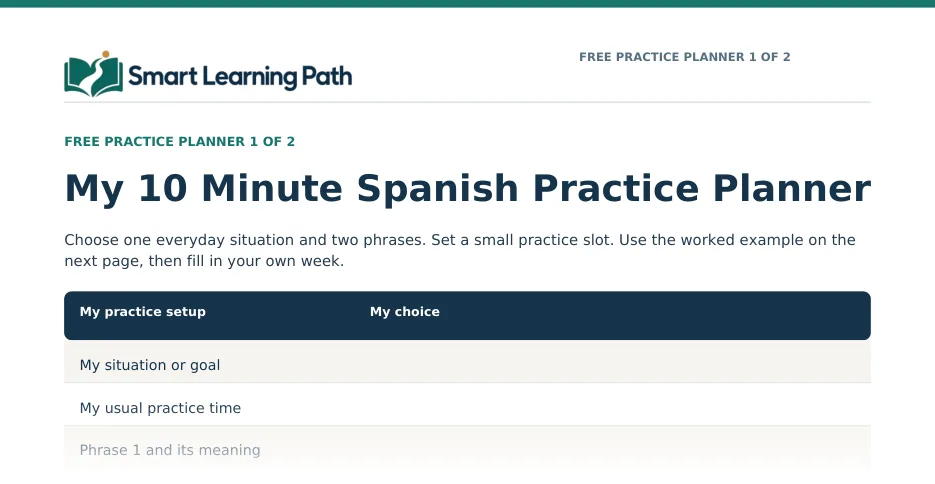
The recording stays on your phone. This site has no microphone, no speech scoring and no accent score, so you are the judge — cheaper and more honest than a badge. The 10 Minute Practice Planner is where you keep the note: its daily log lets you tick “from memory”, “with a prompt” or “not yet” after each pass, alongside the 2 / 3 / 3 / 2 routine and a worked café example.
Recognising a phrase and producing one are different jobs. A tap rewards the first; a café counter needs the second. The IES practice guide Organizing Instruction and Study to Improve Student Learning recommends spacing practice over time and using quizzing with active retrieval. It was written for school subjects, not adult language practice, so treat those as sensible principles rather than evidence about this routine.
A worked example: the café counter.
Suppose the app has just shown you Un café, por favor. Keep the rest of the exchange nearby, because you are going to play both parts.
| Spanish | English |
|---|---|
| Un café, por favor. | A coffee, please. |
| ¿Algo más? | Anything else? |
| No, gracias. | No, thank you. |
| Aquí tiene. | Here you are. |
| Gracias. | Thank you. |
You: Un café, por favor. · Staff: ¿Algo más? · You: No, gracias. · Staff: Aquí tiene. · You: Gracias.
You: A coffee, please. Staff: Anything else? You: No, thank you. Staff: Here you are. You: Thank you. An original practice dialogue, not a recorded conversation; a real café may go differently.
For the photo prompt, use a café picture already on your phone. Look at it, cover the line and order. Then swap roles and be the person behind the counter, asking ¿Algo más? aloud. Day 4 of the free seven-day plan is this same dialogue, with Un té and Un vaso de agua ready to swap in. For the phrases you need when a reply runs away from you, the Conversation Rescue Card gathers eight of them, each with its own audio link.
Practise speaking Spanish with an app, alone.
Alone is the normal condition of practice, not a problem to solve. Three habits make the six minutes work.
Play both parts.
Say your line, then say the reply in a different voice. The reply is the half you have not rehearsed — and in a real café it is the half you cannot control.
Keep one repair phrase loaded.
¿Puede repetir, por favor? is the polite singular form, used with usted — the safe default with a stranger or an official desk. With friends and family you would say ¿Puedes repetir, por favor?
Change one detail a day.
The drink, the time, the number. Small changes turn a recital into speech.
The guide to practising speaking alone takes this further, with more ways to keep a solo session honest.
Burnt before? Here is the whole arrangement.
The fair version of your objection: I have felt productive before and still could not speak, and I do not want another free site that teases a plan and then sells me something. So here is the line, in one place, before you spend any time.
Free in the browser, no account: this article and the full seven-day plan — every phrase and the café dialogue on Day 4 are written out on the page. No install, no microphone.
Only the printable files ask for an email: the plan's PDF and Word copy, the Conversation Rescue Card, the 10 Minute Practice Planner, and the 120-card phrase deck, whose PDF and CSV ask for a first name and email. A download click opens the form, and the file follows once you reply to a short confirmation email. Skip it if you like: the plan is written out on its page, phrase by phrase.
Paid and optional: our own $9 phrase packs, $19 for all three, and a $49 self-paced course (see pricing). This page works without any of it, and nothing here is needed to start. The Spanish is checked with AI review; there is no independent teacher review yet.
Fill in your own six minutes.
Copy this into your phone's notes app, then run it once today rather than waiting for Monday.
| The sentence from the app | Spanish + meaning |
|---|---|
| My photo prompt | e.g. a café counter |
| My six-minute slot | e.g. straight after the app |
| One repair phrase | ¿Puede repetir, por favor? |
| When I will repeat it | tomorrow, same slot |
Your task: finish one app session today, then take a single sentence into the six minutes above. Record it once, listen, and say it again.
Read the free seven-day plan See the practice tools
The plan is free to read in your browser — no account and no microphone.
When the week goes wrong.
A short add-on survives bad weeks only if it has a smaller version. These are the three that come up most.
Only three minutes?
Do steps one and three: say the line three times, record once, listen. Skip the photo.
Missed three days?
Take the same sentence to the next slot. No restart, no catching up.
The line keeps collapsing?
Split it in two, say each half slowly, then join them.
Mark honestly how the sentence came out — a practice note, not a score.
- With the sentence in front of me
- With a prompt, such as the first word
- From memory, out loud, to the photo
Then repeat the same sentence tomorrow: the second pass is where it starts to settle.
Practice, not a promise. These tasks help you rehearse everyday Spanish at your own pace. Individual progress varies; nothing here promises a level, a qualification or a fixed learning speed. How we write and check our Spanish
Common questions.
Is there a free Spanish speaking app I can try today?
There is no app to install here, and that is deliberate: the speaking part is free to read in your browser. The seven-day plan is written out phrase by phrase, with the café dialogue on Day 4, and this six-minute routine needs nothing but your phone's own recorder. Only the printable files ask for a first name and email.
How do I practise speaking Spanish with an app when I am alone?
Use the app for phrases, then run the six minutes: read the line aloud three times, say it from memory to a photo of the place, record it on your phone and compare. Say the reply aloud too, in a different voice, because the reply is easy to skip.
How is this different from the app that gave me a streak?
A streak records that you opened the app. Six minutes of saying a sentence out loud, with the screen covered, is a different task, and you can judge it yourself: did the whole sentence come out? Keep the app for daily exposure and phrases; let the six minutes do the speaking.
Sources and editorial notes
- Content basis: the Smart Learning Path 7 Day Spanish Starter Plan (Day 4, the café dialogue) and the 10 Minute Practice Planner.
- Institute of Education Sciences, What Works Clearinghouse, Organizing Instruction and Study to Improve Student Learning (practice guide, 2007), retrieved October 18, 2026. Lists recommendations on spacing learning over time and on using quizzing with active retrieval. It was written for school subjects and says nothing about this routine.
- Real Academia Española and Asociación de Academias de la Lengua Española, Diccionario panhispánico de dudas: usted, retrieved October 18, 2026. Used for the note that singular usted is the formal treatment in educated usage in America and Spain, and generally implies distance, courtesy and formality.
Six minutes is a planning suggestion, not a measured method; progress varies, and this is practice, not a fluency test. Every dialogue here is an original practice example, not a recorded conversation, and a real exchange may go differently. Spanish checked with AI review. See our Editorial Policy. Spotted a mistake? Suggest a correction.
Three pages that use the same six minutes.
Each one ends with something to say out loud today.
How to Practise Speaking Spanish Alone
Role plays and recall prompts without a partner.
A 10-Minute Spanish Practice Routine
Read, cover, say, check, and repeat.
Remember Spanish Phrases with Spaced Practice
Revisit phrases on later days to keep them.
Six minutes after the app. One sentence out loud.
The seven-day starter plan is free to read in your browser, phrase by phrase, with the café dialogue on Day 4. No account, no microphone.
No account or payment needed.