
Practice habits
A task-based Spanish plan for busy weeks.
One short block, one real task, and a small weekly review. Here is a template you can fill in tonight, plus a checklist that records what you can already do without English.
Streaks are not the same as speaking.
The session ends, the streak stays green, and the app tells you that you practised. Then someone in a shop asks ¿Algo más? and nothing comes out. Tapping the right tile is a different skill from saying a sentence out loud to another person.
If your evenings are already full before a move, a random gamified session adds work rather than taking it away. You cannot see what the session was for, and you cannot see what it changed. A task-based plan swaps the topic list for a shorter question: what do I need to do in Spanish this week, and did I do it?

Give each block one task.
A block is about 10 to 15 minutes, and it belongs to one real situation: ordering a drink, asking where the bathroom is, introducing yourself to a neighbour. Start with a minute to name the task in one sentence. Then run the same four steps that appear in the free 10 Minute Practice Planner.
| Step | Time | Job |
|---|---|---|
| Read and say | 2 minutes | Check the meaning, then say the phrases aloud. |
| Cover and recall | 3 minutes | English first, Spanish from memory, then check. |
| Role play | 3 minutes | Both sides of a short exchange. |
| Note what to repeat | 2 minutes | Say it once with no notes, then write down what slipped. |
The timings follow the planner’s flexible 2 / 3 / 3 / 2 split. They are a planning aid: repeat a step or shorten it whenever you need to.
Your task now: choose one situation from the checklist below and write the sentence you want to say at the end of the block. If you cannot write it yet, copy it from Day 4 of the free plan.
Fill in the one-block template.
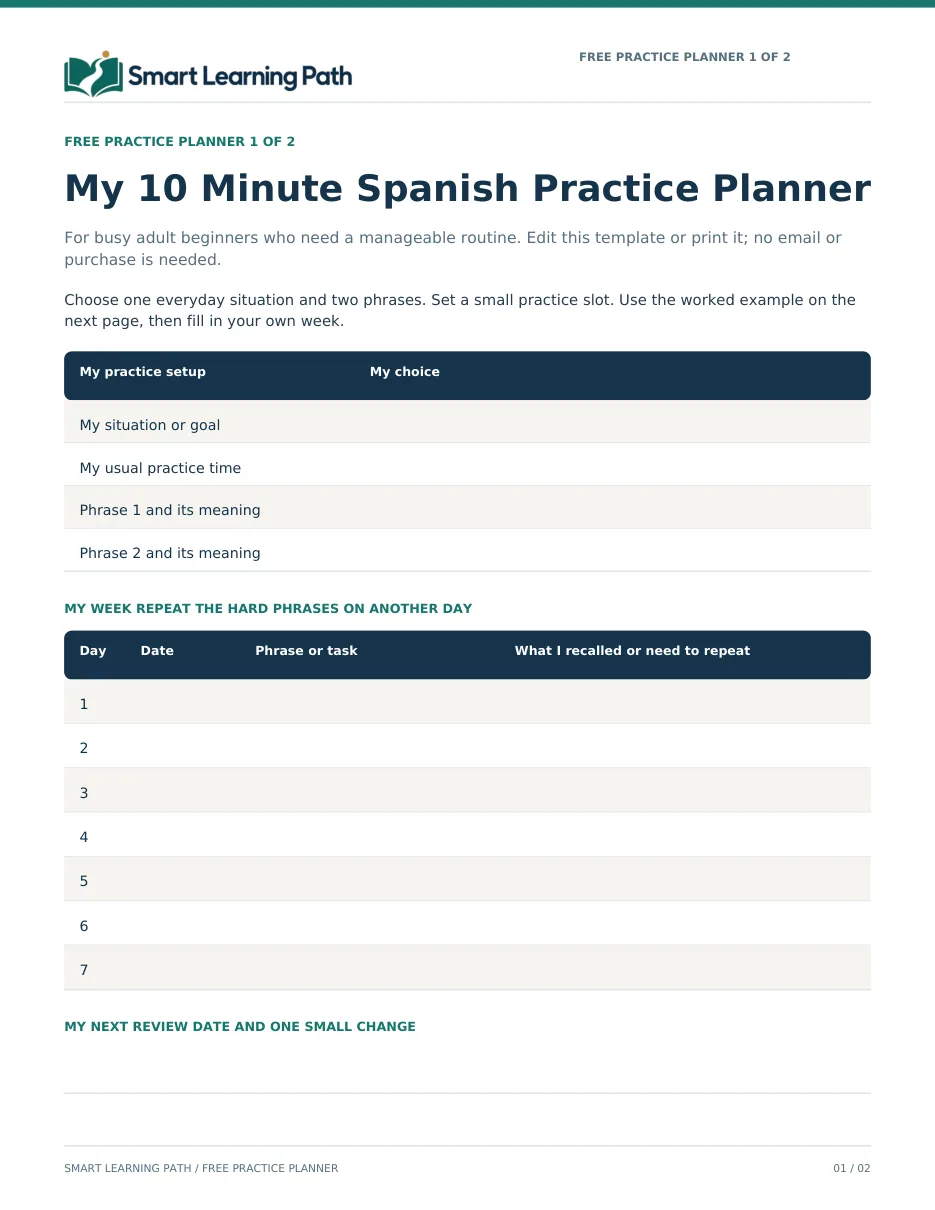
Copy this into a notebook, or use page 1 of the planner. One task per block, and the last two minutes always without notes.
| This week’s situation | e.g. ordering a drink |
|---|---|
| The task, in one sentence | e.g. order a coffee and cope with a fast reply |
| Two phrases I need | your phrase and its meaning |
| When the block happens | e.g. after breakfast |
| What slipped last time | a short note |
| My next block | day and time |
If a phrase slips, do not restart the whole block. Put that phrase at the top of the next block and move on.
Tick scenarios off the checklist.
Tick a line only when you have done the task aloud, in both roles, with the page face down. The list is a record of what you can do. It is not a course to finish quickly.
- Order a drink and thank the person.
- Ask someone to repeat, more slowly.
- Ask where the bathroom is.
- Introduce yourself and ask the other person’s name.
- Ask how much something costs.
- Say you do not understand, then ask what a word means.
The ten everyday scenarios page collects everyday situations, so you can take your next task from there. The free seven-day plan covers greetings, clarification phrases, a café order and directions, so it fills in the first lines of this list.
Review the week with one number.
At the end of the week, count tasks. Not minutes, not points, not streaks.
| Tasks planned this week | a number |
|---|---|
| Tasks done aloud | a number |
| Done without reading the page | a number |
| Done without English in my head | a number |
| Phrase that slipped | your phrase |
| First task next week | one sentence |
The last two rows are the honest ones. Without English means you said the Spanish sentence without translating it in your head first. Reading it off the page does not count, and neither does saying it while the English is in front of you.
A low number is information, not a verdict. It points to the block worth repeating. This is a practice note, not a speaking test.

Worked example: one café block.
An illustrative block, not a record of a real conversation. The task: order a coffee, and cope if the reply comes fast. The phrases are written with their accents and opening question marks, so you learn them as they are written.
| Spanish | English |
|---|---|
| Un café, por favor. | A coffee, please. |
| ¿Algo más? | Anything else? |
| No, gracias. | No, thank you. |
| ¿Puede repetir, por favor? | Can you repeat, please? |
A: Un café, por favor. · B: ¿Algo más? · A: No, gracias. · B: Aquí tiene. · A: Gracias.
A: A coffee, please. B: Anything else? A: No, thank you. B: Here you are. A: Thank you. An original practice dialogue; a real exchange may be different.
Run it twice: once as the customer, once as the person behind the counter. Doing the other side lets you meet the reply you are likely to hear before it arrives.
¿Puede repetir, por favor? uses polite singular address (usted), a safe choice with someone you do not know. You can swap Un café for Un té or Un vaso de agua. Keep the Conversation Rescue Card nearby for the moment a reply outruns you.
Tick the café line on the checklist only after you have ordered aloud with the page face down.
Is this another app, or another free teaser?
Fair question. The honest answer is mostly about what this is not.
- No account needed to read the plan. The whole seven-day plan sits on the web page. The download asks for a first name and an email, and the form states what follows: the plan email, then four emails on days 2, 4, 7 and 10, each with an unsubscribe link.
- Nothing is on sale. The toolkit, the course and the membership are planned and not open for booking, so there is no checkout to fall into. The pricing page gives the planned prices and says which details are not set yet; the refund policy is there to read before anything opens.
- No microphone, no recording. You practise aloud on your own. Nothing is recorded, and nothing you write in the planner reaches us.
- No level promised by a date. No learner results are reported here, and progress varies from person to person.
- Checked Spanish, stated limits. Our editors check the Spanish; there is no independent teacher review yet. The editorial policy sets out how that works.
The structural difference from a points-and-streaks session is the unit of work. Each block ends with a task you performed out loud, with no English in front of you, so the week leaves a list of things you did rather than a number that went up.
Daily Spanish practice in a busy week.
Daily is a rhythm, not a rule. Three blocks that end with a sentence said aloud leave you with three sentences you can say with the page closed, which a tapping session does not. Ten to fifteen minutes is the suggestion here; a five-minute block with one phrase is still a block.
If a day collapses, take the next slot that appears and repeat the task that slipped. Do not restart the plan. Repeating the same café task is a normal part of practice, not falling behind. The spaced-practice guide gives a simple schedule for coming back to a phrase after a gap.
Questions readers ask.
What makes a Spanish learning plan task-based?
It starts from tasks rather than topics. Each 10-15 minute block belongs to one real situation and ends by saying the sentence without notes, so the plan answers what you can do rather than what you read.
Can this be my whole Spanish study plan?
It can be the weekly structure, but you still need phrases to practise with. The free seven-day plan supplies the first seven tasks, and the practice tools give you clarification phrases and a blank week. Nothing here replaces speaking to people.
Is this a full learning Spanish study plan, or a weekly template?
It is a weekly template that you repeat, not a fixed course. Change the scenario each week and keep the four steps. It sets no deadline and names no level to reach by a date.
How much daily Spanish practice should I plan for?
Ten to fifteen minutes per block is the suggestion on this page. Nothing here measures how much practice you need, and a block you can repeat most days is easier to keep than one long session a week.
Do I need to record myself?
No. There is no microphone and no recording. You say the task aloud on your own, and the without-English check is your own count.
Practice, not a promise. These tasks help you rehearse everyday Spanish at your own pace. Individual progress varies; nothing here promises a level, a qualification or a fixed learning speed. How we write and check our Spanish
Sources and editorial notes
- Institute of Education Sciences, What Works Clearinghouse, Organizing Instruction and Study to Improve Student Learning (practice guide, 2007), retrieved October 18, 2026. Its recommendations include spacing learning over time and using quizzing with active retrieval. The guide was written for school and postsecondary teaching in content-heavy subjects, not for adult language learners, and it says nothing about this template.
- Content basis: the Smart Learning Path 7 Day Spanish Starter Plan and 10 Minute Practice Planner.
The block timings are a flexible planning aid; outcomes for this template have not been measured. Examples are illustrative. Spanish checked by our editors. See our Editorial Policy. Spotted a mistake? Suggest a correction.
Related reading.
Visit the blogA 10-Minute Spanish Practice Routine
Read, cover, say, check, and repeat.
Remember Spanish Phrases with Spaced Practice
Revisit phrases on later days to keep them.
How to Practise Speaking Spanish Alone
Role plays and recall prompts without a partner.
Pick one task and one block.
Fill in the template, then work through the free seven-day plan one day at a time.
No account or payment needed.